
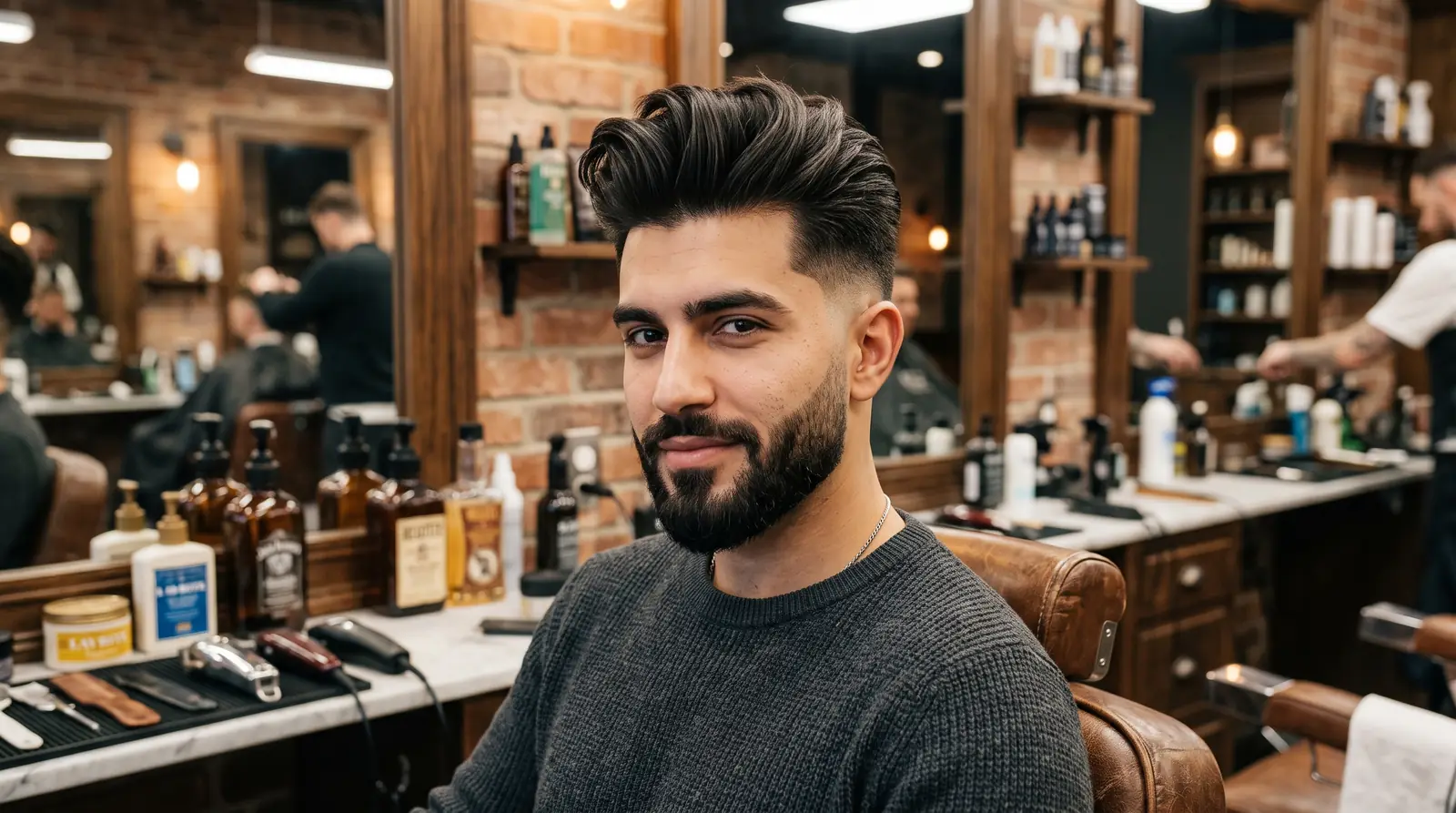
The blowout fade is one of the most energetic haircuts in modern barbering. Where most men's styles trend toward sleek compression and tight control, the blowout goes the opposite direction—pushing the hair upward and outward with maximum volume, then anchoring that drama with a sharp, clean fade on the sides and back. The result is a look that reads bold and high-impact from across the room while still being polished enough for everyday wear.
In 2026, the blowout fade has broken out of its traditional strongholds—urban barbershops and Latin communities where it's been a staple for decades—and spread into mainstream men's grooming. The combination of voluminous texture on top and precise clipper work on the sides is landing on runways, in editorial shoots, and across social media. This guide covers everything: what the blowout fade actually is, how it compares to other styles, which variations work for different hair types and face shapes, and exactly how to describe what you want to your barber.
What Is a Blowout Fade?
A blowout fade is a men's haircut that combines two distinct elements: a "blowout" on top—where the hair is left significantly longer and styled upward and outward to create a voluminous, puffed-up effect—and a fade on the sides and back, where the hair is clipped down progressively shorter, often tapering to skin. The contrast between the full, airy crown and the tight, close sides is what gives the blowout fade its visual power.
The term "blowout" describes the appearance of the top hair, which looks as if it has been blow-dried and pushed outward in all directions from the crown. The hair doesn't lie flat or to one side—it stands out. This can be achieved with natural texture, product, or both.
The fade underneath provides structure and sharpness. Without it, a blown-out top can look unkempt. With a clean fade, the volume on top becomes intentional and architectural.
Key Characteristics of a Blowout Fade
- High-volume crown: The top hair is longer, typically 2 to 4 inches, styled upward and outward
- Visible puff or lift: Hair appears to expand away from the scalp rather than lying flat
- Clean fade on sides: Tight taper, often down to skin, providing contrast to the full top
- High contrast ratio: The dramatic difference between top volume and close sides is the defining feature
- Works with texture: Natural curl, wave, or coil enhances the blown-out silhouette
- Product-driven: Hair wax, pomade, or mousse typically maintains the shape throughout the day
Blowout Fade vs Other Fade Styles
The blowout fade occupies a specific niche in the fade family. Understanding where it differs from related styles helps you choose the right look—and communicate clearly with your barber.
| Feature | Blowout Fade | High Fade | Pompadour Fade | Mohawk Fade | Quiff Fade |
|---|---|---|---|---|---|
| Top Style | Expanded outward, voluminous puff | Any style, fade starts high | Swept back, lifted front | Strip of hair from front to back | Forward-swept with height |
| Volume Direction | Outward in all directions | Depends on top style | Backward and upward | Straight up the center | Forward and upward |
| Fade Height | Low to high, often high | High by definition | Mid to high | Mid to high | Mid to high |
| Best Hair Type | Curly, coily, wavy, thick | All types | Straight to wavy | All types | Straight to wavy |
| Visual Impression | Bold, playful, voluminous | Clean, sharp, modern | Retro, polished | Edgy, dramatic | Casual, European |
| Maintenance Frequency | Every 2 to 3 weeks | Every 2 to 3 weeks | Every 2 to 3 weeks | Every 2 to 3 weeks | Every 3 weeks |
The key distinction is directionality. The pompadour sweeps back. The quiff sweeps forward. The mohawk goes up the center. The blowout expands in all directions—it's the most three-dimensional of the high-volume fades.
Types of Blowout Fade Variations
Classic Blowout Fade
The original template. The top hair is left at medium-to-long length (2 to 4 inches), blow-dried or finger-styled upward to create a rounded, full silhouette, and the sides are faded tight—often down to a mid or high skin fade. The neckline is clean-shaved or lightly tapered. This is the version most associated with the style's roots in Puerto Rican and Dominican barbershop culture in New York.
Curly Blowout Fade
Designed specifically for men with natural curl patterns (Type 2c through Type 4). The curls are left to define the blown-out shape naturally—no blow-drying needed. The fade underneath is typically a high skin fade to create maximum contrast. The curl pattern does all the visual work on top, and the result can be dramatic or soft depending on the tightness of the curl. This variation has seen significant growth as the natural hair movement has intersected with barbershop culture.
Low Blowout Fade
A more conservative take on the style. The fade starts lower—just above the ear—rather than at temple height or above. This preserves more hair on the sides while still creating contrast with the volumized top. It's the version to choose if you like the blowout aesthetic but need something that reads a little less aggressive in professional or formal settings. The silhouette is the same; the sides just have more coverage.
High Blowout Skin Fade
The maximum contrast version. The fade starts above the temples and tapers to bare skin, leaving the top hair as the only significant coverage on the head. This version amplifies every aspect of the blowout—the volume above reads even bigger against the nearly bare sides, and the head shape becomes part of the visual. Best suited to people with good head shape symmetry and defined curl or wave texture.
Blowout Fade with Line Up
Adding a sharp line up—crisp geometric edges along the hairline, temples, and sideburns—to any blowout fade variation takes the style from casual to architectural. The line up creates definition at the edges and makes the blown-out volume look intentional and barbershop-precise. This version is especially popular among men who want the fullness of the blowout but with clean, geometric framing.
Blowout Taper Fade
A hybrid approach where the sides are tapered rather than faded to skin. The taper is still close but doesn't reach zero—it provides a softer transition from the full top to a slightly longer neckline. This version suits men who want the silhouette of a blowout without the starkness of a skin fade, or who are growing their hair out and want to maintain the shape through a transitional phase.
Which Face Shapes Suit the Blowout Fade
The blowout fade adds vertical height and lateral volume, which interacts differently with different face structures. Choosing the right variation makes the difference between a style that enhances your features and one that fights against them.
Oval Face
The most versatile face shape—works with virtually every blowout variation. The proportions are already balanced, so the added height of the blowout enhances without distorting. A classic blowout fade or high skin fade version both work well.
Round Face
The blowout fade is particularly well-suited to round faces. The vertical lift from the volume on top adds height and elongates the visual proportions. Avoid excessive lateral width in the blow-out shape—push the volume upward rather than outward. A high fade amplifies the lengthening effect.
Square Face
The strong jawline and wide forehead of a square face pair well with the blowout's softness. The full, rounded volume on top complements the angular jaw without competing with it. A mid to high fade keeps the sides clean and lets the top do the visual work. Avoid very low fades that might emphasize jaw width.
Oblong or Long Face
The blowout fade can work on longer faces, but volume direction matters. Instead of pushing hair straight up (which adds height you don't need), style the top outward and to the sides to add width and reduce the perception of length. A low to mid fade is preferable over a high skin fade.
Diamond Face
Wider at the cheekbones, narrower at forehead and jaw. The blowout's volume on top helps add width at the crown, balancing the cheekbones. Choose a mid fade to avoid over-emphasizing the cheekbone width.
Triangle or Pear Face
Wider jaw relative to forehead. The blowout's volume at the crown naturally counterbalances a wide jaw by adding proportional width higher on the head. A high fade that keeps sides tight near the jaw makes the bottom appear narrower.
Best Hair Types for a Blowout Fade
The blowout fade works across a range of hair types, but the technique and product approach differ.
Curly and Coily Hair (Type 2c–4c): Natural curl and coil patterns were made for the blowout silhouette. The spring in the curl creates volume without effort. The barber can simply let the natural pattern expand after a precise fade on the sides. Little to no heat styling required. A curl-enhancing cream or light oil can define the pattern while maintaining softness.
Wavy Hair (Type 2a–2b): The wave adds movement and body to the blown-out top without the full volume of tighter curls. Often works well with a diffuser or light blow-drying to encourage the wave to lift. A medium-hold pomade or sea salt spray can enhance texture.
Straight Hair: Achievable but requires more work to maintain volume. A blow-dryer with a volumizing brush or diffuser is needed to create lift. Strong-hold products (wax, clay, or fiber) are necessary to keep the shape throughout the day. The result can be impressive but needs daily effort.
Thick Hair: Thickness helps—more hair means more volume to work with. The fade will need precise clipper work to avoid the sides looking bulky, but the top will hold the blown-out shape with minimal product.
Fine Hair: Possible but challenging. Volumizing products (mousse, thickening spray) before blow-drying can help create the appearance of density. The fade should be clean and tight to maximize the contrast and make the top look fuller by comparison.
How to Style a Blowout Fade at Home
Maintaining the blowout fade's signature volume between barber visits comes down to technique and product choice.
Step 1: Start with the Right Shampoo and Conditioner
Use a volumizing shampoo and a lightweight conditioner. Avoid heavy moisturizing conditioners that can weigh the hair down and reduce lift. Apply conditioner mid-shaft to ends, not at the scalp.
Step 2: Apply a Pre-Styling Product
On damp (not soaking wet) hair, work in a volumizing mousse or lightweight leave-in foam. Distribute evenly through the top hair, focusing on the roots where volume originates.
Step 3: Blow-Dry with Lift
Tilt your head forward or use a diffuser attachment. Use medium heat and medium airflow. Work your fingers through the roots while drying to encourage lift. For curly hair, scrunch upward toward the scalp. For straight or wavy hair, use a round brush or your fingers to push hair away from the scalp as you dry.
Step 4: Apply Finishing Product
Once fully dry, work a small amount of product through the top hair:
- For curls: A light curl cream or shine oil to define without crunching
- For straight/wavy hair: A medium-hold clay or wax for texture and shape retention
- For maximum hold: A fiber-based product that gives structure without shine
Step 5: Shape the Silhouette
Use your fingers—not a comb—to push the hair into the blown-out shape. The goal is a natural-looking expansion, not a helmet. Work from the back forward, lifting at the roots.
Products Recommended for the Blowout Fade
| Product Type | Best For | Hold Level |
|---|---|---|
| Curl cream | Natural curly/coily hair | Light to medium |
| Volumizing mousse | Pre-styling all hair types | Light (base product) |
| Matte clay | Straight and wavy, defined shape | Medium to strong |
| Hair wax | All types, shine and control | Medium to strong |
| Texturizing paste | Wavy and curly, natural look | Medium |
| Sea salt spray | Wavy hair, beachy texture | Light |
| Pomade (water-based) | All types, restyle through the day | Medium |
Avoid heavy oil-based pomades or thick gels for the blowout—they weigh the hair down and work against the volume you're building.
How Often Does a Blowout Fade Need Maintenance?
The fade is the most time-sensitive part of the cut. Once a skin fade grows out even slightly—usually after 10 to 14 days—the sharp contrast between top and sides begins to soften. For men who want to maintain the high-contrast look at its sharpest, a barber visit every 2 weeks is the standard. For variations with a low or taper fade, where contrast is less dramatic, every 3 to 4 weeks is workable.
The top hair can go longer between full cuts—you're primarily managing length on the sides. Some men come in for a "fade touch-up" without a full haircut to maintain the sides between appointments.
How to Ask Your Barber for a Blowout Fade
Clear communication prevents disappointment. Here's how to describe what you want:
The essentials to specify:
- "Blowout fade" — establishes the base style
- Fade height: low, mid, or high (or "above the temples")
- Fade depth: skin fade, or taper (leaving some length at the lowest point)
- Top length: shorter (1.5 to 2 inches), medium (2 to 3 inches), or longer (3 to 4 inches)
- Line up: yes or no
- Neckline: squared, rounded, or tapered
Example request: "I want a blowout fade—high skin fade on the sides, leave the top about 2.5 to 3 inches so I can push it up, and add a line up along the hairline."
Bring reference photos: The blowout fade varies significantly depending on height, top length, and curl pattern. A photo of the exact variation you want removes all ambiguity.
Blowout Fade and Cultural Context
The blowout haircut has deep roots in Black and Latino barbershop culture, particularly in urban communities in the northeastern United States. In Puerto Rican and Dominican barbershops in New York and Miami, the blowout—often called the "box" or referred to by its Spanish equivalents—was a signature style long before it crossed into broader mainstream visibility.
Understanding this context matters both for appreciating where the style comes from and for finding the right barber. A barber who grew up cutting blowouts will have a fundamentally different technical fluency with the style than one encountering it as a trend. If you want a blowout fade done at the highest level, seek out a barbershop with experience in this specific style tradition.
Common Blowout Fade Mistakes to Avoid
Going too short on the top: If there isn't enough length to push upward, the blowout silhouette won't form. Communicate clearly that you want length preserved on top.
Wrong product choice: Heavy products will kill the volume. Stick with lightweight formulas that build texture without weight.
Skipping the pre-styling step: Starting with dry hair and applying a finishing product directly rarely produces the same lift as building volume from damp hair with a volumizing base.
Neglecting the roots: Volume in a blowout comes from the roots, not the ends. If you're blow-drying or styling, focus the lift at the scalp.
Waiting too long between barber visits: The fade fades out (literally) faster than the top loses its length. If the high-contrast look is what you're after, the sides need regular maintenance.
Is the Blowout Fade Right for You?
The blowout fade suits men who:
- Want a high-impact look with real visual presence
- Have naturally curly, coily, or thick hair and want to showcase texture
- Are comfortable with daily styling (5 to 10 minutes of product and shaping)
- Want a fade that works in both casual and semi-formal environments
- Are looking for something distinct from the clean-cut, low-profile fades that dominate office dress codes
It's less ideal for men who:
- Want a truly wash-and-go style with no maintenance
- Work in strict formal environments where volume reads as too casual
- Have very fine, straight hair and aren't willing to use a blow-dryer
- Prefer understated, subtle haircuts
For men who fall in the middle—wanting some of the energy of the blowout without the full commitment—the blowout taper or a low blowout fade offers a toned-down entry point.
The blowout fade is a statement cut. It takes something that could easily look sloppy—a lot of volume on top—and makes it precise through the contrast of the fade underneath. Done right, it's one of the most visually complete haircuts in the barbershop repertoire. If you're considering it, the key is finding a barber who knows the style and communicating your specific preferences. The rest takes care of itself.