
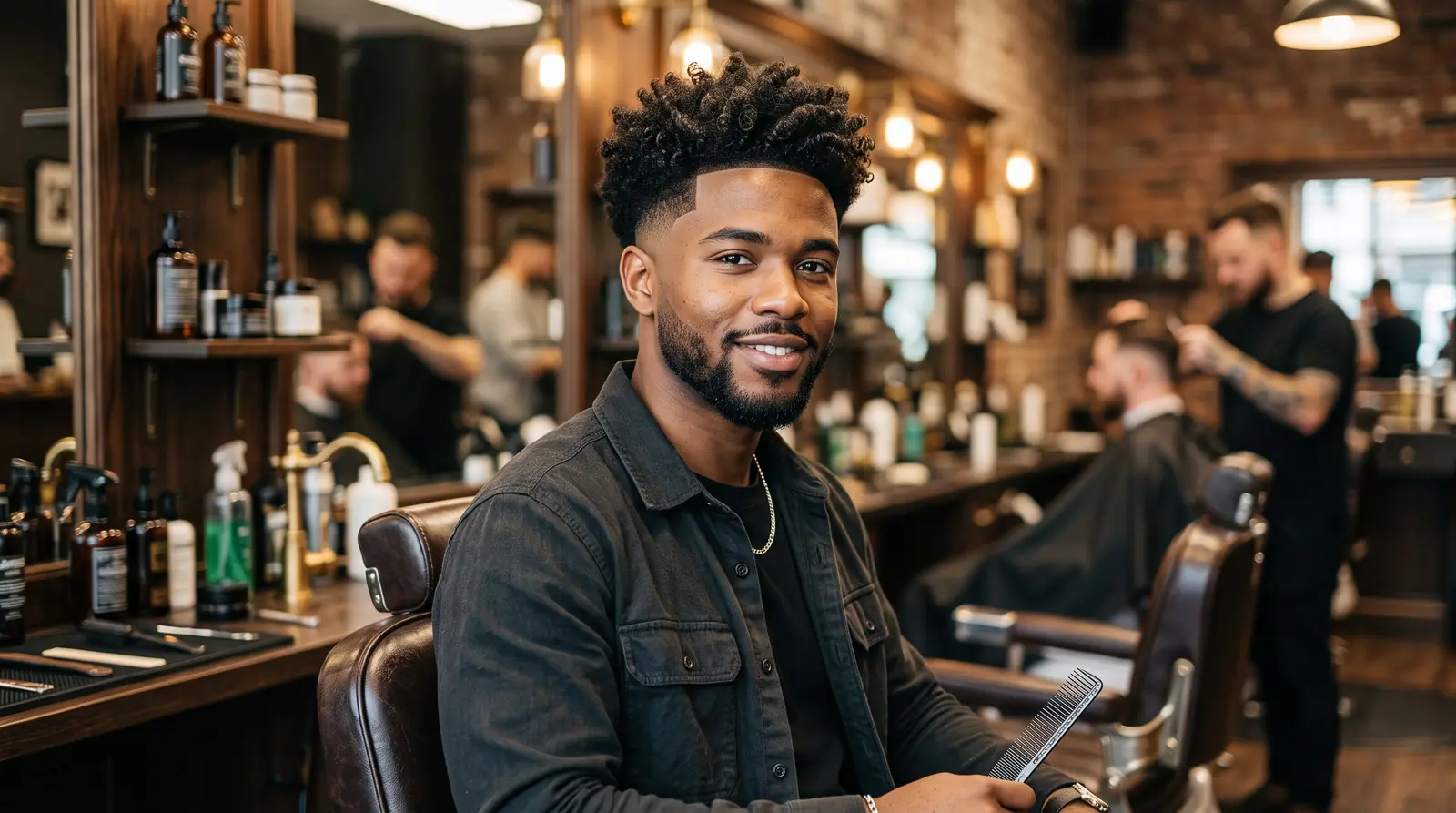
Curly hair and a fade are one of the most naturally compatible combinations in barbering. The contrast between a close, tapered side and a full, textured curl pattern on top produces a look with genuine visual depth—one that flat-haired styles simply can't replicate. The curl itself becomes the design element, and the fade frames it.
The challenge is that curly hair adds complexity. Curl pattern affects how the fade blends, how the top behaves, and which products keep the style sharp between barber visits. A cut that works perfectly on straight hair may need meaningful adjustments for a tight coil versus a loose wave. This guide covers all of it—the best fade variations for curly hair, how curl type changes the approach, which styles suit which face shapes, how to maintain the look at home, and what to say to your barber.
Why Curls and Fades Work So Well Together
Most haircuts sit flat. Curls don't. When a fade brings the sides very close—or down to skin—the volume difference between the sides and the top is dramatic and deliberate. The curl texture catches light differently from every angle. The result is a cut that looks structured from a distance and detailed up close.
Fades also solve one of curly hair's most common aesthetic problems: bulk at the sides. Untreated curly hair tends to expand outward rather than upward, creating width that can visually widen the face. A fade removes the bulk from the sides cleanly, letting the curl expression concentrate on the top where it creates height and shape rather than width.
This is why the curly hair fade has become a foundational style in barbershops globally, cutting across ethnicities, curl types, and style preferences.
Curl Types and How They Affect the Fade
Not all curls behave the same way under clippers. Understanding your curl type helps you have a more productive conversation with your barber and set realistic expectations.
Type 2: Wavy Hair (2A–2C)
Wavy hair falls in loose S-shaped waves without fully forming a coil. On the sides, it fades smoothly and behaves much like straight hair under the clippers. On top, the wave adds natural texture and movement that requires minimal product to activate.
Best fade for wavy hair: Low to mid fade. The softer wave pattern doesn't need aggressive contrast to read clearly. A low or mid skin fade with a textured top looks clean without competing with the wave's relaxed character.
Type 3: Curly Hair (3A–3C)
Type 3 curls form defined spirals ranging from loose, open curls (3A) to tight corkscrews (3C). These are the curls most people picture when they imagine a "curly fade." On the sides, type 3 curls create a distinct texture transition—the curl becomes increasingly visible as you move up from the fade line. On top, the curls can be shaped into a variety of styles depending on length.
Best fade for type 3 curls: Mid to high skin fade. The defined curl pattern benefits from clear contrast between the tight sides and the full top. A high skin fade creates maximum visual impact, while a mid fade gives a versatile everyday look.
Type 4: Coily Hair (4A–4C)
Type 4 hair forms very tight coils or zig-zag patterns with significant shrinkage. On the sides, the coil pattern means the fade transition requires careful blending—the tight curl can make uneven lengths more visible. On top, type 4 hair has enormous volume potential and can be shaped into large naturals, twists, or defined coils depending on how it's styled.
Best fade for type 4 coils: High skin fade or temple fade. The high contrast suits the bold texture of tight coils. A taper fade can also work well for a softer look. The top needs enough length to allow the coil pattern to fully express itself—too short and the curl compresses into undefined puff.
Best Curly Hair Fade Styles
Curly Top with Skin Fade
The most popular combination. The sides are taken down to the skin, creating maximum contrast with the natural curl texture on top. This works across all curl types—the tighter the curl, the more dramatic the contrast appears. The top can be any length from a short textured crop to several inches of full curl.
A key technique your barber should use: dry cutting the top first. Curly hair shrinks significantly when wet, so cutting while dry gives a more accurate read of how much length to remove. The fade is typically done with clippers regardless of moisture level.
Curly Fringe Fade
A fringe (bangs) is brushed or left to fall forward over the forehead, while the sides fade cleanly. For curly hair, the fringe creates natural volume and movement that straight-haired fringe cuts can't replicate. The curl adds a softness to the fringe's forward fall that looks intentional rather than overgrown.
This style works best with looser curl types (2C–3B) where the curl creates forward movement. Very tight coils (3C–4C) tend to spring upward rather than forward, making a traditional fringe harder to achieve without product.
Curly Afro Fade (Natural Top Fade)
One of the boldest curly fade options: a large natural afro on top fading into skin on the sides. This style maximizes the volume contrast and requires regular maintenance to keep the top shape symmetrical and the fade sharp. The barber typically shapes the afro top with a pick and uses an outline razor to define the perimeter.
Best suited for type 4 coily hair with high density. The afro top needs enough density to maintain its rounded shape—thinner hair tends to look deflated.
Curly Temp Fade (Temple Fade)
The temple fade (also called a temp fade) focuses the fade around the temples and creates a clean outline around the hairline. For curly hair, this is a popular choice because it removes excess hair from the temples and sides without being as extreme as a full high fade—the curl on top can grow out more naturally between visits.
The temp fade is also the most conservative option for men with curly hair entering professional environments where a dramatic high fade might feel inappropriate.
Curly Drop Fade
The drop fade curves down behind the ear rather than maintaining a straight horizontal line around the head. For curly hair, this creates a particularly natural look because the fade follows the natural curve of the skull rather than cutting across it. The drop fade suits men who want a stylish, modern look that doesn't emphasize the contrast as aggressively as a straight high fade.
Curly Mohawk Fade
The sides are faded to the skin and the hair on top is grown or styled into a strip running from front to back. For curly hair, the natural volume and texture of the curls creates a mohawk with significantly more character than the flat-haired version. The curls can be left natural, twisted, or shaped for different aesthetics.
This is a bold, high-commitment style. It works best with medium to long curl length on top to allow the full mohawk shape to develop.
Curly Comb Over Fade
The top hair is swept and combed to one side over a fade on the sides. For curly hair, the "comb over" isn't a traditional flat comb-over—instead, the curl texture creates a natural, tousled sweep that looks more relaxed and contemporary than the slicked versions seen with straight hair. A side part or hard part adds definition.
This style works particularly well for men with looser curl types (2C–3B) where the curl can be directed with product while still maintaining its texture.
Comparison of Curly Fade Styles
| Style | Curl Type | Maintenance | Best Face Shape | Visual Impact |
|---|---|---|---|---|
| Curly top skin fade | All types | High | Oval, heart | Maximum |
| Curly fringe fade | 2C–3B | Medium | Long, oval | Moderate |
| Afro fade | 4A–4C | High | Oval, round | Very high |
| Temp fade | All types | Low–Medium | All shapes | Subtle–Moderate |
| Drop fade | All types | Medium | Oval, square | Moderate |
| Curly mohawk fade | 3A–4C | High | Long, oval | Very high |
| Curly comb over fade | 2C–3B | Medium | All shapes | Moderate |
Face Shape Guide for Curly Fades
The fade position and the volume direction of the curl both affect how the face reads. Here's how to work with your face shape.
Oval Face
The most balanced proportion for haircuts. Any curly fade variation works. High skin fades maximize the top's visual height, while temp fades give a cleaner, more understated look. Because no correction is needed, the choice becomes purely about personal preference.
Round Face
Avoid adding width at the sides. A high fade reduces lateral bulk significantly. The curl top should be styled upward rather than outward—a taller, narrower curl silhouette lengthens the face. Avoid low fades on round faces as they leave more hair at the sides and emphasize width.
Square Face
The strong, angular jawline pairs well with the softness of curls. A mid to high fade with a fuller curl top balances the jaw's sharpness. The curl texture adds a contrasting softness to the angular structure. A hard part or very angular fringe may clash with the jaw's geometry.
Long Face
Add width to balance the length. A low to mid fade keeps more hair on the sides, preventing the cut from adding excessive height. Avoid very high fades and very tall curl tops, which further elongate an already long face. A full curl silhouette at mid height creates the illusion of width.
Heart Face (Wide Forehead, Narrow Chin)
Minimize width at the top by keeping the curl volume lower and more forward. A low fade with a fringe or forward-falling curl masks the wide forehead. Avoid very high fades with tall tops as they draw attention to the forehead's width.
Diamond Face (Narrow Forehead, Wide Cheeks, Narrow Chin)
Add width at the forehead. A high fade with a forward fringe or pronounced curl at the hairline creates the illusion of a broader forehead and balances the wide cheekbones.
How to Talk to Your Barber About Your Curly Fade
Curly hair communication at the barbershop is particularly important because terms like "a little off the top" mean entirely different things depending on the curl type. Here's how to get what you want.
What to Specify
1. Fade height: Low (below the ear), mid (at temple level), or high (above the temples).
2. Fade type: Skin (to bare scalp), shadow (very close but not skin), or taper (gradual natural fade).
3. Top length: Give a target length when dry or reference a specific style. With curly hair, always clarify "dry length" since wet curls shrink. "Leave 3 inches dry" is more useful than "leave 3 inches."
4. How to cut the top: Specify if you want it dry-cut (more precise for curls) or if you're comfortable with a wet cut. Most experienced barbers will default to cutting curly tops dry.
5. Outline and shape: Whether you want the top's silhouette shaped (squared, rounded, natural) and whether you want a defined hairline or a natural grow-out.
What to Bring
A reference photo is the most efficient communication tool. Find an image of a curly fade that matches your curl type as closely as possible—a photo of a 3A curl used as reference for 4C hair will produce unrealistic expectations. Aim for a reference where the model appears to have a similar density and curl pattern.
What to Say
A complete barber request for a curly fade might sound like:
"I want a mid skin fade, taken down to a zero at the bottom and blended up to a two on the sides. Leave about two and a half inches dry on top—can you cut it dry? Shape the top naturally rounded, not squared. I want the outline sharp."
This level of specificity gets you a consistent result regardless of which barber you sit with.
Styling a Curly Fade at Home
The fade itself requires minimal maintenance—the most work is keeping the curl top looking intentional rather than neglected between visits.
Product Recommendations by Curl Type
Wavy hair (Type 2): A light sea salt spray or curl-enhancing cream applied to damp hair, then air-dried or diffused. Avoid heavy products that weigh down the wave.
Curly hair (Type 3): A curl-defining cream or gel applied in sections to soaking-wet hair, then air-dried or diffused on low heat. The "squish to condish" technique (applying product while the hair is dripping wet) helps define the curl pattern.
Coily hair (Type 4): A leave-in conditioner followed by a curl cream or butter applied to very wet hair. Coils shrink significantly, so apply product to stretched-damp hair for maximum definition. A satin bonnet or pillowcase preserves the style overnight.
Daily Refresh
Most curly styles can be refreshed the following morning with a spray bottle of water (or diluted leave-in conditioner) and gentle scrunching. Avoid combing or brushing dry curly hair—this creates frizz and disrupts the curl pattern.
Protecting the Fade
The fade grows out faster than any other part of the cut. To keep the sides sharp, consider a lineup or edge-up at a barbershop between full haircut appointments—this refreshes the outline and the fade shape without the full cut cost. Most barbershops offer this as a standalone service.
Frequency of Barber Visits
| Fade Type | Recommended Visit Frequency |
|---|---|
| Skin fade | Every 2–3 weeks |
| Shadow fade | Every 3–4 weeks |
| Temp/taper | Every 4–5 weeks |
Curly tops can generally go slightly longer between visits than straight tops because the curl's volume changes less visibly as it grows. A tight skin fade, however, will show grow-out within 2 weeks regardless of the top style.
Common Mistakes to Avoid
1. Letting the barber wet your curls before cutting the top. Wet curly hair appears several inches longer than it actually is. A barber who cuts your wet curls to a target length will often remove far more than intended once the hair dries and shrinks.
2. Using heavy pomades or waxes on curly hair. These products coat and weigh down the curl, reducing definition and buildup. Water-based creams and gels are preferred.
3. Choosing a fade height based on photos of a different curl type. A high fade on very tight coils looks dramatically different from the same fade on loose waves. Match your reference photo to your curl type.
4. Skipping deep conditioning. Curly hair, especially types 3C–4C, tends toward dryness. A weekly deep conditioning treatment keeps the curl pattern elastic, defined, and resistant to frizz—directly improving how the styled cut looks.
5. Rubbing hair dry with a cotton towel. This disrupts the curl pattern and causes frizz. Use a microfiber towel or an old cotton T-shirt, and scrunch upward rather than rubbing.
Frequently Asked Questions
Can any curl type get a fade? Yes. Every curl type—from loose waves (2A) to very tight coils (4C)—can have a fade. The execution differs by curl type, and the best fade height and style varies, but no curl pattern is incompatible with a fade haircut.
Will a fade look good if I have uneven curl patterns? Many men have mixed curl patterns across the scalp. This is normal and doesn't prevent a great fade cut. An experienced barber can work with uneven curl patterns by adjusting top shaping and styling techniques. Be upfront with your barber about any uneven areas.
How do I maintain my curls while growing out the fade? The fade grow-out period can be awkward. The best approach is to maintain the curl top with consistent product use (which keeps the top looking intentional) and to schedule a lineup or edge-up service to keep the hairline sharp even as the fade fills in.
Is the curly fade appropriate for professional settings? A low or mid temp fade with a maintained curl top is universally appropriate in professional environments. High skin fades and mohawk-style tops may require judgment based on your specific workplace. When in doubt, opt for a lower fade and keep the curl top shorter.
What's the difference between a curly fade and an afro fade? The terms overlap. An "afro fade" typically refers specifically to a high or skin fade with a rounded natural top (the afro shape). A "curly fade" is a broader term that covers any fade haircut where the top hair has a natural curl texture, regardless of the top style.
The curly hair fade earns its popularity because it works with the hair's natural texture rather than against it. The curl is the feature—the fade is the frame. Understanding your curl type, choosing the right fade position, and learning how to maintain the style at home puts you in full control of the cut from barbershop to day five. The investment in understanding your specific curl pattern pays dividends every time you sit in the chair.