

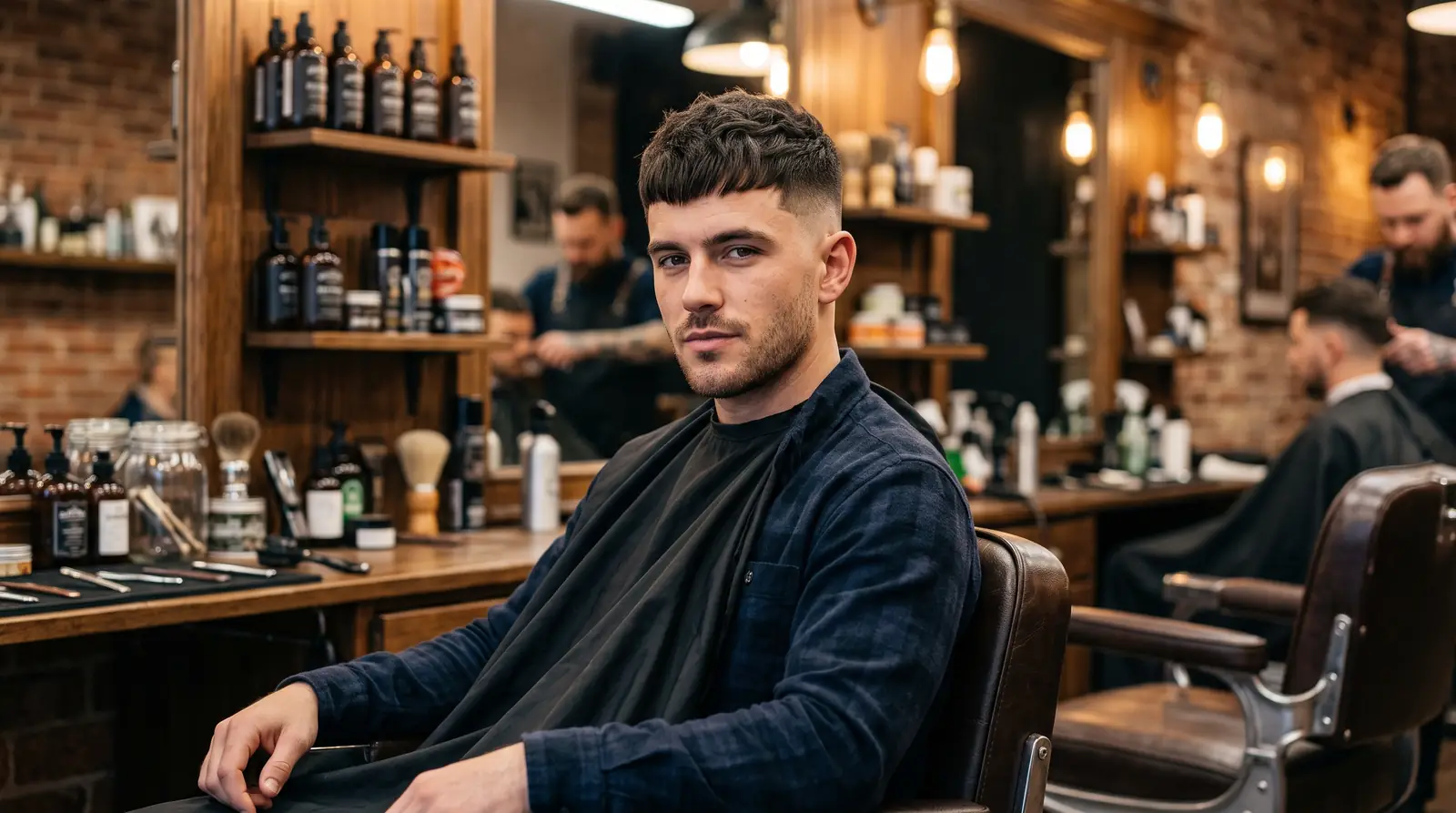
The French crop fade has become one of the defining men's haircuts of 2026—minimal, masculine, and effortlessly versatile. It delivers the clean structure of a professional cut while maintaining a modern, low-maintenance character that works from the office to the weekend. If you've noticed more men walking out of barbershops with short textured fringe and tight faded sides, you're looking at the French crop fade in action.
But like any fade-based style, "French crop fade" encompasses a wide range of looks depending on fringe length, texture, and fade height. A blunt, heavy fringe with a skin fade looks completely different from a choppy textured top with a low taper. This guide covers everything—what makes a French crop a French crop, every major variation, how to match the style to your face and hair type, and exactly how to communicate your preferences to your barber.
What Is a French Crop Fade?
A French crop fade is a men's haircut that combines two elements:
- French Crop: A short top with a forward-brushed fringe. The hair on top is kept relatively short and combed or styled toward the forehead, creating a horizontal fringe line. The fringe can be blunt and heavy or choppy and textured depending on the look you want.
- Fade: The sides and back are faded—gradually tapered from short near the crown to skin or near-skin at the hairline, with no visible transitions between clipper guard lengths.
The result is a clean, structured cut with a distinctive horizontal accent at the front and precision-faded sides. It requires minimal daily styling—typically a small amount of product worked into the fringe—and it maintains its shape well between barber visits.
Why It's Dominating 2026
The French crop fade has surged in popularity for several reasons:
- Low maintenance: The short top means styling takes under two minutes
- Works for most hair types: Straight, wavy, curly, and coily hair all respond well to this cut
- Age versatile: Appropriate for teens and men in their 40s and beyond
- Office-appropriate: Even with a high skin fade, the French crop reads as polished
- Complements most face shapes: The horizontal fringe is a universally flattering element
The Three Pillars of a French Crop Fade
Every French crop fade, regardless of variation, has three defining elements. Understanding them helps you communicate precisely with your barber.
1. The Fringe
The fringe is what makes a French crop a French crop. It runs horizontally across the forehead, created by cutting and styling the front hair forward. Two primary approaches:
- Blunt fringe: Cut straight across, creating a strong horizontal line. More classic, pairs well with higher fades for strong contrast
- Textured fringe: Point-cut to create a choppy, uneven edge. More modern and relaxed, pairs well with any fade height
Fringe length typically ranges from above the eyebrows to at or just below the brow line. Higher fringes read as more aggressive and modern; fringe touching the brow is more conservative.
2. The Top
The top is kept short—typically 1 to 3 inches—and styled forward or slightly forward-and-to-the-side. Common approaches:
- Short and tight: 0.5–1 inch on top, very close to the skull. Maximum structure, minimal styling required
- Medium texture: 1.5–2.5 inches with texture product. Allows fringe definition with some movement
- Longer crop: 2.5–3.5 inches. More styling flexibility, slightly more casual feel
3. The Fade
The fade on the sides and back defines the overall energy of the cut. Low fades feel understated and professional; high skin fades look bold and precise. The right fade height depends on face shape, lifestyle, and personal preference—covered in detail below.
Types of French Crop Fade
French Crop Low Fade
The low fade begins just above the natural hairline. The transition zone is narrow, preserving hair on the lower sides while keeping the perimeter clean. This is the most conservative and professional variation.
Characteristics:
- Fade starts at or just above the ear level
- Maximum hair preserved on sides and back
- Subtle contrast between top and sides
- Grows out with the most grace
Best for:
- Professional environments
- Men preferring a more understated look
- Oblong and heart-shaped faces
- Fine hair (preserves volume on the sides)
Maintenance: Every 3–4 weeks
French Crop Mid Fade
The mid fade begins at the temples and provides a balanced look that's the most universally requested variation. It delivers clear visual definition without being aggressive.
Characteristics:
- Fade starts at temple level
- Clear separation between top and sides
- Modern without being bold
- Works with blunt or textured fringe
Best for:
- Most face shapes and hair types
- Men who want a versatile everyday style
- Oval, square, and diamond faces
Maintenance: Every 2–3 weeks
French Crop High Fade / Skin Fade
The high skin fade begins near the top of the head, creating maximum contrast between the textured fringe on top and the faded-to-skin sides. This is the most striking and modern variation.
Characteristics:
- Fade begins high, near the crown
- Sides go all the way to skin (zero guard)
- Dramatic contrast amplifies the fringe's presence
- Very sharp, intentional look
Best for:
- Bold style preference
- Round, square, and diamond face shapes (adds height)
- Thick hair on top (top texture looks more dramatic against skin)
- Men who refresh their cut regularly
Maintenance: Every 1–2 weeks
French Crop Taper Fade
The taper fade follows the natural hairline shape, creating a clean perimeter while blending seamlessly. It can be applied at any height but typically stays at low-to-mid range, giving a natural shape rather than a strictly geometric one.
Best for:
- Men who want a polished but slightly softer look
- Natural hairline shapes
- Professional settings requiring refined cuts
French Crop with Disconnected Undercut
A more dramatic variation that skips the gradual blend entirely, creating a hard line between the longer top and the closely-cropped sides. Not technically a "fade" but often requested as a French crop variation.
Best for:
- Men with very thick, straight hair
- Those who want maximum contrast
- Edgier personal style
French Crop Fade vs. Similar Styles
| Feature | French Crop Fade | Caesar Cut | Textured Crop | Buzz Cut |
|---|---|---|---|---|
| Top style | Forward fringe, crop | Horizontal fringe, slightly longer | Textured top, no specific fringe | Uniform short all over |
| Fringe direction | Forward | Forward | Any | None |
| Fade | Yes | Optional | Yes | Optional |
| Length on top | 1–3 inches | 1–3 inches | 1–3 inches | Under 1 inch |
| Styling required | Minimal | Minimal | Minimal to medium | None |
| Modern feel | Very high | Medium | High | High |
The Caesar cut is the closest relative. The key difference: the Caesar cut has a longer, heavier fringe that often reaches the eyebrows and is more uniform in length. The French crop fringe is typically shorter and often textured for a modern feel.
"The French crop fade has become my go-to recommendation for men who want to look sharp with minimal effort. The fringe does all the work—the fade does the rest." — Professional barbers consistently cite this as their most-requested low-maintenance cut
Choosing the Right French Crop Fade for Your Face Shape
Oval Face
The most versatile face shape—any variation works. Mid fade with textured fringe is the most popular choice. The horizontal fringe complements oval proportions naturally.
Best options: Any height. Mid fade with textured fringe is the default recommendation.
Round Face
A shorter, higher-positioned fringe and a mid-to-high fade add vertical definition and reduce the appearance of width. Avoid heavy, low fringes that emphasize horizontal width.
Best options: Mid or high fade with a light, textured fringe positioned above the eyebrows.
Square Face
Strong jawlines pair well with the French crop's structured fringe. A low to mid fade softens the sharp jaw angle without competing with it. The horizontal fringe complements square features.
Best options: Low or mid fade. Blunt fringe works well with square faces; textured fringe adds softness.
Oblong (Long) Face
A longer, fuller fringe that reaches the brow adds horizontal emphasis, counterbalancing the vertical elongation of a long face. A low fade preserves more hair on the sides.
Best options: Low fade with a longer, slightly heavier fringe. Avoid very high fades that add even more perceived height.
Heart Face
Heart-shaped faces—wider at the temples, narrower at the chin—benefit from a low to mid fade that doesn't over-emphasize the width at the top. The French crop's fringe helps draw the eye down to the face's narrower midpoint.
Best options: Low or mid fade with a medium-length fringe.
Diamond Face
Narrow forehead and jaw with cheekbone width at the widest point. A mid fade with a fuller fringe adds width at the forehead, balancing the cheekbone prominence.
Best options: Mid fade with textured fringe; avoid very short, airy fringes that narrow the forehead further.
French Crop Fade for Different Hair Types
Straight Hair
Straight hair shows the French crop's structure most clearly—fringe lines are crisp, fade gradients are visible. Blunt fringes work especially well with straight hair. A small amount of pomade or clay gives the fringe definition without heaviness.
Recommended: Mid fade, blunt or textured fringe, light pomade
Wavy Hair
Wavy hair adds natural movement to the fringe, creating an effortless, modern look. The natural wave means styling takes minimal effort—the hair tends to fall forward with little product needed.
Recommended: Mid fade with textured fringe. Let the wave shape the fringe naturally.
Curly Hair
Curly hair brings volume and texture to the French crop fringe, creating a distinctive look that differs significantly from straight-hair versions. The fade contrast with a defined curly top is visually striking. Moisture-based products (curl cream, light mousse) help define the fringe without flattening the curl.
Recommended: High or mid fade with defined curl fringe. Ask barber to point-cut the fringe for curl-friendly edges.
Coily and Natural Hair
Type 4 coily hair creates a dense, voluminous fringe that sits as a lifted texture rather than a flat horizontal line. A high fade with a coily French crop fringe has become one of the most distinctive and requested looks in 2026. The fade amplifies the contrast with the dense natural texture on top.
Recommended: Mid or high fade. Let natural texture define the fringe shape.
Thick Hair
Thick hair holds the French crop structure well and benefits from point-cutting to reduce bulk in the fringe. A mid or high fade looks proportionate against a thick-haired top.
Recommended: Mid or high fade. Request point-cutting on the fringe to prevent heaviness.
Fine Hair
Fine hair benefits from a shorter, more conservative French crop. A low fade preserves more hair on the sides, creating better proportional balance. Using a texturizing spray or sea salt spray adds volume to a fine fringe without weighing it down.
Recommended: Low or mid fade, shorter fringe. Texturizing spray for volume.
Popular French Crop Fade Styles in 2026
Classic Textured French Crop Mid Fade
The baseline popular style: mid fade, 1.5–2 inches on top with point-cut texture, fringe positioned just above the eyebrows. Works for nearly every man. A small amount of matte clay defines the fringe without shine.
French Crop High Skin Fade
Maximum contrast. Sides go to skin, the top fringe is short and heavily textured. Looks best with regular maintenance and is the most photogenic variation—high contrast creates a sharp, editorial look.
French Crop Low Fade with Blunt Fringe
The professional's choice. Low fade, straight-cut blunt fringe at brow level. Clean, restrained, and appropriate for conservative environments. The blunt fringe gives structure without being flashy.
French Crop Mullet (Cropped Mullet)
The 2026 breakout trend. A French crop fringe in the front, with length retained at the back—creating a cropped version of the mullet. The fade on the sides bridges the two lengths. Bold but increasingly mainstream.
Curly French Crop High Fade
Curly or coily hair on top with a high skin fade. The fringe is defined by the curl pattern rather than a cut line. One of the most distinctive expressions of the French crop fade, particularly popular among men with natural curl patterns.
French Crop with Line Design
The French crop provides a clean canvas for razor line work. A defined line at the fringe or a design shaved into the fade adds individuality without changing the fundamental cut structure.
How to Talk to Your Barber
Basic request:
"I'd like a French crop fade—short textured top with the fringe brushed forward, and a [low/mid/high] fade on the sides."
Specific details to communicate:
- Fringe style: Blunt (straight-cut edge) or textured (choppy, point-cut edge)
- Fringe length: Above the brow, at the brow, or just touching the brow
- Top length: "About an inch on top" or "keep enough length to style forward"
- Fade height: Low (just above ears), mid (temple level), or high (near crown)
- Skin or no skin: Whether you want the fade to go all the way to skin
Sample scripts:
For a mid fade with textured fringe:
"Mid fade on the sides down to the skin, and a French crop on top—about an inch and a half, textured, fringe forward. Point-cut the fringe so it's not too blunt."
For a high skin fade with blunt fringe:
"High skin fade on the sides, and a French crop with a blunt fringe. Keep the top short—about an inch."
For a conservative office cut:
"Low fade on the sides and back, French crop on top with a clean blunt fringe at eyebrow level. Nothing too aggressive."
Bring a photo: A reference image is always clearer than a verbal description. Search for "French crop fade" with your hair type and preferred fade height, then show it before the barber starts.
Maintenance and Styling
Visit Schedule
- High skin fade: Every 1–2 weeks to maintain the clean skin finish
- Mid fade: Every 2–3 weeks
- Low fade: Every 3–4 weeks
Daily Styling
The French crop fade requires minimal daily effort:
- Towel dry or blow dry briefly with fingers to set the fringe forward
- Apply product: A small amount (dime to quarter-size) of clay or pomade. Matte finish suits the textured crop; shine finish suits a blunter, more classic fringe
- Style forward: Push fringe toward the forehead and let it sit naturally, or use fingers to define the texture
Product Recommendations by Hair Type
- Fine hair: Sea salt spray or texturizing powder for volume
- Medium/thick straight hair: Matte clay or fiber paste for definition without heaviness
- Wavy hair: Light cream or air-dry for natural shape; matte clay for more control
- Curly hair: Curl cream or light mousse, applied to damp hair
Frequently Asked Questions
What's the difference between a French crop and a Caesar cut? Both feature forward-brushed horizontal fringes. The French crop typically has a shorter, often textured fringe and is more likely to include a fade. The Caesar cut usually has a longer, heavier blunt fringe and historically doesn't fade the sides. In 2026, the lines have blurred—many barbers and clients use the terms interchangeably.
Is a French crop fade good for receding hairlines? Yes—the forward-styled fringe is one of the most effective cuts for disguising a receding hairline. The fringe covers the hairline entirely, and the fade on the sides redirects attention. A mid or low fade is typically recommended for this purpose.
How much product do I need for a French crop? Very little. A dime-sized amount of a medium-hold matte clay or paste is typically enough. The French crop's structure is largely created by the cut itself—product just defines the edges.
Can a French crop work with long hair? The French crop is fundamentally a short-to-medium top cut. Going much above 3.5 inches starts to become a different style (closer to a textured undercut). If you want a longer top, a different fade style is likely more appropriate.
Will a French crop work if I have a cowlick? It depends on cowlick position. Front cowlicks can work against the forward fringe direction—a textured, point-cut fringe handles cowlick interference better than a strict blunt fringe. Ask your barber to work with the cowlick's direction rather than against it.
How long does it take to grow a French crop from a buzz cut? Approximately 4–8 weeks to have enough length for a basic French crop fringe. The exact timeline depends on your growth rate and desired fringe length.
Final Thoughts
The French crop fade has earned its dominance in 2026 by delivering what most men actually want from a haircut: a clean, modern look that requires minimal daily effort and works across a broad range of contexts. The forward fringe gives the cut a distinctive character that distinguishes it from a generic short back and sides, while the fade keeps it crisp and contemporary.
The key decisions—fade height, fringe length, and fringe texture—are all adjustable based on your face shape, hair type, and lifestyle. A low fade with a blunt fringe serves professional environments; a high skin fade with a textured top works for men who want maximum visual impact. Both are French crop fades, and both reward the same low-maintenance routine.
Find the variation that fits your face, communicate it clearly to your barber with a reference photo, and maintain it consistently. The French crop fade will reliably deliver a sharp, intentional look with less effort than almost any other cut at this level of style.