

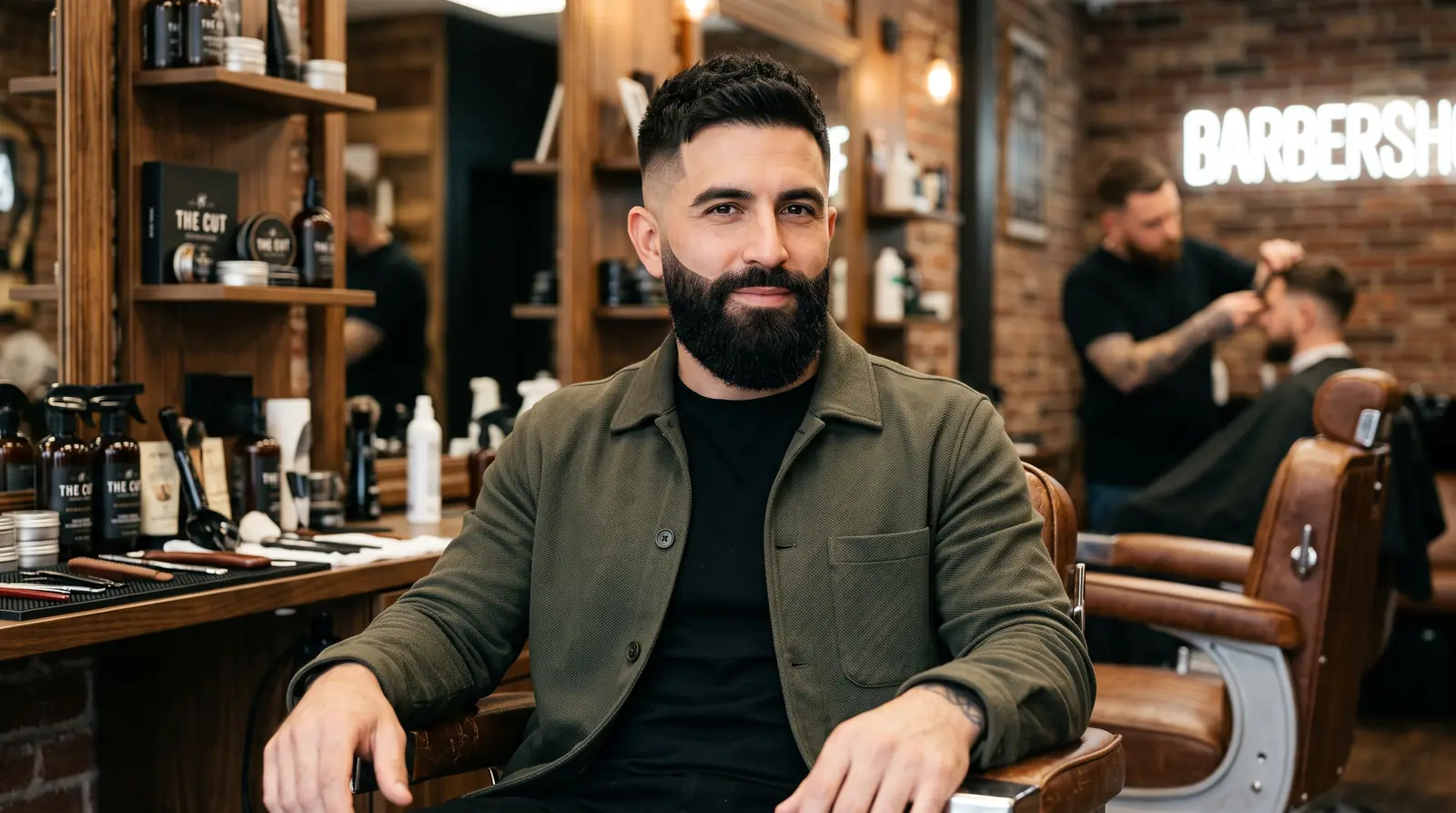
The fade haircut and the beard are the two most powerful tools in a man's grooming arsenal. Individually, each transforms a face. Together, when matched correctly, they create a look that is cohesive, intentional, and genuinely commanding. But "fade with beard" isn't one look — it's dozens of combinations, each producing a different visual effect, each suited to different face shapes, lifestyles, and barber skills.
In 2026, the fade-beard combination has reached a level of sophistication that demands more than just "I'll have a fade and I'm growing a beard." The best combinations are deliberately chosen: the right fade height paired with the right beard density, engineered to work with your specific face shape and maintained on a schedule that keeps both elements sharp. This guide covers all of it — which fades pair with which beards, what your face shape demands, and how to keep everything looking intentional rather than accidental.
Why the Fade-Beard Combination Works
The visual logic behind the fade-beard pairing is fundamentally about contrast and transition. A fade takes the hair from a defined, close-cropped length up the sides to the longer hair on top. A beard takes the hair from the same close-cropped starting point downward. When the two are aligned properly, they create a seamless visual flow from the top of the head down through the jaw — the fade and beard become one continuous statement rather than two separate grooming decisions.
The transition zone is the key. Where the fade ends and the beard begins — typically around the sideburn area and the cheekline — is what separates a great fade-beard combination from one that looks accidental. A skilled barber creates a clean line connecting the two, so the overall silhouette reads as one unified style.
The Three Rules of a Great Fade-Beard Combination
Rule 1: The fade height should match the beard density. A high fade (which removes most of the hair from the sides) needs a full, substantial beard to balance it — otherwise the head looks like a lightbulb. A low fade works well with stubble or a light beard because the contrast between the sides and the face is already minimal.
Rule 2: The transition must be deliberate. Your barber needs to specifically address where the fade meets the beard. This means establishing a clean cheekline and blending the sideburn area into either the fade or the beard — not leaving a fuzzy, undefined middle zone.
Rule 3: Both elements need to be maintained on compatible schedules. A razor-sharp skin fade surrounded by an overgrown beard looks unfinished. A perfectly groomed beard paired with a grow-out fade looks inconsistent. Both need attention at appropriate intervals.
Fade Types and Their Beard Pairings
Not every fade works equally well with every beard. Here's the breakdown of the most common fades and which beard styles they complement.
Low Fade with Beard
The low fade is the most versatile partner for a beard. Because the fade starts just above the ear and the hairline, there's a natural blending zone where the fade can transition smoothly into the sideburn area without an abrupt visual jump. This makes the low fade the go-to choice for men who prefer a classic, sophisticated look.
Best beard pairings:
- Full beard (any length): The low fade creates a gradual transition into the beard, making the overall look polished without being severe
- Corporate beard (short, neatly trimmed): The subtlety of the low fade matches the understated nature of a professional beard
- Stubble: The low fade's close taper at the bottom blends almost invisibly into stubble, creating one of the cleanest and most wearable combinations
Avoid: Very long, heavy beards paired with a very tight low fade to skin — the contrast between the bare sides and dense beard can look unbalanced without careful blending.
Mid Fade with Beard
The mid fade sits at the midpoint of the head — starting at about ear level and blending upward. This is the most popular fade choice globally, and it pairs well with a wide range of beard styles because it offers enough contrast to look intentional without the severity of a high fade.
Best beard pairings:
- Medium full beard (2 to 4 inches): The mid fade creates strong definition between the hair on top, the clean sides, and the beard below — a three-zone look that photographs extremely well
- Circle beard or goatee: The mid fade draws the eye down to the face, where a precise circular beard or goatee acts as the focal point
- Designer stubble: A mid fade with heavily shaped, defined stubble is one of the sharpest combinations in modern barbering
Avoid: Very sparse, patchy beards with a high mid fade — the contrast exposes beard weakness rather than concealing it.
High Fade with Beard
The high fade removes most of the side hair, fading up to the upper temples. This is the most dramatic fade option, and it requires a substantial beard to anchor the look. Without a beard, a high fade can make the head look disproportionately top-heavy. With the right beard, it creates a dramatic, frame-like effect that is genuinely striking.
Best beard pairings:
- Full, dense beard (medium to long): The beard provides the visual weight that balances the high fade's removal of side mass. This is the archetypal "barber shop classic" combination
- Heavy stubble (5 to 10mm): Dense stubble with a high fade reads as intentionally masculine without the maintenance demands of a full beard
- Viking-style or extended beard: Long, styled beards with a high fade create a bold contrast that works particularly well for men with strong jawlines
Avoid: Stubble that is too light or sparse — a high fade needs beard density to balance the visual equation.
Skin Fade with Beard
The skin fade takes the sides completely down to bare skin. This is the highest-contrast fade available, and the transition between the fade and the beard is one of the most critical — and most visually stunning — transitions in barbering when executed correctly.
Best beard pairings:
- Full beard: The combination of bare skin on the sides against a full beard below creates maximum definition. The sideburn-to-beard transition becomes a hard, clean line that needs to be sharp
- Defined neckline beard: A skin fade demands a beard with equally precise lines — cheekline, neckline, and sideburn all need to be deliberate
- Short boxed beard: A boxed beard (square, defined edges at the cheeks and neck) pairs with a skin fade to create a geometric, almost architectural look
The critical detail: A skin fade with a beard needs the sideburn area addressed explicitly. Your barber should discuss whether to create a hard line connecting the fade to the beard or blend the sideburn hair gradually into the beard. A hard line creates a defined, graphic look; a blend creates a softer, more natural appearance.
Avoid: Letting the sideburn area grow out between visits when wearing a skin fade — it breaks the entire visual logic of the combination.
Taper Fade with Beard
The taper fade is the most conservative of the fade family — it doesn't remove as much bulk and blends more gradually. This makes it the natural choice for professional environments and for men who want a clean, refined look without making a bold statement.
Best beard pairings:
- Short, neatly trimmed beard: The taper's subtlety matches a beard that is kept precise and well-maintained
- Corporate beard: The taper fade is the standard professional choice precisely because it creates structure without aggression
- Stubble: A taper fade with stubble is a timeless combination that works in virtually every context
Avoid: Very long, dramatic beards — they contrast too strongly with the taper's conservative nature and the combination reads as mismatched.
Temple Fade with Beard
The temple fade focuses the fade specifically at the temple area, often combined with a defined hairline. It's subtle, precise, and works best for men who want the benefits of a fade without the significant contrast of a mid or high fade.
Best beard pairings:
- Medium stubble to short beard: The temple fade's precision complements well-maintained facial hair
- Textured, defined styles: Combined with a beard, the temple fade creates a clean perimeter that frames both the top style and the beard below
- Waves or textured crops: The temple fade and beard combination is extremely popular in the waves community, where the fade provides definition without disrupting the wave pattern
Fade-Beard Combinations by Face Shape
Matching the right fade-beard combination to your face shape is what takes the look from "good" to "great." The goal in most cases is to create the appearance of an oval face — the proportions that are universally considered balanced and attractive.
| Face Shape | Recommended Fade | Recommended Beard Style | Result |
|---|---|---|---|
| Round | High or mid fade | Full beard with straight edges, minimal cheek roundness | Adds vertical length, reduces horizontal emphasis |
| Square | Low to mid fade | Short to medium rounded beard | Softens angles, creates harmony |
| Oval | Any fade | Any beard style | Most versatile shape — experiment freely |
| Oblong/Long | Low fade | Short stubble to light beard, width at the sides | Reduces vertical elongation |
| Diamond | Mid fade | Full beard or heavy stubble | Balances narrow jaw and forehead |
| Heart | Low to mid fade | Medium beard with fullness at the jaw | Adds width at the chin to balance wide forehead |
| Triangle | Low to mid fade | Full, rounded beard | Balances wide jaw with more hair above |
Round Face Strategy
Round faces need vertical extension. A high or mid fade combined with height on top and a beard that has straight, defined edges — rather than rounded, full cheeks — creates the illusion of length. Keep the cheekline clean and defined; a fluffy, full beard that extends the cheek width makes a round face look rounder.
Square Face Strategy
Square faces have strong, angular jawlines. The goal is often to soften without losing the masculine strength. A low to mid fade keeps the sides from adding too much visual weight, while a short to medium beard with slightly rounded edges at the corners counterbalances the jaw's angularity. Avoid extremely clean-lined, geometric beards on square faces — they amplify the angularity past the point of balance.
Long Face Strategy
Long faces benefit from visual width. A low fade (which keeps more hair on the sides) with a beard that doesn't extend the face downward — stubble to a short, contained beard — is the standard recommendation. Avoid high fades that remove side width while also maintaining a long, pointed beard that extends the face further.
Diamond Face Strategy
Diamond faces are widest at the cheekbones, with a narrower forehead and jawline. A full beard or heavy stubble adds width at the jaw, which helps balance the prominent cheekbones. A mid fade is appropriate; avoid high fades that might make the cheekbone width even more prominent by removing the visual weight of the sides.
The Critical Transition Zone: Sideburn to Beard
The junction between the fade and the beard — the sideburn area — is where most fade-beard combinations succeed or fail. Here's how to approach this area:
Option 1: Hard Line Transition
The barber creates a clean, defined line where the fade ends and the beard begins. This produces a sharp, graphic look that reads as deliberate and precise. It works best with skin fades and high fades where the contrast is already high. The downside is that it requires more frequent maintenance — as soon as the sideburn area starts to grow, the hard line breaks.
Option 2: Graduated Blend
The barber gradually blends the sideburn hair into the beard, creating a smooth transition without a defined line. This produces a softer, more natural look that is more forgiving as the hair grows out. It's the better choice for taper fades and low fades where subtlety is the goal.
Option 3: Disconnected Fade
The fade ends clearly, and the beard begins with a slight gap or disconnection. This intentional contrast has been popular in modern barbering for several years and works well when both the fade and the beard are kept extremely precise. The gap must look intentional — any ambiguity makes it look unplanned.
What to tell your barber: "I want the sideburn area to [hard line / blended / disconnected] where the fade meets the beard." This single piece of instruction separates great fade-beard combinations from forgettable ones.
Grooming and Maintenance Schedules
One of the most common mistakes with fade-beard combinations is maintaining the two elements on incompatible schedules. Here's a practical framework:
| Combination | Fade Maintenance | Beard Maintenance | Total Monthly Visits |
|---|---|---|---|
| Skin fade + full beard | Every 1 to 2 weeks | Barber trim every 2 to 3 weeks, daily home grooming | 3 to 4 visits |
| Mid fade + medium beard | Every 2 to 3 weeks | Barber every 3 to 4 weeks, 3x/week home maintenance | 2 to 3 visits |
| Low fade + stubble | Every 3 to 4 weeks | Home trimmer maintenance weekly | 1 to 2 visits |
| Taper + corporate beard | Every 3 to 4 weeks | Barber every 3 to 4 weeks | 1 to 2 visits |
| High fade + full beard | Every 1 to 2 weeks | Barber every 2 to 3 weeks, daily home grooming | 3 to 4 visits |
Essential Home Grooming Tools for the Fade-Beard Combination
For the beard:
- Beard trimmer with multiple guards — for length maintenance between barber visits
- Straight razor or precision trimmer — for cheekline and neckline maintenance
- Beard oil — for skin hydration and hair softening (apply daily to medium to long beards)
- Beard balm or wax — for shaping and hold
For the fade between visits:
- T-blade trimmer — for touching up the hairline and sideburn area
- Mirror set — for seeing the back and sides accurately
How to Ask Your Barber for a Fade-Beard Combination
Most men ask for the fade and describe the top, then forget to explicitly address the beard connection. Here's the complete set of information your barber needs:
- The fade type and height: "Mid fade" / "High skin fade" / "Low taper fade"
- The top style: What you want on top of your head
- The transition zone: "Hard line," "blended," or "disconnected" where the fade meets the beard
- Beard trim or shape-up: Whether you want the barber to trim and shape the beard itself, or just address the fade-beard connection
- Cheekline style: "Natural cheekline" vs "defined straight line" — this dramatically affects the overall look
- Neckline: "Clean shaved neckline" vs "natural neckline" for the beard itself
Full example: "I'd like a mid fade down to skin, with the top kept textured and about two inches long. For the beard, I want a hard line where the fade connects, with a straight cheekline and a clean neckline. Leave the beard length as is — just tighten the edges."
Product Recommendations by Beard Length
Stubble (1 to 5mm)
- Trimmer: Philips Norelco OneBlade or Wahl Micro Groomsman — precise guard control for consistent length
- Moisturizer: Daily face moisturizer keeps stubble skin hydrated and reduces the "sandpaper" texture
- Beard oil: Even at stubble length, 2 to 3 drops of beard oil prevents itching and improves texture
Short Beard (5mm to 1 inch)
- Trimmer: Any adjustable guard trimmer with 0.5mm increments
- Beard oil: Apply daily, especially after washing. Massage into skin beneath the beard
- Beard balm: Light-hold balm keeps short beards shaped without looking stiff
Medium Beard (1 to 3 inches)
- Boar bristle brush: Daily brushing trains hair growth direction and distributes oils
- Beard oil: 5 to 8 drops daily — apply to damp beard after washing
- Beard balm or butter: For shaping and weather protection
- Scissors: For spot-trimming strays between barber visits
Long Beard (3 inches and above)
- Beard comb: Wide-tooth for detangling, fine-tooth for smoothing
- Beard wash: Don't use regular shampoo — beard wash is formulated for coarser hair and beard skin
- Heavy beard balm or wax: For significant shaping hold
- Beard oil: 8 to 12 drops daily — long beards need substantial conditioning to stay soft
Common Mistakes to Avoid
Not communicating the transition zone. Walking in and asking for "a fade and a beard trim" without addressing the sideburn connection is the single most common cause of a fade-beard combination that looks unfinished.
Letting either element go too long between maintenance. A fresh fade with a scraggly beard undermines both. Both elements need to be in their best state simultaneously.
Choosing the wrong fade height for your beard density. Men with sparse or patchy beards should avoid high fades — the imbalance becomes very visible. A low to mid fade gives sparse beards a better frame.
Ignoring the neckline. The beard's neckline is as important as the cheekline. A defined, appropriate neckline (typically one to two finger-widths above the Adam's apple) gives the beard its foundation. Letting the neckline grow out undermines the entire combination.
Over-oiling a short beard. Using too much beard oil on stubble or a short beard makes it look greasy rather than groomed. Two to three drops is sufficient for most short beards.
Fade with Beard FAQs
Can any fade work with any beard?
Technically yes, but aesthetically not every pairing is optimal. High fades need substantial beards for visual balance. Low fades are more forgiving with sparse facial hair. The combination works best when the visual weight of the fade and the beard are considered together.
How do I know if my beard is dense enough for a high fade?
If you can see significant skin through your beard when viewed from a few feet away, it's likely too sparse for a high skin fade. Consider a mid or low fade instead, which creates less contrast and is more forgiving of beard density variation.
Should the barber do the beard or should I do it myself at home?
For the initial cheekline and neckline establishment, always have the barber do it. Once the lines are set, you can maintain them at home with a precision trimmer. Return to the barber for any resetting of lines, significant trimming, or when the lines have grown out significantly.
Does the fade-beard combination work for all hair textures?
Yes. The fade itself is achievable on all hair textures. The beard side may require different products and techniques for different textures — curly or coily beard hair benefits significantly from beard oil and a boar bristle brush to manage growth direction and reduce frizz.
How long does it take for a barber to do both the fade and beard together?
A combined fade and beard service typically takes 45 to 75 minutes at a skilled barbershop. More complex combinations — skin fade, detailed beard shape-up with defined lines — can run to 90 minutes.
Can I grow a beard while maintaining a fade?
Absolutely. Many men start growing a beard while continuing to get regular fade touch-ups. During the early beard growth phase (the first 4 to 6 weeks), the beard may look patchy and undefined — this is normal. The fade can be maintained on schedule throughout. Once the beard has enough density to shape, bring the barber in to establish the lines.
Ready to Book Your Fade-Beard Combination?
The fade-beard combination is the most complete, versatile, and masculine haircut statement in 2026. When both elements are matched deliberately — the right fade height paired with the right beard density, connected by a precise transition zone, maintained on a coordinated schedule — the result is a look that requires no further explanation. It simply looks right.
The investment is real: more frequent barber visits, daily beard maintenance, and a moment of deliberate communication with your barber. The return is equally real: a look that is cohesive, confident, and unmistakably intentional.
Explore the individual guides for each fade type on BaldFade to dial in your specific combination — whether you're drawn to the drama of a high fade, the versatility of a mid fade, the refinement of a low fade, or the precision of a skin fade.