

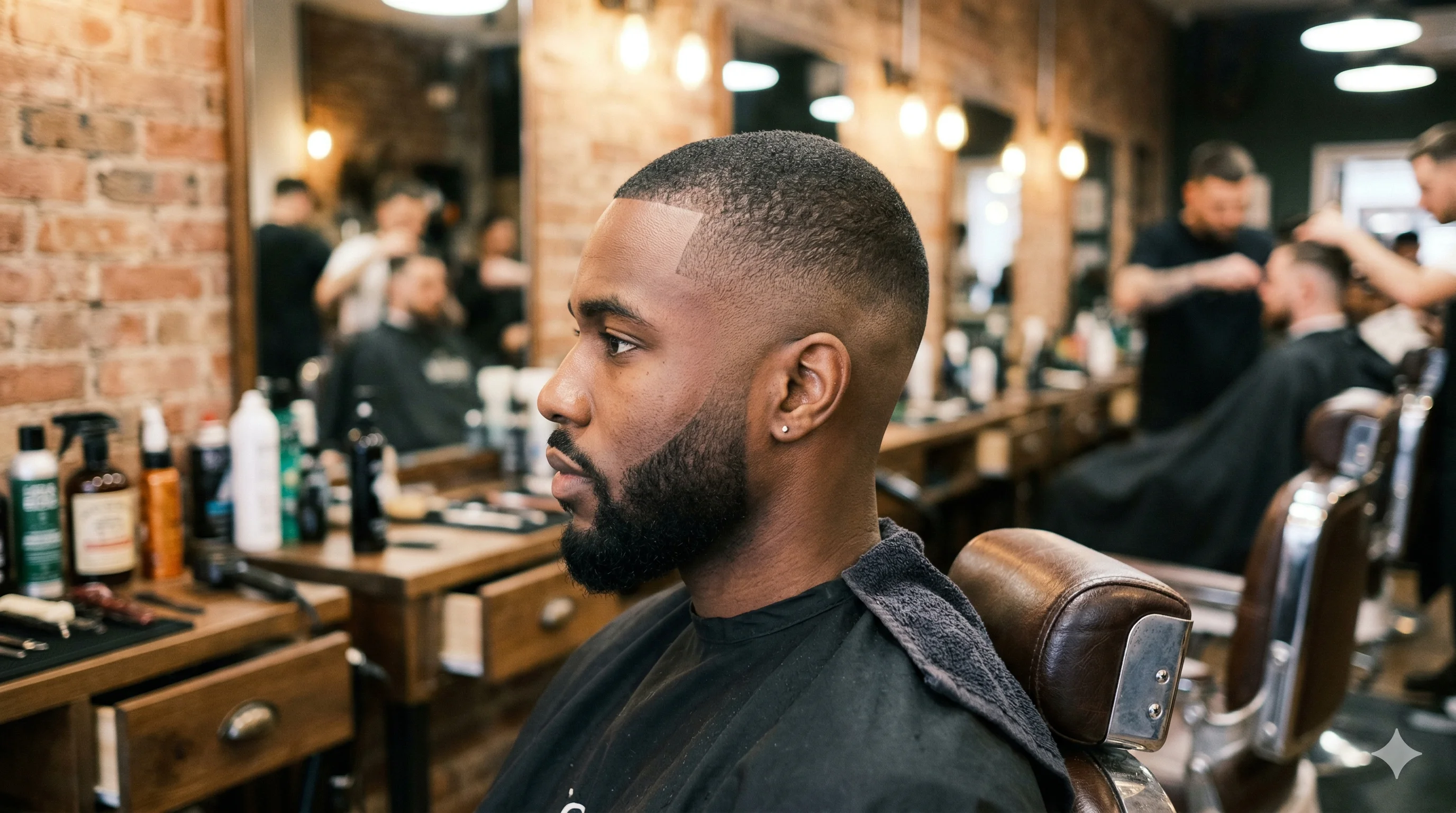
The skin fade is the benchmark of modern barbering—a cut where the hair on the sides and back disappears completely into bare skin at the lowest point, then gradually builds back up into whatever length you're carrying on top. It's the standard by which sharp haircuts are measured in 2026, and once you've had one done right, it's hard to go back.
But "skin fade" covers a lot of ground. The height of the fade, the style on top, and even the direction of the taper all change the look dramatically. This guide breaks down every variation, matches them to face shapes and hair types, and gives you the exact language to use at your next barber appointment.
What Is a Skin Fade?
A skin fade—also called a zero fade or bald fade—is a haircut technique where the sides and back are tapered using clippers, blending gradually from bare skin (zero length) at the neckline and around the ears upward into progressively longer hair. The defining characteristic is that the fade begins at true skin level with no guard, creating a seamless transition with no visible line.
Unlike a regular taper, which simply reduces hair length without reaching bare skin, a skin fade goes all the way down to zero. Unlike a bald fade, which is often used interchangeably with "skin fade," the terminology is essentially the same—both describe the same technique, though some barbers use "bald fade" specifically when the fade extends unusually high.
What Makes a Skin Fade Different
- Starts at zero: No guard at the lowest point—actual skin is visible at the base
- Seamless gradient: No harsh lines; the blend is smooth and continuous
- High contrast: Creates a dramatic visual difference between the skin at the bottom and the hair on top
- Requires skill: Achieving a truly seamless skin fade requires a skilled barber with proper technique and quality clippers
- Fast regrowth: Because it reaches bare skin, it shows growth more quickly than other fade styles
Skin Fade vs Bald Fade vs Taper Fade: Clearing Up the Confusion
These three terms get mixed up constantly, even by experienced barbers. Here's how they actually differ:
| Feature | Skin Fade | Bald Fade | Taper Fade |
|---|---|---|---|
| Lowest point | Bare skin (0 guard) | Bare skin (0 guard) | Short but not bare skin |
| Contrast level | Very high | Very high | Low to moderate |
| Clean lines | Yes | Yes | Yes, softer |
| Maintenance frequency | Every 1–2 weeks | Every 1–2 weeks | Every 2–4 weeks |
| Best for | Sharp, modern looks | Bold, high-contrast styles | Classic, professional looks |
| Visibility when grown out | Immediately noticeable | Immediately noticeable | Grows out gracefully |
In practice, skin fade and bald fade are used interchangeably by most barbers. Taper fade is the clear outlier—it never reaches bare skin and grows out more gradually.
Types of Skin Fade Haircuts
The height at which the fade begins—and how far up it travels—determines the entire personality of the cut.
Low Skin Fade
The low skin fade starts just above the natural hairline, near the bottom of the ears, and blends skin-to-length upward from there. The result is subtle: most of the side hair remains, but the base transitions cleanly to skin. It's the most understated skin fade option, popular with men who want precision without maximum contrast.
Best for:
- Professional environments where a sharp but conservative look is expected
- Men who prefer longer intervals between barber visits
- Round or wide faces where retaining more side hair helps balance proportions
- First-timers nervous about committing to a dramatic fade
Styling tip: A low skin fade pairs especially well with longer tops—pompadours, quiffs, or comb overs—where the retained side length creates a natural visual flow into the top.
Mid Skin Fade
The mid skin fade begins around temple level, roughly in line with the middle of the ear, and works upward from there. This is the sweet spot of the skin fade world: enough contrast to look modern and deliberate, without going so extreme that it demands constant maintenance.
Mid skin fades are the most-requested variation in barbershops across North America in 2026, according to industry surveys. They work on nearly every face shape and hair type, which explains their dominance.
Best for:
- Most face shapes and hair types
- Men who want a modern, versatile look
- Balancing bold top styles without overwhelming them
- The ideal first skin fade for most men
Styling tip: A mid skin fade is versatile enough to pair with anything—a crew cut, a textured crop, a French crop, or a full comb over. It's the chameleon of skin fade heights.
High Skin Fade
The high skin fade starts near or above the temples, taking the blend all the way up toward the crown area. This is the most dramatic option—maximum contrast, maximum statement. The sides and back become almost fully faded, putting all the attention on the top.
Best for:
- Men who want a strong, bold aesthetic
- Thick or voluminous hair on top that can fill the visual space the faded sides create
- Creative or fashion-forward environments
- Oval or oblong face shapes that can carry height
- Those who want their haircut to make a statement
Caution: A high skin fade on a long or rectangular face can further elongate the silhouette—opt for a low or mid fade if face length is a concern.
Styling tip: With a high skin fade, the top is the entire haircut. Invest in quality product—matte clay for a textured modern finish, or pomade for a sleek polished look—and spend time styling the top properly.
Drop Skin Fade
The drop skin fade arcs downward behind the ear, "dropping" lower in the back than at the sides before blending back up. The curved fade line creates a rounded shape that works with the natural curve of the skull, giving a cleaner look from behind.
Best for:
- Men who want a distinctive, slightly artistic fade shape
- Pairing with curly or wavy tops where the curved fade mimics the hair's natural movement
- Burst fade aesthetics with a skin finish
Note: Not every barber offers drop fades by default—specify "drop skin fade" when booking or at the chair to make sure you get the curved line rather than a straight horizontal fade.
Skin Fade Styles: The Best Top Combinations
A skin fade is the foundation; what you put on top determines the final look. Here are the most popular skin fade combinations in 2026:
Skin Fade with Crop Top
The textured crop paired with a skin fade is the most popular combination of the decade. The top is cut short with a fringe that sits horizontally across the forehead, and the skin fade beneath creates maximum contrast.
Why it works: Low-maintenance top, high-impact fade. You get a sharp, modern look with minimal daily styling. The textured crop requires little more than a small amount of matte clay.
Skin Fade with Pompadour
A classic pompadour—hair swept back and up from the forehead—elevated by a skin fade that contrasts sharply with the voluminous top. This combination reads as both vintage and contemporary at once.
Why it works: The skin fade removes all visual clutter from the sides, putting the dramatic height of the pompadour in total focus. High-maintenance but high-reward.
Skin Fade with Comb Over
A skin fade paired with a comb over gives a side-parted, swept style its most polished possible version. The skin base of the fade creates a razor-clean canvas for the part line.
Why it works: Professional, sharp, and versatile. A hard part razor-cut into the skin level amplifies the precision of the style.
Skin Fade with Curls / Natural Texture
Men with naturally curly or coily hair can use a skin fade to highlight their natural texture by letting the curls sit full on top against faded sides. This is especially popular with afro-textured hair.
Why it works: The contrast between bare skin at the base and full, natural curl pattern on top creates one of the most visually striking combinations in barbering. The natural texture does the styling work.
Skin Fade with Buzz Cut
A skin fade buzz cut keeps the top very short (1–3 guard) and fades the sides down to skin. The difference in length from top to sides is subtle but the fade creates a clean, precise finish.
Why it works: The lowest-maintenance skin fade option. It still looks sharp and deliberate, but requires no daily styling product and grows out more gracefully than longer tops.
Face Shape Guide for Skin Fades
| Face Shape | Best Skin Fade | Recommended Top | Why |
|---|---|---|---|
| Oval | Any height | Any style | Balanced proportions work with everything |
| Square | Low to mid | Textured crop, comb over | Softens angular jaw; high fade can over-sharpen |
| Round | High or mid | Pompadour, quiff | Adds vertical height to elongate the face |
| Rectangle/Oblong | Low | Full textured top, crop | Avoids adding more height; keeps proportions |
| Diamond | Mid | Textured top, loose comb over | Balances wide cheekbones |
| Heart | Mid to low | Volume at sides, textured | Balances narrow jaw with wider forehead |
Key principle: Use fade height to adjust perceived face length. High fades add height and length; low fades preserve width. Let your face shape guide the height, and let personal preference guide the top.
Hair Type Considerations
Skin fades work across all hair types, but the experience and result differ:
Straight hair: The fade gradient is most visible and clean with straight hair. Products like pomade or paste hold well and give precise definition.
Wavy hair: Adds natural movement to the top without much effort. Use a lighter product to enhance the wave rather than fighting it. The fade looks especially clean below the wave zone.
Curly hair: Naturally textured tops create dramatic contrast with a skin fade. Embrace the curl with a curl cream or leave-in conditioner; the fade does the rest.
Coily/Afro-textured hair: The afro fade is one of the most striking skin fade combinations. A barber skilled in natural hair is essential for a seamless blend through tight curl patterns.
Fine hair: Skin fades can help fine hair look fuller by concentrating the visual weight on top. Avoid a high fade if your hair is very thin on top—it may draw attention to sparse areas.
Thick hair: Ideal for skin fades. The natural density supports any top style, and the fade provides necessary bulk reduction on the sides.
How to Style a Skin Fade Haircut
Tools You'll Need
- Blow dryer (optional for textured crops, useful for pompadours and comb overs)
- Quality comb or styling brush: A boar bristle brush for sweep-back styles; a wide-tooth comb for textured crops
- Styling product: Matched to the desired finish and hold level
Step-by-Step Styling Guide
- Start with clean, damp hair: Work with hair that's been washed and towel-dried. Damp hair distributes product evenly and is easiest to shape.
- Blow-dry with direction (for longer tops): If your top is more than 2 inches, blow-dry in the direction you want the final style to go—back for a pompadour, to the side for a comb over, forward for a crop. This "trains" the hair.
- Warm a small amount of product: Rub product between your palms to activate it before applying. A dime-to-quarter sized amount is usually sufficient.
- Work from roots to ends: Apply product starting at the roots, then distribute through to the tips for even coverage.
- Shape and style: Use a comb for structured styles (comb over, pompadour) or your fingers for textured styles (crop, curls).
- Leave the sides alone: Your skin fade doesn't need product—it's styled by the cut itself.
- Finish with a touchup comb: For comb overs or slick backs, one final pass with a fine-tooth comb sets the style cleanly.
Product Guide by Style
| Style | Product Type | Hold Level | Finish |
|---|---|---|---|
| Textured crop | Matte clay or fiber | Medium | Matte |
| Pompadour | Pomade | Strong | High shine or natural |
| Comb over | Pomade or paste | Medium–strong | Shine to natural |
| Curls | Curl cream or gel | Light–medium | Natural |
| Buzz cut | None required | — | Natural |
| Slick back | Water-based pomade | Strong | High shine |
Skin Fade Maintenance Schedule
A skin fade's biggest trade-off is maintenance frequency. Because the cut reaches bare skin, regrowth is immediately visible.
| Fade Height | Recommended Touch-Up | Why |
|---|---|---|
| High skin fade | Every 7–10 days | Growth shows at temples quickly |
| Mid skin fade | Every 10–14 days | Moderate growth; starts to blur around 2 weeks |
| Low skin fade | Every 14–21 days | Most forgiving; the lower starting point grows slower |
| Drop skin fade | Every 7–14 days | Curved line is first to blur; height-dependent |
Pro tip: If you can't make it to the barber every week, a mid or low skin fade extends your window considerably. A high skin fade demands consistent maintenance—factor that into your lifestyle before requesting it.
What to Tell Your Barber
Walking into the barbershop with the right vocabulary gets you exactly what you want:
Full request script: "I'd like a skin fade—taking the sides and back down to zero at the base. I want a [low/mid/high] fade starting around [the hairline / my temples / my crown area]. On top, keep it [style and length description]. [Optional: Can you add a hard part?]"
Key terms:
- "Take it to skin" or "zero fade" — confirms you want bare skin at the base
- "Low/mid/high" — specifies where the fade begins
- "Drop fade" — requests the arc behind the ear
- "Hard part" — razor-etched line at the part
- "Clean up the neck" — sharp horizontal or rounded neckline at the base
- "Taper the neckline" — gradual fade at the neckline rather than a hard line
Bring reference photos. Even experienced barbers benefit from seeing your exact vision, and it eliminates any ambiguity about fade height or top style.
Is a Skin Fade Right for You?
Skin fades work well for:
- Men who want a sharp, modern, high-impact look
- Those willing to commit to 1–2 week barber visit cycles
- Any hair type—straight, wavy, curly, or coily
- Men who want a versatile foundation that pairs with dozens of top styles
- Those whose workplace and lifestyle welcome bold grooming choices
Consider alternatives if you:
- Want low-maintenance cuts that look fine growing out for 4+ weeks
- Have very fine or thinning hair where bare skin contrast may be unflattering
- Prefer a softer, more natural hairline rather than a sharp fade
- Are looking for a first "experimental" cut and want something easier to grow out
Frequently Asked Questions
How is a skin fade different from a bald fade? In practice, they're the same cut—both take the sides to zero, bare skin. Some barbers use "bald fade" when the fade extends particularly high or when the style is especially aggressive. If a barber distinguishes the two, ask them to clarify what they mean, since terminology varies by region.
Does a skin fade work on thick hair? Yes—in fact, thick hair is ideal for skin fades. The density on top creates impressive contrast with the faded sides, and the thickness holds styles like pompadours and crop tops especially well.
How often do I need to get a skin fade touched up? Every 1–2 weeks for high skin fades; every 2–3 weeks for mid and low skin fades. The first 5–7 days after a skin fade are its sharpest.
Can I get a skin fade with naturally curly hair? Absolutely. Curly and coily hair looks spectacular with a skin fade. The contrast between the natural texture on top and the bare skin at the sides is one of the most visually striking combinations in barbering. Make sure your barber has experience with your specific curl type.
Does a skin fade cause razor bumps or irritation? Some men—particularly those with coily or curly hair—are prone to razor bumps (pseudofolliculitis barbae) at the neckline. If this is a concern, ask your barber to leave a very short guard (0.5) at the base rather than going completely bare. Proper post-cut care with an antiseptic or aftershave also helps.
How long does it take to get a skin fade? A skilled barber needs 20–45 minutes for a complete skin fade haircut, depending on the style on top and the complexity of the fade. Rush jobs compromise the blend quality—a good skin fade takes time.
What's the most popular skin fade style in 2026? The mid skin fade paired with a textured crop or French crop is the dominant combination in 2026, reflecting the broader trend toward lower-maintenance top styles with high-impact precision sides.
Final Thoughts
The skin fade earns its reputation as the gold standard of men's haircuts because it forces precision—there's no hiding an imprecise blend when the baseline is bare skin. A well-executed skin fade at the right height for your face shape and paired with the right top style is one of the most powerful upgrades in men's grooming.
Find a barber who specializes in fades, communicate clearly using the guide above, and commit to the maintenance schedule. The payoff is a haircut that consistently turns heads and projects the kind of deliberate grooming confidence that no off-the-shelf style can replicate.
Ready to book? Use our guide to walk in knowing exactly what you want—and walk out with the sharpest version of it.