

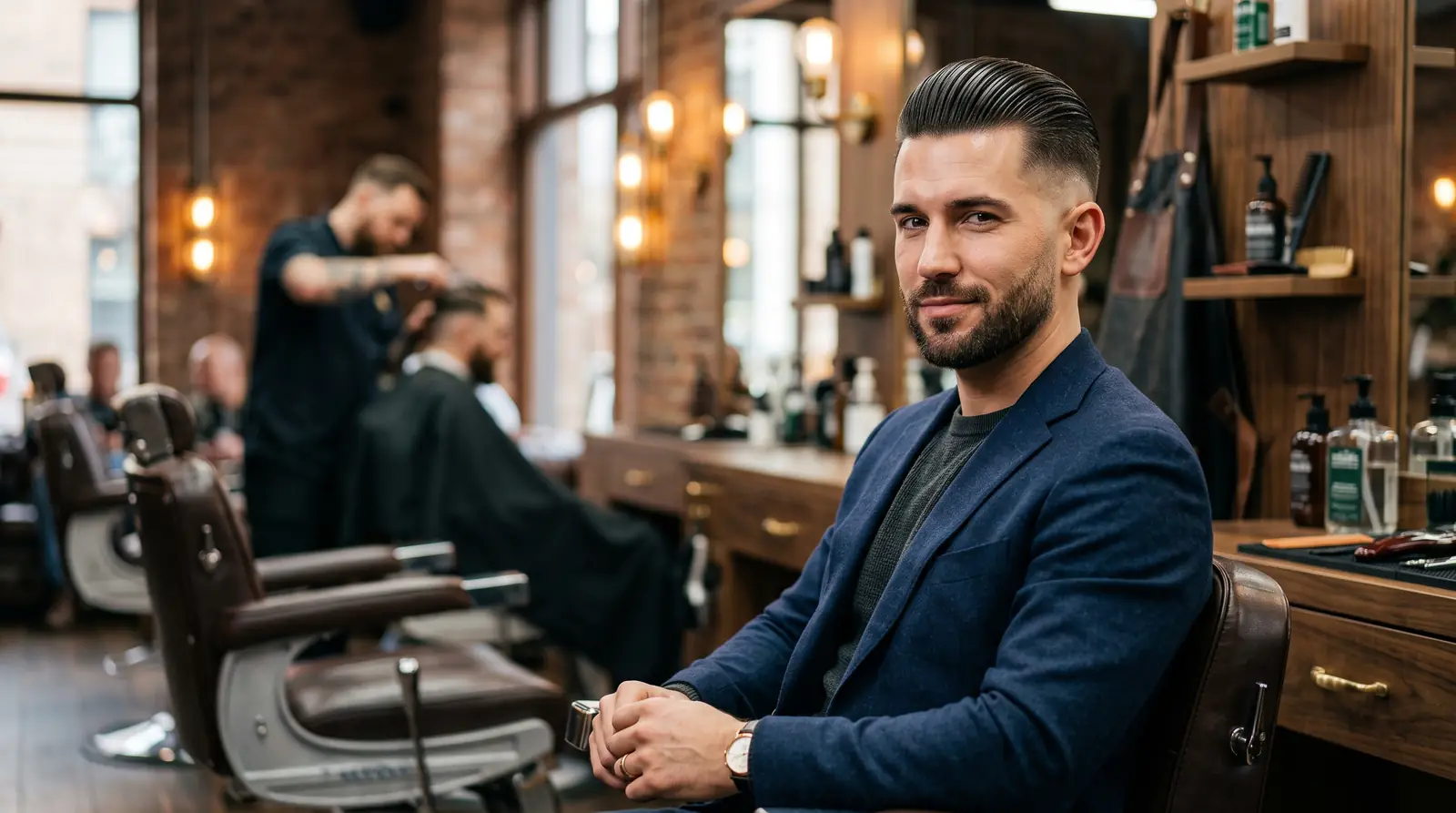
The slick back fade is one of those rare haircuts that manages to be both classically rooted and unmistakably current at the same time. It's been a consistent presence in barbershops for decades, but in 2026, it's having a particular moment — updated with harder lines, cleaner fades, and a more sculptural quality that feels sharp rather than retro. Whether you're drawn to the polished executive look or a looser, more textured take, the slick back fade has a variation that works.
This guide covers everything you need to know: what defines the slick back fade, how it compares to similar styles, the full range of fade variations, how to match it to your face shape and hair type, and exactly how to brief your barber to get it right.
What Is a Slick Back Fade?
A slick back fade combines two distinct elements. The "slick back" refers to the top and crown hair being swept directly rearward — away from the face, toward the back of the head — typically with product that gives the hair a smooth, controlled finish. The "fade" refers to the clipper gradient on the sides and back, where hair blends from short near the hairline up toward the longer length on top.
The result is a haircut with strong directional emphasis: everything moves backward, drawing the eye along the line of the top from forehead to crown, while the faded sides provide contrast and clean definition. It's a bold cut — the swept-back direction makes it inherently assertive — but the quality of the fade and the finish of the top determine whether it reads as polished professional or fashion-forward street style.
The slick back fade is distinct from a pompadour in that the volume on top lies flat or close to the head rather than being lifted at the front. It differs from a comb over in that the direction is backward rather than lateral. And it differs from a simple taper cut in the precision and drama of the clipper fade.
Key Characteristics of a Slick Back Fade
- Top swept backward: Hair on top directed straight back from the hairline, lying flat or close to the head
- Medium to long top length: Typically 2–5 inches on top — enough length for the swept-back style to work
- Faded sides: Smooth clipper gradient from short at the base up toward the top
- Product-dependent finish: Requires pomade, gel, or wax to hold the direction and surface texture
- Strong silhouette: Distinct profile — clean at the sides, with visible length and direction on top
Slick Back Fade vs Similar Styles
The slick back fade is frequently confused with several related cuts. Here's how to distinguish them clearly.
| Feature | Slick Back Fade | Pompadour Fade | Comb Over Fade | Undercut Fade |
|---|---|---|---|---|
| Top direction | Straight back | Up and back | Lateral (to one side) | Varies |
| Volume | Low to medium | High lift at front | Low to medium | Any |
| Top length | 2–5 inches | 3–6 inches | 2–5 inches | 3–6 inches |
| Product hold | Medium to strong | Medium to strong | Light to medium | Optional |
| Fade type | Any | Any | Any | Disconnected or blended |
| Formality | Versatile | Smart casual to formal | Business to casual | Casual to fashion |
The pompadour fade is the closest relative — both sweep hair back — but the pompadour builds height at the front, creating a lifted, rounded shape. A slick back lies flatter, with the emphasis on length and backward direction rather than volume. Some barbers use the terms interchangeably for shorter lengths, but technically the distinction is in the lift.
The comb over fade sweeps hair to one side across the head. The slick back goes rearward. The difference is significant visually: a comb over emphasizes horizontal width, a slick back emphasizes backward length.
"The slick back fade is one of the most requested cuts right now from men who want something bold but wearable. It works in a suit or casual — the product choice does most of the work in shifting the formality." — common observation from experienced barbers
Types of Slick Back Fade Haircuts
The height of the fade fundamentally changes how the slick back reads. Here are all the main variations.
Low Slick Back Fade
The fade starts just above the ear and at the nape, keeping the gradient tight to the natural hairline. The sides are clearly shorter than the top but not dramatically contrasted. This is the most wearable, versatile version — it reads as polished and conservative without being attention-grabbing. The low fade suits professional environments well and grows out gracefully.
Best for: First-time fades, conservative dress codes, professional environments, men who prefer understated style.
Mid Slick Back Fade
The fade begins at roughly temple height, creating a more visible contrast between the blended sides and the longer swept-back top. This is the most commonly requested slick back fade variation — the balance between modern contrast and wearable restraint is at its best here. The mid fade accentuates the directional drama of the slick back without making the cut look too aggressive.
Best for: Most men, most occasions. The standard, all-purpose slick back fade.
High Slick Back Fade
The fade starts high — above the temples, close to the top section — creating strong contrast and a more graphic, fashion-forward silhouette. The line between the faded sides and the swept-back top is clearly visible and intentional. This version leans into the cut's boldness and makes a deliberate style statement.
Best for: Oval and oblong face shapes, men who want a modern, high-contrast look, fashion-forward environments.
Skin (Bald) Slick Back Fade
The fade goes all the way down to bare skin at the base, creating maximum contrast against the length on top. The sides and nape are essentially bare near the hairline, blending seamlessly upward into the longer swept-back section. This is the most striking version — the cleanness of the skin fade makes the top styling pop with maximum definition.
Best for: Oval face shapes, men who want a dramatic, clean finish, and those comfortable with high-maintenance upkeep.
Slick Back Undercut Fade
A variation where the sides are disconnected rather than blended — a hard part or a visible line separates the top from the shorter sides, rather than a gradient fade. The sides may still be faded among themselves, but the transition to the top is a deliberate cut rather than a blend. This gives the slick back a harder, more graphic character.
Best for: Men who want maximum definition and a more editorial, fashion-forward look.
Textured Slick Back Fade
The top is swept back but styled with a matte, piece-y texture rather than a glossy slicked finish. This version softens the cut's formality and makes it more casual and approachable. It works particularly well with thicker, wavier hair where the natural texture adds interest. The fade is usually mid to high for maximum contrast against the looser top.
Best for: Casual settings, wavy or thick hair, men who prefer matte product over glossy finishes, 2026 natural-texture trend.
Slick Back Fade for Every Face Shape
Your face shape determines which slick back fade variation flatters most and which to avoid.
Oval Face Shape
Oval faces are the easiest to work with — most slick back fade variations look excellent. The backward direction of the slick back suits the balanced proportions of an oval face. High and skin fades create particularly strong results. The main consideration is top length — keep it proportional to your facial length and you'll have very few wrong choices.
Square Face Shape
For square faces, a mid or low fade works best — the stronger contrast of a high or skin fade can over-emphasize the width of the jaw and temples. A slightly textured finish on top, rather than a very tight slick, softens the angularity. Moderate product hold is better than a very stiff finish.
Round Face Shape
A mid to high fade with significant length and height on top helps elongate round faces. The backward sweep of the slick back naturally creates upward visual emphasis, which is flattering for round shapes. Avoid very low fades or short top lengths that keep the silhouette wide and horizontal. The more vertical emphasis you can create, the better.
Oblong / Long Face Shape
For longer faces, a low to mid fade with moderate top length prevents the slick back from adding too much vertical length. A loose, slightly forward-textured version — where the hair isn't pulled quite so far back — works better than a tightly swept-back slick. Avoid skin fades and very high fades that extend the apparent height of the head.
Diamond Face Shape
The slick back fade works well for diamond faces. The backward direction draws attention away from the widest point (cheekbones), and a low to mid fade that preserves some width at the temples keeps the silhouette balanced. Moderate top length — around 2.5–3.5 inches — is ideal.
Heart Face Shape
Heart faces (wider forehead, narrower jaw) benefit from a mid fade that maintains some width at the temples, balancing the narrower chin. Avoid very high or skin fades that remove too much width from the sides. A looser, more textured top finish is more flattering than a very tight slick.
Slick Back Fade for Every Hair Type
Straight Hair
Straight hair is arguably the ideal texture for a slick back fade. The hair lies flat naturally, making the swept-back direction easy to achieve and maintain. Product holds cleanly without fighting the hair's natural movement. Any pomade or gel grip level works well, from light hold for a natural finish to strong-hold gel for a very defined wet look.
Wavy Hair
Wavy hair can produce an excellent slick back fade with the right approach. The waves add texture and movement, which looks particularly good in the textured slick back variation. For a sleeker finish, blow-dry the hair backward first before applying product — this trains the waves flat temporarily. Medium-hold pomade works better than gel, which can accentuate frizz.
Thick Hair
Thick hair holds the slick back direction very well once set, but requires more product to manage. Request that your barber thin the top section slightly to reduce bulk and prevent the hair from becoming too heavy to stay swept back. A mid or high fade helps by removing the bulk on the sides, making the top the visual focus.
Fine Hair
Fine hair needs careful handling for a slick back fade. The swept-back style can flatten fine hair against the scalp, reducing apparent volume. Use a volumizing product to add body before applying a finishing pomade. Avoid heavy gels that weigh fine hair down further. A mid fade (not too high) keeps the sides looking proportional to a thinner top.
Curly Hair
Curly hair presents the most specific challenge for a slick back fade. The curls resist the backward direction naturally. A looser approach works better — rather than pulling curls tightly back, train them backward with a medium-hold cream that allows the curl pattern to remain partially visible. A high or mid fade provides contrast against the volume of curls on top.
Coarse Hair
Coarse hair benefits from the slick back fade's use of product — the right pomade tames coarseness while providing the hold needed for the swept-back direction. Use a product specifically formulated for coarse or thick hair. A mid to high fade provides strong contrast and makes the cut work harder visually.
How to Ask Your Barber for a Slick Back Fade
Getting this cut right requires clear briefing. Use this language at your next appointment:
The complete request:
"I'd like a slick back fade — keep the top about [2.5 / 3 / 3.5] inches so I have enough length to sweep it back. For the sides, I'd like a [low / mid / high / skin] fade. No part — just sweep everything straight back from the hairline. For the neckline, [squared / rounded / natural taper]."
What to clarify before they start:
- Top length: The slick back requires sufficient length to work — tell your barber explicitly how much length you're keeping
- Fade height: Point to where you want the fade to start rather than relying on terms alone
- Part vs no part: Classic slick backs have no part — confirm you want everything swept straight back unless you're after a variation with a defined parting
- Product finish: Tell your barber if you prefer matte or glossy — some barbers will finish with product after cutting, and knowing your preference matters
- Neckline shape: Squared is sharp and deliberate. Rounded is softer. Natural taper grows out most cleanly
Bring reference photos: The slick back fade has many variations across product finish, top length, and fade height. Photos eliminate ambiguity faster than any description.
Styling a Slick Back Fade
Styling is where the slick back fade lives or dies. The technique and product choice determine 80% of the final look.
The Classic Slick Back (5–8 minutes)
- Wash hair and towel-dry until damp — not dripping, not fully dry
- Apply a small amount of pomade or gel to your palms and work through the damp hair
- Using a fine-tooth comb, sweep the hair backward firmly, starting at the hairline and moving toward the crown
- Repeat the sweep 2–3 times to build definition
- Blow-dry on medium heat while combing backward — this sets the direction
- Apply a small finishing amount of pomade to smooth the surface and add shine
- Do a final comb-through for a clean, defined finish
Best products for this method: Water-based pomade for a classic glossy finish, petroleum pomade for heavier hold and higher gloss.
The Textured Slick Back (3–5 minutes)
- Wash and blow-dry on medium heat, using your hands (not a comb) to push hair backward as it dries
- Work matte clay or fiber through dry or slightly damp hair
- Push hair backward with your fingers — avoid a comb to keep the texture piece-y
- No need to over-define the surface — a rougher finish is intentional
Best products for this method: Matte clay, fiber paste, or dry texturizer.
Maintaining the Slick Back Through the Day
- Re-slicking: If the style loses definition mid-day, dampen your hands slightly and run them backward through the top. For oil-based pomade, this re-activates the product.
- Shine control: If the slick back becomes too glossy, a small amount of matte powder or finishing spray applied lightly over the top can tone it down.
- Wind and humidity: These are the slick back's main enemies. A stronger-hold product is worth using on days when either is a factor.
Product Guide for a Slick Back Fade
Choosing the right product is essential for this cut. Here's how to match product to your desired finish:
| Finish | Product Type | Hold Level | Best For |
|---|---|---|---|
| High gloss, classic | Water-based pomade | Medium | Polished, professional look |
| High gloss, maximum | Petroleum pomade or gel | Strong | Wet look, maximum definition |
| Matte, textured | Clay or fiber | Medium | Casual, natural-finish slick back |
| Natural shine | Cream pomade | Light to medium | Wavy or curly hair variations |
| Long-lasting definition | Gel | Strong | High humidity, all-day hold |
For most men, a water-based pomade at medium hold is the starting point. It provides the finish the slick back is associated with, washes out easily, and works across hair types.
Maintenance Schedule
The slick back fade requires consistent barbershop visits to stay sharp. The fade in particular grows out quickly and softens the cut's contrast.
- Every 2 weeks: Skin fades and high fades — at this level of contrast, growth is immediately visible. A 2-week schedule keeps the cut looking intentional rather than grown-out.
- Every 3 weeks: Mid fades — the sweet spot for most men. The shape is softening but still clearly defined.
- Every 4 weeks: Low fades — the most forgiving option for longer intervals. The fade has grown out noticeably by 4 weeks but the overall cut is still recognizable.
Between Appointments
- Daily styling: The slick back requires product every day it's worn in this style. Planning 5 minutes into your morning routine is essential.
- Neckline maintenance: The neckline is the first area to look unkempt. Ask your barber if they offer neckline clean-ups between appointments.
- Product buildup: Water-based pomades wash out easily. Petroleum-based products require a clarifying shampoo or dish soap wash every 1–2 weeks to prevent buildup.
Frequently Asked Questions
Is the slick back fade a professional haircut? Yes — a low or mid fade version with a medium-hold pomade and a tidy finish reads as polished and professional in most environments. Higher fades and very glossy wet-look finishes are more fashion-forward. The versatility of the slick back comes largely from the product choice: matte clay for casual, water pomade for professional, gel for fashion.
How much hair do I need for a slick back fade? You need at least 2 inches on top for the style to work effectively — enough length for the swept-back direction to read clearly. Most slick back fades work best between 2.5 and 4 inches on top. Very short lengths can work if the hair is dense, but the look becomes more of a textured sweep than a true slick back.
Does a slick back fade work with curly hair? Yes, with adjustments. A loose, backward-trained curl look works very well — it's a different aesthetic from the sleek, straight version but a legitimate and fashionable take on the slick back. The key is using a curl-friendly product (cream or curl pomade) rather than a gel that flattens and hardens curls.
How long does a slick back fade take to cut? A skilled barber typically takes 25–40 minutes. The fade work requires precision and usually accounts for the majority of the time. The top is relatively straightforward once the correct length is established.
What's the difference between a slick back fade and a pompadour fade? The key difference is lift. A pompadour builds height at the front of the hairline — the hair is swept back and up, creating a raised, rounded shape at the front. A slick back keeps the hair close to the head, moving backward without significant lift. Both use product and a backward direction, but the pompadour is more dramatic in volume.
Can I get a slick back fade with thinning hair? It depends on the degree of thinning and where it's occurring. Men with thinning at the crown should be cautious — the slick back direction can expose thinning areas. A looser, more textured version combined with a volumizing product is more forgiving than a very tight, glossy slick. Discuss placement concerns with your barber before committing.
Ready to Get a Slick Back Fade?
The slick back fade is a bold, directionally strong haircut that rewards good technique — both from your barber in the cutting and from you in the daily styling. When it's right, it's one of the most visually striking cuts available, capable of reading sharp and professional or fashion-forward depending entirely on how you finish it.
Find a barber experienced with fades, bring clear reference photos of the top length and fade height you want, and spend five minutes on product selection — that combination will get you exactly where you want to be.
Explore more fade styles in our complete guides to the pompadour fade, comb over fade, and high fade.