

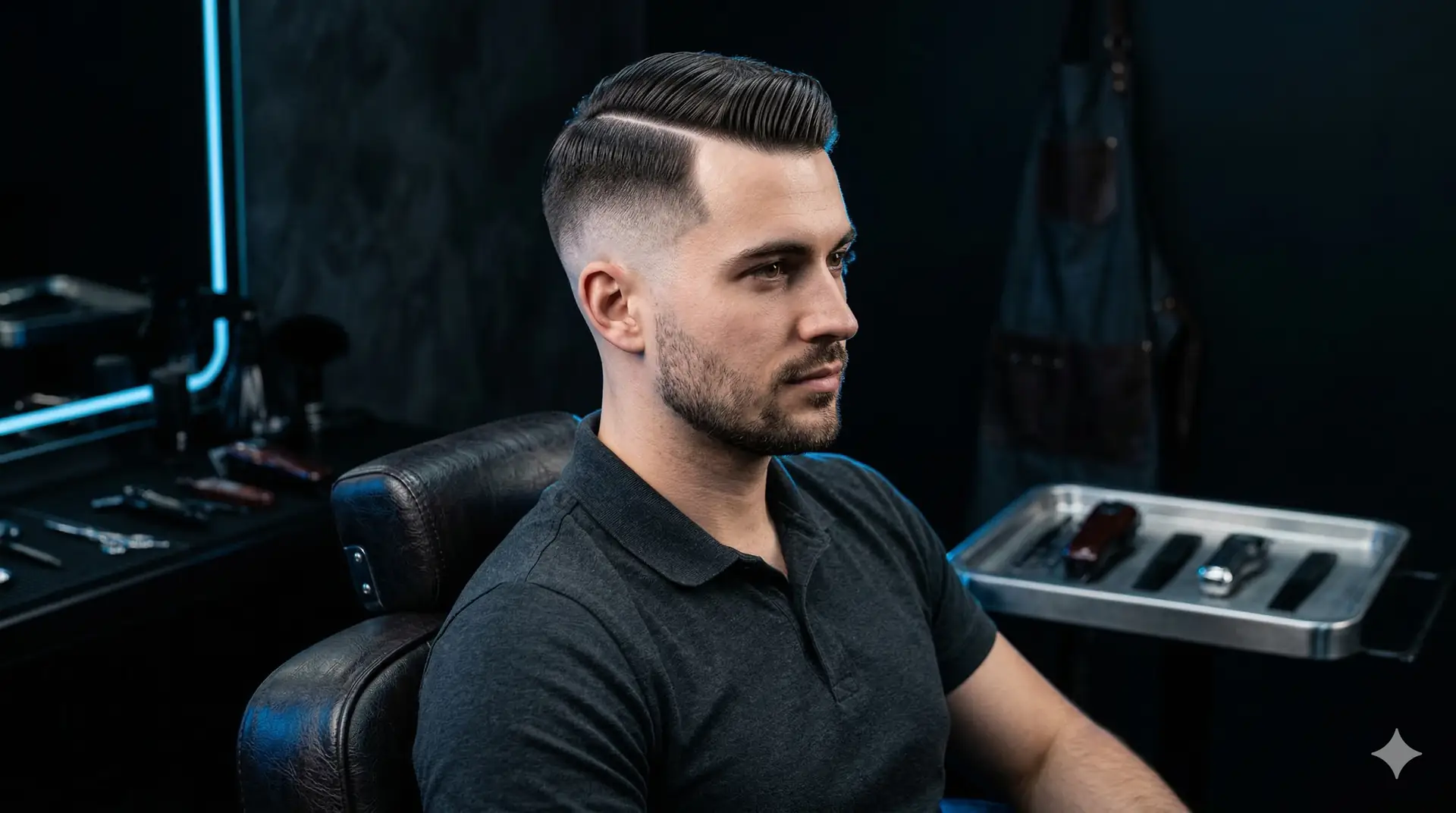
The comb over fade is having a major moment in 2026—and it's not hard to see why. It merges old-school sophistication with contemporary barbering precision, producing a look that works equally well in a corner office, at a wedding, or on a Saturday night out. At its core, the style pairs a clean side-parted top with a faded sides and back, balancing structure with movement in a way that few haircuts can match.
If you've ever wondered what separates a sharp comb over fade from a dated side part, or if you want to nail the exact terminology before your next barber appointment, this guide covers everything—from defining characteristics and variations to face-shape advice, styling routines, and maintenance schedules.
What Is a Comb Over Fade?
The comb over fade is a men's haircut that combines a comb over top—where hair is grown longer on top and swept to one side along a clean part line—with a faded sides and back, where hair transitions seamlessly from skin or very short lengths up into the longer top. The result is a structured, polished look with a clear visual contrast between the fuller crown and the tapered sides.
Unlike the old-fashioned "comb over" associated with thinning hair being swept across a bald spot, the modern comb over fade is a deliberate style choice. The hair on top is typically 2–4 inches long, intentionally parted and combed, while the sides are cut with clipper work that produces a smooth, skin-to-length blend—no visible lines, no abrupt transitions.
Key Characteristics of a Comb Over Fade
- Defined side part: A clean part line is either naturally formed or razor-etched for extra crispness
- Longer top: Hair on the crown is kept long enough to comb and style with hold
- Faded sides: Sides and back blend from skin or very short up into the length on top
- Versatile finish: Can range from sleek pomade-polished to relaxed matte-textured
- Adaptable height: Fade can start low, mid, or high depending on desired contrast
- Universal formality: Appropriate from casual settings to formal occasions
Comb Over Fade vs Regular Comb Over: Understanding the Difference
Many men use "comb over" and "comb over fade" interchangeably, but they're not the same cut. Understanding the distinction helps you walk out of the barbershop with exactly what you want.
| Feature | Comb Over Fade | Regular Comb Over |
|---|---|---|
| Sides/back treatment | Faded (gradual blend to skin) | Tapered or clipper-cut without fade |
| Contrast level | High—dramatic skin-to-length blend | Low to moderate |
| Maintenance frequency | Every 1–3 weeks depending on fade height | Every 3–4 weeks |
| Modern vs traditional | Modern, fashion-forward | More traditional, conservative |
| Sharpness | Razor-clean fade line | Softer, less defined edge |
| Best setting | Versatile (work to weekend) | Primarily professional/formal |
According to barbers surveyed across major US cities, the comb over fade has replaced the plain comb over as the go-to professional cut for men under 40, largely because the fade adds a contemporary edge without sacrificing the respectability of the side-part silhouette.
Types of Comb Over Fade Haircuts
The comb over fade isn't a single style—it's a framework. The fade height, skin vs. length finish, and top styling options create dozens of distinct variations. Here are the most popular in 2026:
Low Fade Comb Over
The low fade starts just above the natural hairline—near the bottom of the ear—and blends upward. Combined with a comb over, this creates a subtle, refined look with minimal contrast.
Best for:
- Conservative professional environments
- First-timers who want a polished but understated look
- Men who prefer slower regrowth between barber visits
- Round or wide faces where keeping more hair on the sides adds width balance
Styling tip: Pair with a medium-hold pomade and a hard side part for a timeless business-ready look.
Mid Fade Comb Over
The mid fade begins around the temple level—the middle of the ear and crown—creating a balanced contrast that's neither too dramatic nor too subtle. This is consistently the most-requested comb over fade variation in 2026.
Best for:
- Universal appeal across virtually all settings
- Most face shapes and hair types
- Men who want a modern look without committing to extreme contrast
- Transitioning from a conservative look to something more stylish
Styling tip: Works beautifully with a matte clay for a textured, natural finish that reflects the 2026 trend toward less product-heavy styling.
High Fade Comb Over
The high fade begins near the temples or higher, removing significant bulk from the sides and creating dramatic contrast with the longer top. This is the boldest comb over fade variation.
Best for:
- Men who want maximum visual impact
- Thick or voluminous hair on top that benefits from side reduction
- Creative or fashion-forward environments
- Those with strong angular features that can carry high contrast
Styling tip: With this much contrast, the top becomes the focal point—invest in a quality pomade or paste and take time perfecting the comb direction.
Skin Fade Comb Over
A skin fade takes the sides all the way down to bare skin at the lowest point, then blends upward. Combined with a comb over, it creates a razor-sharp modern look with maximum contrast.
Best for:
- Men who love ultra-clean, precise barbering
- Darker hair where contrast is naturally higher
- Men willing to maintain every 1–2 weeks
- Making a strong grooming statement
Note: Skin grows back fast with a skin fade—plan your barber visits accordingly or the fade loses its crispness quickly.
Textured Comb Over Fade
A more relaxed variation where the top is styled with movement and texture rather than slicked flat. The part may be softer and the overall look feels more casual while retaining the clean faded sides.
Best for:
- Men who prefer a natural, lived-in look
- Wavy or naturally textured hair
- Casual environments where a sleek finish feels too formal
- The 2026 trend toward matte, textured grooming aesthetics
Hard Part Comb Over Fade
A razor-cut line is etched directly into the scalp at the part, creating an ultra-defined separation between the combed-over top and the faded sides. The most precise variation available.
Best for:
- Maximum definition and crisp visual lines
- Men who want their haircut to look freshly done at all times
- Modern, urban, fashion-conscious environments
- Pairing with a skin or high fade for maximum impact
Face Shape Guide for Comb Over Fades
Choosing the right comb over fade variation for your face shape is the difference between a haircut that flatters and one that merely functions.
| Face Shape | Recommended Variation | Reason |
|---|---|---|
| Oval | Any variation | Balanced proportions suit all styles |
| Square | Low to mid fade, softer part | Softens angular jaw without harsh lines |
| Round | High fade, hard part | Adds height, reduces width—elongates the face |
| Rectangle/Oblong | Low fade, loose texture on top | Avoids adding more height; keeps proportions balanced |
| Diamond | Mid fade, textured top | Balances wider cheekbones with fullness on top |
| Heart/Triangle | Mid fade, volume at sides | Balances a narrow jaw against wider forehead |
Key consideration: Men with long or rectangular faces should be cautious with high fades—they can further elongate the face. Bring the fade down and keep volume at the sides to add width.
Comb Over Fade vs Other Popular Fades
The comb over fade shares DNA with several other styles. Here's how it compares:
| Style | Top Length | Side Treatment | Formality | Maintenance |
|---|---|---|---|---|
| Comb Over Fade | Long, parted and combed | Faded | High | Every 1–3 weeks |
| Pompadour Fade | Long, swept back | Faded | High | Every 1–2 weeks |
| Taper Fade | Variable | Tapered blend | High | Every 3–4 weeks |
| Crop Fade | Short, textured | Faded | Medium | Every 2–3 weeks |
| Undercut | Long, variable direction | Disconnected | Medium–High | Every 2–4 weeks |
| Slick Back Fade | Long, swept back | Faded | High | Every 1–2 weeks |
The comb over fade's distinguishing feature is the intentional part line combined with a faded finish—it's the only style where the directional sweep of the hair is the central design element.
How to Style a Comb Over Fade
Getting the comb over fade right at home requires a few essential tools and a consistent routine.
Tools You'll Need
- Fine-tooth comb: For defining the part and training the direction
- Blow dryer: Blow-drying in the direction you want the hair to lie sets the style's foundation
- Quality styling product: Pomade (high-shine), paste (natural finish), or clay (matte texture)
Step-by-Step Styling Guide
- Start with damp hair: Towel-dry after showering—damp hair is easier to train than wet or fully dry hair
- Blow-dry with direction: Using a comb and medium heat, blow-dry the top in the direction you want it to lie. This sets the hair's memory before you apply product
- Find your part: Use a comb to locate your natural part line (usually above the arch of an eyebrow) or where your barber razor-etched it. Part firmly
- Apply product: Work a pea-sized amount of pomade, paste, or clay through the top, distributing evenly from roots to ends
- Comb to shape: Using your fine-tooth comb, sweep the hair across to one side, following the part line you established
- Finish the sides: The faded sides need little to no product—they're already styled by the cut
- Set if needed: For a sleeker finish, run the comb through once more after the product has set for 30–60 seconds
Recommended Products
- High-shine sleek look: Water-based pomade (easy wash-out, strong hold)
- Natural matte finish: Matte clay or fiber paste
- All-day lasting power: Hybrid cream-pomade combinations
- Lightweight hold for fine hair: Volume paste or texture spray
Apply modestly—a comb over fade is about the cut doing the work, not the product.
Comb Over Fade Maintenance Schedule
| Fade Type | Recommended Barber Visit | Why |
|---|---|---|
| Skin Fade | Every 1–2 weeks | Skin grows back visibly fast |
| High Fade | Every 1–2 weeks | High contrast shows growth quickly |
| Mid Fade | Every 2–3 weeks | Balance between maintenance and longevity |
| Low Fade | Every 3–4 weeks | Slower to show growth, more forgiving |
| Hard Part Addition | Every 1–2 weeks | Razor-etched line grows out and blurs |
The top grows roughly ½ inch per month. Most men maintain the top length by trimming the ends every 4–6 weeks while getting the fade refreshed more frequently.
What to Tell Your Barber
Clear communication is the fastest way to get exactly the comb over fade you want. Use this script at your next barber appointment:
Full request: "I'd like a comb over fade. Keep the top long enough to comb over—around 2 to 3 inches—with a [low/mid/high] fade on the sides and back. [Optionally: Can you razor a hard part on my left side?] I want the fade to go down to [skin / a 1 guard / a 0.5 guard]."
Key terms to know:
- "Leave the top long" — makes clear you don't want the top cut short
- "Fade to skin" or "bald fade" — for a skin fade finish
- "Fade to a 1" — leaves a tiny bit of length at the base of the fade
- "Hard part" — razor-cut part line etched into the scalp
- "Keep my natural part" — use your existing part, don't create a new line
- "Textured on top" — you want movement, not a flat sleek finish
Bring a photo for reference—barbers universally agree that a reference image eliminates miscommunication instantly.
Is the Comb Over Fade Right for You?
The comb over fade works well for:
- Men wanting a polished, professional appearance
- Those with straight, wavy, or slightly thick hair
- Anyone who enjoys a structured styling routine
- Men who want a haircut that works for both work and social settings
- Those with receding hairlines who want a style that looks intentional
Consider alternatives if you:
- Have very fine or thin hair (a high fade can make sparse areas more visible)
- Prefer low-maintenance cuts that need minimal daily styling
- Have extremely curly or coily hair (the comb-over direction may not hold as easily—though a textured variation can work beautifully)
- Want to downplay a very long or narrow face shape
Frequently Asked Questions
Is a comb over fade professional? Yes—the comb over fade is one of the most professional haircuts available for men. The side part communicates neatness and intention, and the faded sides look clean and maintained. It's common in corporate, legal, financial, and creative professional environments alike.
How long does the top need to be for a comb over fade? Minimum 1.5 inches for a basic comb over; 2–4 inches for a fuller, more defined swept look. If your top is too short, the hair won't have enough length to stay parted and combed across.
How often should I get a comb over fade touched up? Depends on the fade height. Skin fades and high fades need refreshing every 1–2 weeks. Mid fades every 2–3 weeks. Low fades can last 3–4 weeks before looking grown-out.
Can the comb over fade work with a receding hairline? Yes—a well-styled comb over can actually help manage and stylize a receding hairline by working with it rather than against it. A mid or low fade with a comb over that flows back rather than strictly to the side tends to work best. Avoid skin fades that cut very close to the hairline area.
What's the difference between a comb over fade and a slick back fade? Both have faded sides and longer tops, but a comb over is swept to the side along a part line, while a slick back is swept straight back from the forehead. The comb over looks more structured and classic; the slick back is sleeker and more modern.
Can I get a comb over fade with curly hair? Absolutely. Curly or wavy hair adds natural texture to the top, which can produce a softer, more relaxed comb over fade look. A textured variation with a matte product and a light, loose part works especially well for waves and curls. Ask your barber to keep more length on top so the natural pattern can form.
Final Thoughts
The comb over fade is more than a haircut trend—it's a modern barbering standard that has outlasted fads by staying genuinely versatile. It works because it respects both the craft of precision barbering and the everyday reality of men who want to look sharp without overthinking it.
Whether you opt for a low fade with a soft natural part for Monday morning meetings or a high skin fade with a razor hard part for the weekend, the comb over fade gives you a framework that's endlessly adjustable. The cut does the heavy lifting; your styling routine keeps it sharp.
Ready to book your appointment? Walk in with confidence, use the communication guide above, and walk out with one of the sharpest looks in men's grooming today.