

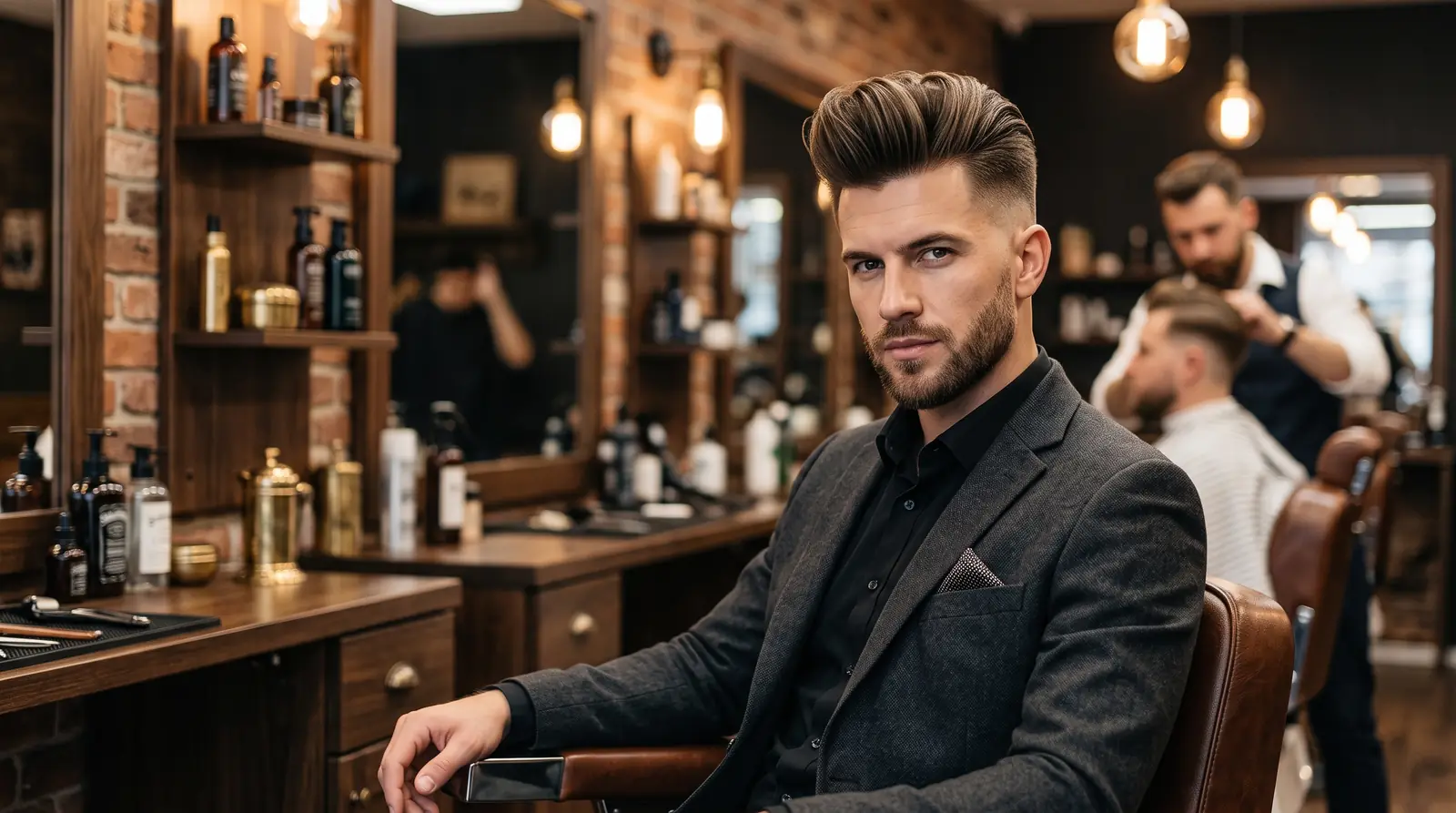
The pompadour fade is one of the most versatile and enduringly stylish haircuts in men's grooming—a cut that bridges the gap between classic barbershop elegance and modern technical precision. By combining the pompadour's signature volume on top with the clean gradient of a fade on the sides, it delivers a look that works at a job interview, a night out, and everywhere in between. In 2026, it's shed its retro associations entirely and become a genuinely wearable, everyday style that more men are requesting every year.
This guide covers everything you need to know: what makes a pompadour fade different from other styles, the major fade variations, how to match the cut to your face shape and hair type, and the exact words to use at your next barber appointment.
What Is a Pompadour Fade?
A pompadour fade combines two classic elements: the pompadour—a style where the hair on top is swept upward and backward from the forehead, creating significant volume—and a fade, where the sides and back are tapered using clippers to create a seamless gradient from short near the hairline to longer as it approaches the top.
The defining characteristic is the contrast between a voluminous, swept-back top and clean, graduated sides. The top does the heavy lifting visually: hair is grown longer (typically 3–6 inches), styled upward and back to create a prominent sweep. The sides fade from the top length downward to as short as bare skin, depending on which fade variation you choose.
Unlike the classic vintage pompadour—which featured hair slicked back with heavy pomade across the entire head—the pompadour fade specifically uses clipper work on the sides to create a gradient rather than simply combing the side hair back. The result is cleaner, sharper, and much more wearable by modern standards.
Key Characteristics of a Pompadour Fade
- Voluminous top: Hair swept upward and backward from the forehead, creating height and visual presence
- Faded sides: Gradual clipper blend from short at the base to longer near the top—no harsh lines
- Strong contrast: The juxtaposition of top volume against close-cropped sides defines the style
- Styling-dependent: The pompadour requires product and technique to hold its shape
- Versatile finish: Can range from high-gloss, slicked-back vintage to textured, matte modern
Pompadour Fade vs Similar Styles
The pompadour fade is frequently confused with related haircuts. Understanding the differences helps you choose the right style and communicate clearly with your barber.
| Feature | Pompadour Fade | Quiff Fade | Comb Over Fade | Slick Back Fade |
|---|---|---|---|---|
| Top direction | Swept back, lifted | Forward, then up | Swept to one side | Straight back, flat |
| Volume | High, front-focused | Medium, front-focused | Low to medium | Low, sleek |
| Structure | Defined, rounded peak | Looser, textured | Linear sweep | Smooth, flat |
| Best hair type | Medium to thick | All types | Thick, straight | Thick, straight |
| Styling time | 5–10 minutes | 3–5 minutes | 3–5 minutes | 3–5 minutes |
| Maintenance frequency | Every 2–3 weeks | Every 2–3 weeks | Every 2–4 weeks | Every 2–3 weeks |
The clearest distinction between a pompadour and a quiff is direction and volume. A quiff pushes hair upward and slightly forward, creating a crest near the forehead. A pompadour pushes hair backward and upward simultaneously, creating the characteristic rounded sweep and greater overall height. A slick back lies flat; a pompadour rises.
"The pompadour fade is one of the most technically demanding cuts to get right, but when it's done properly, it's also one of the most impactful. The contrast between that volume on top and the clean fade on the sides is just unbeatable." — Common sentiment from experienced barbers
Types of Pompadour Fade Haircuts
The height and type of fade dramatically changes the character of the pompadour. Here's every major variation, from subtle to bold.
Low Pompadour Fade
The low pompadour fade begins the taper just above the natural hairline, near the bottom of the ears. The sides retain significant hair length overall, and the fade itself is subtle—concentrated in the lower third of the head. The top volume is the dominant visual element, with the fade providing a clean foundation rather than high contrast.
Characteristics:
- Fade begins just above the ear, in the lower third of the head
- More hair preserved on the sides overall
- The transition from sides to top is gradual and understated
- Grows out gracefully over several weeks
Best for:
- Professional or conservative workplace environments
- Men who want pompadour styling without high contrast
- Oval, square, and heart-shaped faces
- First-time pompadour fade wearers
Maintenance: Every 3–4 weeks
Mid Pompadour Fade
The mid pompadour fade starts the taper at the temples—roughly halfway up the head. This is the most universally requested pompadour fade variation, striking an ideal balance between the clean contrast of a high fade and the subtlety of a low fade. It's sharp enough to be distinctly modern, conservative enough for most professional settings.
Characteristics:
- Fade begins at temple level, the midpoint of the sides
- Strong contrast between top volume and faded sides
- The pompadour sits visually above a distinct fade line
- Works across virtually all lifestyle contexts
Best for:
- Most face shapes, particularly oval and oblong
- Office environments and social settings equally
- Men who want a defined style without extreme contrast
- Medium to thick hair
Maintenance: Every 2–3 weeks
High Pompadour Fade
The high pompadour fade starts the taper near the crown level—the upper portion of the sides. This produces maximum contrast: the fade travels almost to the top of the head, leaving the pompadour as an isolated island of volume. The result is bold, modern, and visually striking.
Characteristics:
- Fade begins near the top of the sides, close to the crown
- Maximum visual contrast between top and sides
- The pompadour appears dramatically elevated above the fade
- Requires more frequent maintenance to stay sharp
Best for:
- Men with oblong or oval face shapes (the high fade emphasizes height)
- Bold, fashion-forward personal styles
- Athletic builds and strong jawlines
- Thick, dense hair that holds volume easily
Maintenance: Every 1–2 weeks
Skin Fade Pompadour
The skin fade pompadour—also called a bald fade pompadour—takes the fade all the way down to bare skin at the base, then builds gradually upward. Combined with a pompadour on top, the result is the highest-contrast variation in the pompadour fade family: a maximally clean foundation beneath significant top volume.
Characteristics:
- Zero guard (bare skin) at the lowest point near the hairline
- Seamless gradient from skin to the pompadour top
- The most dramatic and modern pompadour fade variation
- Shows regrowth most quickly of all fade types
Best for:
- Confident personal style, fashion-forward looks
- Oval, oblong, and diamond face shapes
- Men who visit the barber frequently (every 1–2 weeks)
- Thick, resilient hair that holds product and style
Maintenance: Every 1–2 weeks
Disconnected Pompadour Fade
The disconnected pompadour fade features a hard line—rather than a gradual blend—separating the top section from the faded sides. Rather than a smooth gradient, there is a visible, intentional line of demarcation. This creates a graphic, high-fashion look that reads as deliberately architectural.
Characteristics:
- Hard line separates top from sides (no gradual blend at the disconnect)
- Below the line: short fade or shaved; above: full pompadour volume
- Often paired with a skin fade or very high fade beneath the disconnect
- The most fashion-forward pompadour variation
Best for:
- Strong creative or fashion-industry contexts
- Diamond, oval, and square face shapes with defined bone structure
- Men who want a very distinct, intentional look
- Experienced pompadour wearers who want to push the style further
Maintenance: Every 1–2 weeks (disconnect line requires precision upkeep)
Textured Pompadour Fade
The textured pompadour fade replaces the traditional smooth, slicked-back pompadour with a more casual, piece-y finish. Rather than combing the top into a unified sweep, the hair is worked with product to create separation, movement, and a deliberate messiness. Combined with a clean fade, the effect is relaxed on top, sharp on the sides.
Characteristics:
- Top is styled for texture and separation rather than a unified sweep
- Matte or low-shine finish products used instead of high-gloss pomade
- Volume is present but more natural-looking, with visible movement
- Works with wavy and curly hair more naturally than the classic version
Best for:
- Men who find classic pompadour styling too formal
- Wavy, curly, or thick hair types
- Casual lifestyle contexts, creative industries
- Men who prefer lower daily styling effort
Maintenance: Every 2–3 weeks
Curly Pompadour Fade
The curly pompadour fade takes advantage of natural curl pattern to create volume and texture without heavy styling. Curly hair naturally wants to rise—when the curls are managed and encouraged rather than suppressed, a pompadour profile emerges organically. A clean fade on the sides frames the curls and prevents the overall shape from looking uncontrolled.
Characteristics:
- Natural curl pattern used to create pompadour volume
- Less product needed—curl provides its own structure
- Fade is critical for controlling the overall shape
- Unique, highly personalized look for each curl pattern
Best for:
- Type 2 (wavy) through Type 4 (coily) hair
- Men who want to work with their natural texture
- Oval, heart, and diamond face shapes
- Low daily styling effort with maximum visual impact
Maintenance: Every 2–3 weeks; curl care products essential
Choosing the Right Pompadour Fade for Your Face Shape
Face shape is the primary factor in selecting the right pompadour fade variation. The goal in almost every case is to approach an oval silhouette.
Oval Face
The oval face is the most balanced face shape, and it's the most versatile for pompadour fades. Almost every variation works well. If you have an oval face, choose based purely on your personal style preference and lifestyle context.
Best variations: All pompadour fade styles; particularly great with mid and high fades
Square Face
Square faces have strong, defined jawlines with similar width at the temples and jaw. The goal is to add height and soften the angularity of the jaw.
Best variations: High pompadour fade or mid pompadour fade—the added height lengthens the face proportionally; avoid very low fades that emphasize jaw width
Round Face
Round faces have soft contours with cheek width roughly equal to face length. The goal is to add apparent length and create angles.
Best variations: High pompadour fade with significant top volume—the height creates length; avoid low fades that emphasize roundness
Oblong/Rectangular Face
Oblong or rectangular faces are already long and narrow. The goal is to add width without adding more height.
Best variations: Low pompadour fade with medium volume; avoid very high fades that make the face appear even longer
Heart Face
Heart faces are wider at the temples and forehead, narrowing toward the chin. The goal is to balance the broader upper face with visual weight below.
Best variations: Low or mid pompadour fade; textured pompadour with moderate volume that doesn't further emphasize the wide forehead
Diamond Face
Diamond faces are widest at the cheekbones with narrower forehead and jaw. The goal is to add width at the forehead and jaw while keeping cheekbone prominence.
Best variations: Mid pompadour fade with moderate volume; textured or disconnected variations work well
Hair Type Considerations
Your natural hair type significantly affects how a pompadour fade will look and how much daily styling effort it requires.
| Hair Type | Challenge | Best Pompadour Variation | Product Recommendation |
|---|---|---|---|
| Straight, fine | Lacks natural volume | Classic mid or high fade pompadour | Volumizing mousse + clay |
| Straight, thick | Heavy, wants to fall forward | Low to mid skin fade pompadour | Medium-hold pomade |
| Wavy | Volume without control | Textured pompadour fade | Sea salt spray + light hold cream |
| Curly | Shape management | Curly pompadour fade | Curl-defining cream + light hold gel |
| Coily | Maximum volume, shape control | Curly pompadour fade | Moisturizing cream + edge control |
Fine, straight hair requires the most effort to maintain pompadour volume—volumizing products and blow-drying with a round brush are essential. Thick, straight hair falls naturally with weight, requiring a strong-hold pomade to maintain the sweep. Curly and wavy hair types often create pompadour shapes more easily but need product to define the profile and keep the sides clean.
How to Style a Pompadour Fade at Home
Getting the pompadour to hold between barber visits requires consistent technique. Here's the step-by-step process used by professional barbers and stylists.
What You'll Need
- Hair dryer with concentrator nozzle
- Boar bristle brush or comb
- Pomade, clay, or wax (medium to strong hold)
- Optional: volumizing mousse for fine hair
Classic Pompadour Styling Process
Step 1: Start with damp hair Apply your product to damp hair, not soaking wet. Towel-dry first, then work a small amount of pomade or clay evenly through the top section. Start with less product than you think you need—you can always add more, but too much kills volume.
Step 2: Section the hair Use a comb to section off the top (pompadour) portion from the sides. This mental boundary helps you focus the styling work where it needs to go.
Step 3: Blow-dry for volume Point the hair dryer at the front hairline, directing heat upward and backward while using your brush or comb to train the hair in that direction. The heat sets the lift. Work from front to back, always directing the airflow against the direction of natural growth to maximize volume.
Step 4: Shape the sweep While the hair is still warm (heat makes it most malleable), use your comb or your fingers to shape the sweep. Push the front upward and backward—the crest of the pompadour should sit just behind the hairline, not directly at it.
Step 5: Lock it in Once the shape is established, use a light blast of cool air from the hair dryer to set it. Cool air closes the hair cuticle and helps the style hold longer.
Step 6: Finish and refine Apply a small amount of additional product to the surface—no more than a pea-sized amount—and smooth any flyaways or stray hairs. Use a comb or your hands to refine the edges.
Matte vs. Gloss Finish
The finish you choose changes the entire character of the pompadour:
- High-gloss pomade: Classic, vintage look. Think 1950s barbershop. Strong hold, difficult to wash out. Best for very defined, structured pompadours.
- Medium-shine clay: The modern default. Strong hold, buildable texture, matte to medium shine. Most versatile option.
- Matte paste: Textured, natural-looking finish. Low shine, medium hold. Best for the textured pompadour variation.
- Water-based pomade: Easy to wash out, reworkable throughout the day. Good hold, medium shine. Best for men who restyle during the day.
Pompadour Fade Maintenance Schedule
| Fade Type | Touch-Up Frequency | Full Restyle |
|---|---|---|
| Skin fade pompadour | Every 1–2 weeks | Every 4–6 weeks |
| High pompadour fade | Every 1–2 weeks | Every 4–6 weeks |
| Mid pompadour fade | Every 2–3 weeks | Every 6–8 weeks |
| Low pompadour fade | Every 3–4 weeks | Every 8–10 weeks |
| Disconnected pompadour | Every 1–2 weeks | Every 4–6 weeks |
The pompadour itself rarely needs a full restyle between appointments—the top section grows slowly, and the shape can usually be maintained with product alone. The fade on the sides shows regrowth most quickly. A "touch-up" appointment addresses the sides only, while a "full restyle" includes reshaping the top.
What to Tell Your Barber
Clear communication is the difference between the pompadour fade you envisioned and something that misses the mark. Use this language:
For the top:
- "Leave X inches on top—I want enough length to style a pompadour"
- "I want the front swept back with volume—a pompadour shape"
- "Keep it texturized on top" (for textured variation) or "I want a smooth, clean sweep" (for classic)
For the fade:
- "Low fade starting just above the ear" / "Mid fade starting at the temples" / "High fade starting near the crown"
- "Skin fade on the sides" (if you want bare skin at the base)
- "Disconnected—I want a hard line, not a blend" (for disconnected variation)
For overall length:
- "Take [X] off the length on top but leave enough to style a pompadour—at least 3 inches"
- "I want to maintain the current length, just clean it up"
Bring a reference photo. For pompadour fades specifically, a photo is worth a thousand words. Save two or three images that represent the exact fade height, top length, and finish you want. Show them at the start of the appointment.
Frequently Asked Questions
How long does hair need to be to style a pompadour fade? At minimum, 2.5 to 3 inches on top to create a recognizable pompadour sweep. For a more dramatic pompadour with significant height, 4 to 6 inches is ideal. The sides can be any length depending on the fade variation you choose.
Does a pompadour fade work with thinning hair? Yes, with some adjustments. A low pompadour fade with a mid-length top and volumizing products can create the appearance of density. Avoid very high fades that draw attention to the contrast between sparse top and shaved sides. Thickening sprays and matte clays work better for thinning hair than heavy pomades.
How do I keep the pompadour from collapsing during the day? Use a clay or paste rather than a pomade—these have more grip and flexibility, and the hold doesn't break down as quickly with humidity or sweat. Blow-dry thoroughly (heat-set is more durable than air-dry), and use a small amount of product on the surface to lock in the shape after styling.
What's the difference between a pompadour fade and an undercut pompadour? A pompadour fade uses a gradual clipper gradient (fade) on the sides—no harsh lines. An undercut pompadour uses scissors or clippers to create a hard, disconnected line between the long top and the short sides, without a gradual blend. The undercut is more graphic; the fade is more seamless.
Can I get a pompadour fade with curly or wavy hair? Absolutely. Curly and wavy hair often creates pompadour shapes more naturally than straight hair, since the curl provides built-in volume and lift. The key is working with the natural texture rather than against it—use curl-friendly products and let the natural pattern define the sweep.
How often should I get my pompadour fade touched up? For skin fades and high fades, every 1–2 weeks to maintain the clean gradient. For mid fades, every 2–3 weeks. For low fades, every 3–4 weeks. The top section can often go longer between full recuts—it's the fade on the sides that shows growth most quickly.
Final Thoughts
The pompadour fade is one of the few haircuts that simultaneously references a century of style history while remaining genuinely current. The formula is timeless: volume and presence on top, technical precision on the sides, and a contrast between the two that creates a cut that simply looks intentional. Whether you go classic and slicked-back or textured and modern, skin-faded or low-tapered, the pompadour fade is a cut built to be worn with confidence.
Bring your reference photos, communicate clearly with your barber, invest in the right products for your hair type, and you'll have one of the sharpest haircuts available in 2026.