

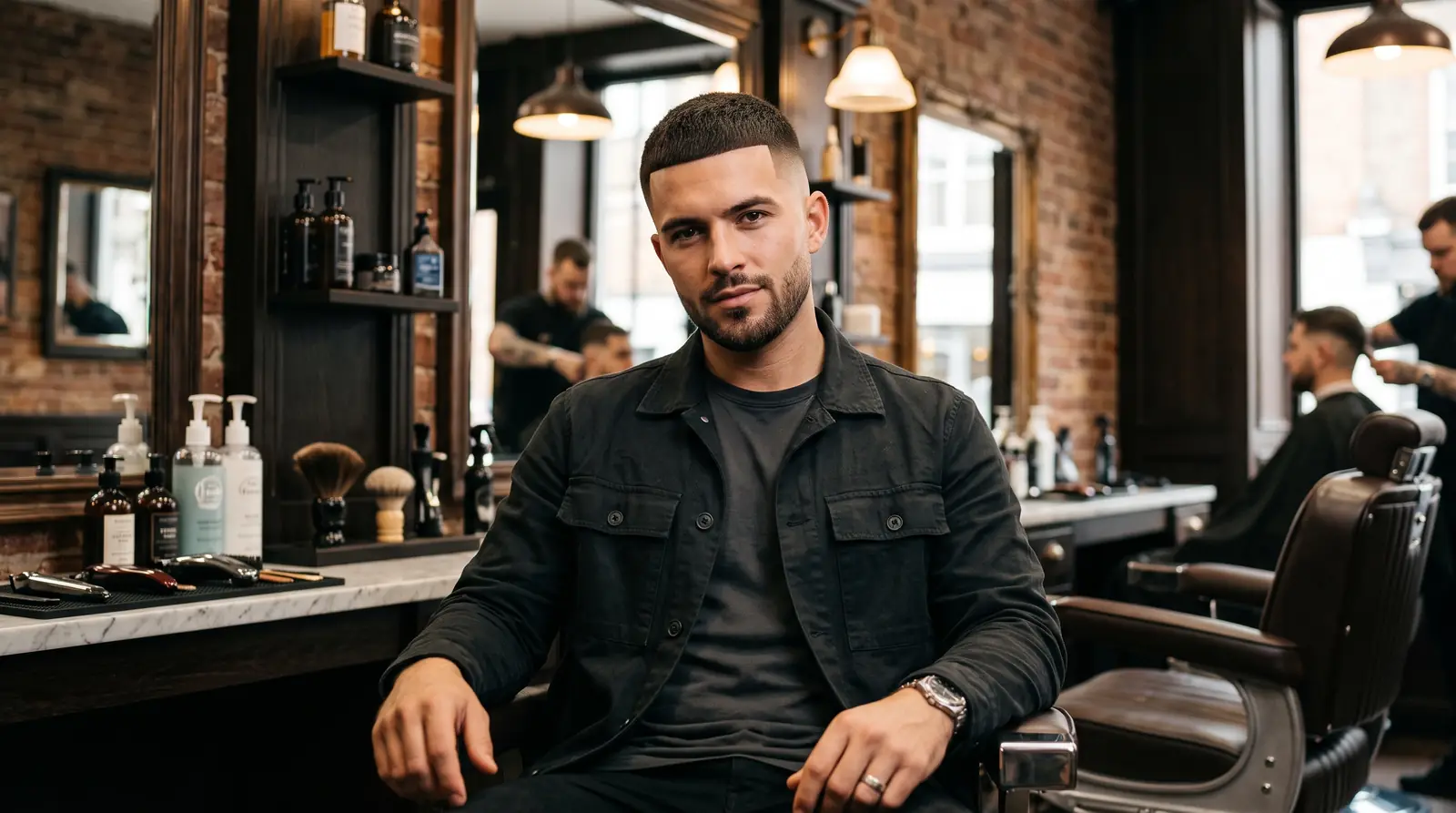
The buzz cut fade is one of the cleanest, most versatile men's haircuts you can get — and it remains one of the most popular choices in barbershops worldwide in 2026. It's effortless to maintain, works across virtually every setting, and the addition of a fade elevates what was once a strictly utilitarian cut into something genuinely polished. If you want a low-effort style that still looks deliberate and sharp, the buzz cut fade is one of the most effective answers.
This guide covers everything: what defines a buzz cut fade, how it compares to similar styles, all the fade variations available, how to match the right version to your face shape and hair type, and exactly how to communicate what you want to your barber.
What Is a Buzz Cut Fade?
A buzz cut fade combines the classic buzz cut — uniform short length all over using clippers — with a clipper fade on the sides and back that blends from short or skin at the base up toward the buzzed top. The result is a structured gradient that replaces the blunt line of a basic buzz cut with a smooth, professional transition that makes the whole style look intentional.
The standard buzz cut has been a military and athletic staple for decades. It's defined by clipper-cut uniform length across the entire head — no styling, no variation, just clean, functional shortness. The buzz cut fade introduces a key design element: the sides and back are cut shorter than the top, with a gradual clipper gradient fading them out toward the neckline and temples. The top stays buzzed but remains noticeably longer than the faded sides, creating a clean contrast.
What separates a buzz cut fade from a standard buzz cut is that gradient — the smooth blend from very short or skin at the sides into the slightly longer top length. That blend is what requires a skilled barber and what distinguishes the cut from something you do at home.
Key Characteristics of a Buzz Cut Fade
- Uniform buzz on top: Typically a number 2–4 guard (0.25–0.5 inch) across the crown
- Faded sides: Smooth clipper gradient blending from shorter length or skin at the base upward
- Defined separation: Clear visual contrast between the buzzed top and the faded sides
- Clean neckline: Squared, rounded, or naturally tapered at the nape
- Zero styling required: The structure of the cut works on its own — no product needed
Buzz Cut Fade vs Similar Styles
The buzz cut fade sits close to several other popular short styles. Understanding the differences helps you choose — and communicate with your barber.
| Feature | Buzz Cut Fade | Crew Cut Fade | Skin Fade | High and Tight |
|---|---|---|---|---|
| Top length | Number 2–4 (0.25–0.5 inch) | 0.5–1.5 inches | Variable | Number 1 or less |
| Top texture | Uniform buzz, no styling | Slightly styled front | Varies | Flat, very short |
| Fade position | Low, mid, or high | Low, mid, or high | Any | High (above temple) |
| Styling required | None | Minimal | None to minimal | None |
| Versatility | Very high | Very high | High | Military/athletic |
| Maintenance | Every 2–3 weeks | Every 2–3 weeks | Every 1–2 weeks | Every 1–2 weeks |
The buzz cut fade's advantage over a standard crew cut is its simplicity — there's nothing on top to style or manage. Compared to a skin fade alone, the buzz cut fade has a defined top length that adds structure. Compared to a high and tight, it's less severe and reads as casual-to-professional rather than strictly military.
Buzz Cut Fade Variations
Low Buzz Cut Fade
The fade begins at or just above the ear, blending down toward the neckline. This is the most conservative and workplace-friendly variation. The sides taper gradually, which makes the transition subtle rather than dramatic. It grows out gracefully and suits most face shapes.
Best for: Professional environments, older men, men with rounder faces, anyone new to fades
Mid Buzz Cut Fade
The fade starts at the mid-temple — roughly halfway up the side of the head. This is the most common version and what most people picture when they say "buzz cut fade." The contrast between the top and sides is noticeable but not aggressive. It reads as clean without being extreme.
Best for: Most men, most settings, the best all-around balance of modern and classic
High Buzz Cut Fade
The fade begins at or near the top of the temple, creating strong contrast and a sharp visual separation between the buzzed top and the faded sides. This is the most contemporary and bold version — it looks sharp but can read as more casual or urban.
Best for: Men with oval or longer face shapes, those wanting a strong visual statement, younger men
Skin Buzz Cut Fade
The sides and back are faded completely to the skin before blending up into the buzzed top. This is the most dramatic version — clean, precise, and striking. It requires more frequent maintenance (every 1–2 weeks) as the faded section grows back quickly.
Best for: Men who want maximum contrast, those with defined features, frequent barbershop visitors
Taper Buzz Cut Fade
A more subtle variation where the sides taper gradually rather than fading sharply. The neckline and sides are shorter than the top, but the gradient is more conservative — closer to a classic taper than a full fade. This is the most traditional and understated option.
Best for: Older professionals, men wanting minimal contrast, conservative dress codes
Choosing the Right Buzz Cut Fade for Your Face Shape
Oval Face
Oval faces suit every buzz cut fade variation. The balanced proportions mean there's no correction needed — you can go low, mid, or high fade depending on your preference. A mid or high fade enhances the face's natural structure.
Round Face
A mid or high buzz cut fade helps elongate a round face by creating vertical visual lines and adding contrast at the sides. Avoid a low fade — it keeps volume around the widest part of the face and can make it look broader.
Square Face
A low to mid buzz cut fade works best. The natural structure of a square face is already strong; a very high or skin fade can make it look overly angular. A lower fade softens the jawline slightly and maintains balance.
Oblong or Rectangular Face
A low or mid fade is ideal — it keeps some width at the sides, which balances a longer face. A high or skin fade would accentuate the length and make a rectangular face look more elongated.
Diamond Face
A mid fade works well for diamond faces. Avoid a very high fade, which would emphasize the narrow forehead and chin. The mid fade draws attention to the cheekbones, which are the feature strength of a diamond face.
Heart Face
A low to mid fade balances a heart-shaped face by maintaining some weight at the sides near the jaw. A skin or high fade would accentuate the wider forehead and narrow chin contrast.
Buzz Cut Fade for Different Hair Types
Straight Hair
Straight hair shows the buzz cut fade at its cleanest — the lines are sharp, the fade blends precisely, and the top has a smooth, even texture. Any fade variation works well.
Wavy Hair
Wavy hair adds subtle texture to the buzzed top. The fade still looks clean, but the top has a slightly softer appearance. A number 3 or 4 on top tends to look best with wavy hair as it shows the texture without looking messy.
Curly Hair
Curly hair buzzed short creates a distinctive texture contrast with the smooth faded sides. A number 3–4 guard leaves enough curl to show, while shorter guards (number 1–2) minimize the curl. Both work — it comes down to preference.
Coarse or Thick Hair
Thicker hair holds the buzz well and can look very clean when faded. A mid to high fade with a number 3–4 on top tends to look sharp. Coarse hair may require more frequent touch-ups as it grows back quickly.
Fine Hair
Fine hair benefits from the buzz cut fade because the uniform short length minimizes the appearance of thinning. The fade draws attention away from hair density and toward the cut structure itself. This is one of the best styles for men concerned about fine or thinning hair.
How to Tell Your Barber What You Want
Being specific with your barber ensures you get exactly what you're after. Here's what to communicate:
- Top length: Give a guard number — "number 3 on top" is clear and precise
- Fade position: Low, mid, or high — or describe where on your head it should start
- Fade type: Skin fade, low fade, taper — or show a reference photo
- Neckline: Squared, rounded, or naturally tapered
- Blend style: Hard line between top and sides, or gradual blend
Example script: "I want a buzz cut fade — number 3 on top all over, mid fade on the sides starting around the temple, faded down to a number 1 at the bottom. Square neckline, please."
Bring a reference photo when in doubt. Barbers are visual — a photo eliminates ambiguity entirely.
Buzz Cut Fade Maintenance
The buzz cut fade is one of the lowest-maintenance styles available, but it does need regular upkeep to stay sharp.
How Often to Get it Cut
- Mid to high fade: Every 2–3 weeks to maintain the fade gradient
- Skin fade: Every 1–2 weeks as the faded area grows back quickly
- Low fade or taper: Every 3–4 weeks is often sufficient
Between Visits
- No product needed: The cut works without any styling product
- Optional: A light matte clay or pomade can define the top if you want a more finished look
- Scalp care: With short hair, your scalp is more visible — use a moisturizer if you have dry or flaky skin
- Sun protection: Short buzzed hair provides minimal sun protection — apply SPF to your scalp in sun exposure
At-Home Touch-Ups
Some men maintain the top length at home between barber visits using a clipper with the right guard. The fade itself is harder to replicate — leave that to the barber. Focus home clipping on the top length only if you're comfortable.
Buzz Cut Fade Styling Tips
The buzz cut fade is intentionally a no-styling style, but a few optional finishing touches can refine the look:
- Matte clay, very small amount: Rub between palms and apply to the top for definition without shine
- Scalp moisturizer: Keeps the skin healthy under short hair — especially visible with a skin fade
- Beard pairing: A buzz cut fade pairs exceptionally well with a short beard or stubble — the combination creates strong facial framing
- Line-up: Adding a crisp line-up at the hairline and temples creates a sharper, more defined look
Common Buzz Cut Fade Mistakes to Avoid
Asking for too short too soon. If you're new to very short cuts, start with a number 3 or 4 on top rather than a 1 or 2. You can always go shorter next visit.
Not specifying fade position. Without guidance, barbers default to their standard — which varies. Always specify low, mid, or high.
Skipping the reference photo. If you're unsure how to describe what you want, show a photo. It eliminates guesswork.
Waiting too long between cuts. The fade looks best when it's fresh. Letting it grow past 4 weeks usually means it needs a full restyle rather than a quick tidy-up.
Ignoring the neckline. The neckline detail matters — specify squared, rounded, or tapered based on your preference and neck shape.
Frequently Asked Questions
Is a buzz cut fade good for a receding hairline? Yes — the buzz cut fade is one of the best styles for receding hairlines. The uniform short top reduces contrast between areas of different hair density, while the faded sides create a structured look that doesn't draw attention to hairline recession.
Can I get a buzz cut fade with very short hair? Yes. Even a number 1 guard on top can be faded — the fade would blend from skin at the bottom to the very short top length. The contrast is minimal but still creates structure.
How much does a buzz cut fade cost? A standard buzz cut fade at a quality barbershop typically ranges from $25–$50 depending on location and barber. Skin fades or more technical work may be on the higher end.
Is the buzz cut fade a good choice for thinning hair? It's one of the best choices. Short, uniform length minimizes the visual difference between thinner and thicker areas. Many men find a buzz cut fade actually improves the appearance of thinning hair versus longer styles that draw attention to it.
What's the difference between a buzz cut fade and a taper fade? A buzz cut fade has a uniform buzz on top with a gradual clipper gradient on the sides. A taper fade refers specifically to the fade starting low and blending gradually — it's a fade position and style, not a top-cut description. You can have a buzz cut with a taper fade (starting low).
Final Thoughts
The buzz cut fade is one of the most enduring men's haircuts for good reason: it looks clean, requires almost no effort to maintain, and suits a wide range of face shapes, hair types, and style preferences. Whether you want a subtle low fade for the office or a sharp skin fade for maximum contrast, the buzz cut fade delivers.
The key is communicating clearly with your barber — tell them your top guard number, fade position, and neckline preference. With that information, any skilled barber can give you a precisely executed buzz cut fade that works for your specific face and hair.
Ready to try it? Bring a reference photo, keep it simple, and you'll walk out of the barbershop with one of the cleanest cuts in men's grooming.
Preview It Before the Clippers
The fastest way to decide is to see it on yourself: the buzz cut fade preview tool puts this exact cut on your own photo in about 30 seconds. Or browse other looks with BaldFade's AI preview tool.