

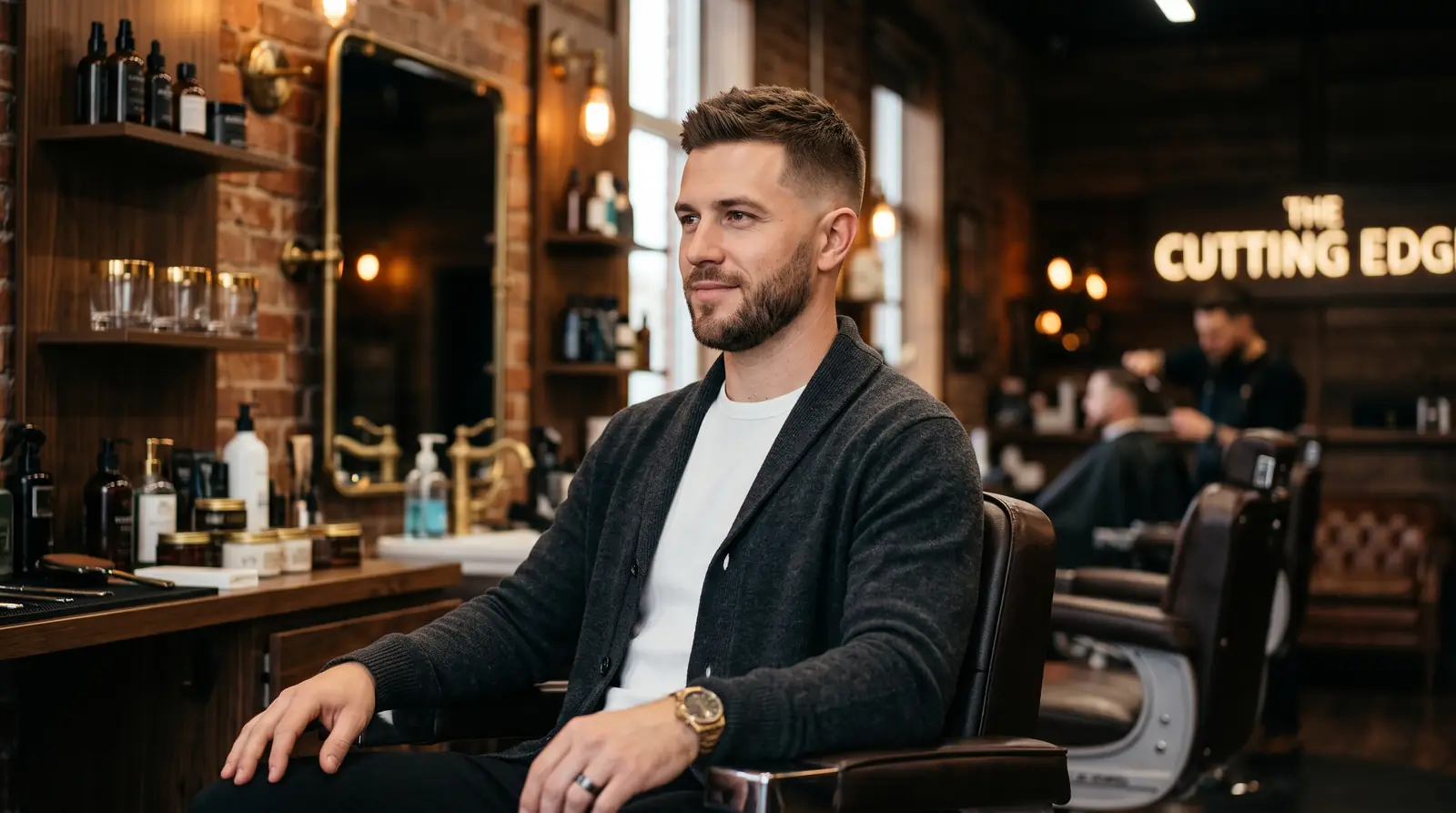
The crew cut fade is the most enduringly popular men's haircut in the world — and in 2026, it remains at the top of that list for good reason. It's clean, versatile, low-maintenance, and works across virtually every setting from job interviews to weekend barbecues. The addition of a clipper fade to the classic crew cut transforms a utilitarian military cut into a precision-crafted modern style with real visual impact.
This guide covers everything you need to know: what defines a crew cut fade, how it differs from similar styles, all the fade variations you can choose from, how to match the right version to your face shape and hair type, and exactly how to communicate what you want to your barber.
What Is a Crew Cut Fade?
A crew cut fade combines the classic crew cut — short on top, progressively longer at the front, tapered sides — with a clipper fade that blends the sides and back into the skin or a very short length. The result is a structured, polished look that takes the no-frills crew cut and adds a level of technical precision that elevates it from basic to sharp.
The traditional crew cut was developed for military personnel in the mid-20th century. The defining features are a short, uniform top — typically between half an inch and an inch — with the front slightly longer to allow for a small degree of styling. The sides are shorter than the top and taper toward the ears and neck. The crew cut fade keeps all of this structure and adds a modern gradient on the sides that gives the cut a clean, barbered finish.
What separates the crew cut fade from simply "a crew cut with short sides" is the fade itself — a seamless gradient from very short or skin at the temples and nape, blending upward into the natural length of the sides and top. This blend requires skill and precision that distinguishes a professional cut from a home clipper job.
Key Characteristics of a Crew Cut Fade
- Short, structured top: Typically 0.5–1.5 inches on top, slightly longer at the front hairline
- Faded sides: Smooth clipper gradient from short or skin at the base to the natural length near the top
- Tapered neckline: Clean, defined neckline — either straight, rounded, or tapered naturally
- Length contrast: Clear visual difference between the top and the faded sides
- Low maintenance styling: The structure of the cut holds without product for most hair types
Crew Cut Fade vs Similar Styles
The crew cut fade sits in a crowded neighborhood of short, clean men's haircuts. Here's how it compares to the styles it's most often confused with:
| Feature | Crew Cut Fade | Buzz Cut Fade | Ivy League Fade | High and Tight |
|---|---|---|---|---|
| Top length | 0.5–1.5 inches | Uniform short (0.25–0.5 inch) | 1.5–2.5 inches | Very short (0.25 inch) |
| Top styling | Minimal or light pomade/clay | None needed | Can be parted/combed | None |
| Front length | Slightly longer | Same as crown | Noticeably longer, side part | Same as crown |
| Fade type | Low, mid, high, or skin | Low, mid, high, or skin | Low or mid | High or skin |
| Formality | Versatile, professional | Casual to professional | Polished, professional | Military/athletic |
| Versatility | Very high | High | High | Lower |
The crew cut fade's advantage is its balance: it's shorter and cleaner than the Ivy League but has more styling potential than a buzz cut. It reads as professional without being severe.
Crew Cut Fade Variations
Low Crew Cut Fade
The fade starts at or just above the ear and blends down toward the neckline. This is the most conservative and versatile version — it works in professional settings, suits most face shapes, and grows out gracefully. If you're unsure which crew cut fade to get, start here.
Best for: Professional environments, first-time crew cut fade wearers, men wanting a subtle style upgrade
Mid Crew Cut Fade
The fade begins at the mid-temple — roughly halfway up the side of the head. This is the most popular variation and the one most people picture when they say "crew cut fade." It creates strong visual contrast between the top and sides without being as aggressive as a high fade.
Best for: Most men, most settings, the ideal balance of clean and casual
High Crew Cut Fade
The fade reaches up to or just below the temples, leaving the top section of the head with natural-length hair on a very narrow crown of sorts. The high fade crew cut is the most dramatic version — it creates maximum contrast and looks best when the top is kept very short and the styling precise.
Best for: Athletic builds, oval and square faces, men who want a bolder statement
Skin Crew Cut Fade (Bald Fade)
The sides are tapered completely to the skin at the base, with the fade blending from bare skin up into the short top length. The skin crew cut fade demands technical skill from your barber and requires more frequent touch-ups to look its best — but the result is razor-sharp contrast that makes the crew cut structure unmistakably defined.
Best for: Confident style statements, darker hair (the contrast is maximized), professional athletes and those in image-conscious industries
Taper Fade Crew Cut
Unlike the full side fades above, a taper fade focuses the blend at the sideburns and neckline — the fade is subtle and doesn't ride high up the sides. The result is a more traditional, conservative look that's very workplace-appropriate.
Best for: Conservative dress codes, traditional workplaces, older men who want a modern update without a dramatic change
Textured Crew Cut Fade
The same fade on the sides as a standard crew cut fade, but the top is cut with point-cutting or razor work to add texture and movement rather than a blunt, uniform length. The textured version works particularly well for men with naturally wavy or thick hair.
Best for: Thick hair, wavy hair, men who want more visual interest on top
Choosing the Right Crew Cut Fade for Your Face Shape
Oval Face
Oval is the most balanced face shape — most crew cut fade variations work well. The mid and high fade versions look particularly strong because they enhance the natural proportions. You have the most flexibility: experiment with the skin fade or high fade for a bolder look.
Best variations: Mid crew cut fade, high crew cut fade, skin fade crew cut
Square Face
Square faces have a strong, defined jawline with roughly equal width at the forehead and jaw. The crew cut fade works exceptionally well here — the clean sides and structured top echo the angular qualities of the face without overpowering them. Avoid very high fades that add height, which can make the face appear boxy.
Best variations: Low or mid crew cut fade, taper fade crew cut; keep the top length on the shorter side
Round Face
Round faces benefit from height at the crown to elongate the overall appearance. The crew cut fade creates this effect naturally by drawing the eye upward. A slightly taller top (toward 1.5 inches) paired with a high or mid fade creates the best elongating effect.
Best variations: Mid or high crew cut fade with a slightly taller, more defined top; avoid very low fades that keep width at the sides
Oblong / Rectangular Face
Oblong faces are already long — the goal is to avoid adding more height. Keep the top short (0.5–0.75 inch) and opt for a low fade that preserves some width at the sides. Avoid high fades and very tall tops.
Best variations: Low crew cut fade, taper fade; shorter top length
Heart Face
Heart faces are wider at the forehead and temples, narrowing toward the chin. The crew cut fade works well here — the fade naturally reduces apparent width at the temples. Keep the fade at low to mid height and avoid very high skin fades that further thin the sides.
Best variations: Low or mid crew cut fade, taper fade
Diamond Face
Diamond faces have prominent cheekbones with a narrower forehead and jaw. The crew cut fade's clean sides keep the cheekbone area tidy. A mid fade with a slightly fuller top creates balance between the narrow forehead and the wider midface.
Best variations: Mid crew cut fade with moderate top length
Hair Type Considerations
| Hair Type | Challenge | Best Crew Cut Fade Variation | Product Recommendation |
|---|---|---|---|
| Straight, fine | Lays flat, appears thin | Textured crew cut fade with layers | Volumizing clay or matte paste |
| Straight, thick | Can appear heavy, falls forward | Mid or high fade with blunt top | Medium-hold clay |
| Wavy | Volume and frizz | Textured crew cut fade | Sea salt spray or light cream |
| Curly | Shape management | Mid or high fade, longer textured top | Curl cream + light hold |
| Coily | Volume control | High or skin fade with defined top | Moisturizing cream |
Fine, straight hair benefits most from a textured crew cut — the point-cutting adds dimension that a blunt crop won't provide. Thick, straight hair can handle any version but looks best with a firm-hold product to control bulk. Curly and wavy hair naturally adds visual interest on top, so the fade can do more of the heavy lifting.
How to Tell Your Barber What You Want
The crew cut fade has enough variations that vague instructions often result in something different from what you pictured. Use these specific phrases:
For a mid fade crew cut: "I want a crew cut with a mid fade. Take the sides down to about a 1 or 0.5 on the bottom, fade up to blend with the top. Keep the top around an inch, maybe a little longer at the front. Square off the neckline."
For a skin fade crew cut: "Skin fade on the sides — start bare skin at the base, blend up smoothly. Leave an inch on top, uniform length, slightly longer in the front. Keep the neckline squared."
For a taper fade crew cut: "Crew cut, keep the sides natural length up top but taper it in at the neckline and sideburns. No high fade — just a subtle taper. Top around an inch."
What to bring: Photos are the most reliable communication tool. Find 2–3 reference images on Google or Instagram showing the exact fade height and top length you want. Even experienced barbers benefit from seeing a visual target.
Styling a Crew Cut Fade
One of the crew cut's biggest advantages is that it requires minimal styling — the cut does most of the work. But the right product and technique can refine the look significantly.
Step-by-step styling:
- Start with slightly damp or dry hair — the crew cut doesn't require wet styling
- Take a small amount of product (pea- to dime-sized depending on hair thickness) and rub between your palms
- Work through the top from back to front, distributing evenly
- Use your fingertips to push the front hair slightly upward and backward — the classic crew cut "slope" from front to back
- If you want definition, use a fine-tooth comb to set the shape
- For a more natural look, use your fingers and leave slight texture
Product guide:
- Matte clay: Best all-purpose option — provides hold without shine, works on all hair types, easy to rework throughout the day
- Pomade (water-based): Adds shine and a slicker finish for a more polished look; washes out easily
- Paste: Similar to clay but with slightly more shine and lighter hold — good for fine hair
- Wax: Strong hold, moderate shine — good for thick hair that needs control
- No product: Completely valid for the crew cut — many men wear it without anything and the cut holds its shape naturally
Crew Cut Fade Maintenance Schedule
The crew cut fade is one of the lower-maintenance haircuts available — but maintaining it at its sharpest requires discipline:
Every 2–3 weeks: The fade needs refreshing. This is the most critical maintenance window for the crew cut fade — fades grow out faster than they appear, and by 3 weeks the sides can start looking shaggy rather than sharp.
Every 3–4 weeks: Full cut to re-establish the top length and re-do the fade from scratch. At this frequency, the cut always looks intentional.
Between cuts: The crew cut needs almost no at-home maintenance. A quick application of product takes 30 seconds. That's the whole routine.
Growing it out: If you decide to move to a longer style, the crew cut grows into an Ivy League or a longer textured cut gracefully. You'll need to get the sides trimmed while the top grows — keep the fade fresh while adding length on top over 2–3 months.
Crew Cut Fade for Different Ages
The crew cut fade is one of the few haircuts that works across age groups without adjustment:
Teens and 20s: Any variation works — the skin fade and high fade look particularly strong. Experiment with textured tops and bolder fade heights.
30s and 40s: The mid fade and taper fade versions are the most workplace-versatile. The textured crew cut fade adds dimension that counters any thinning without looking forced.
50s and beyond: The taper fade and low crew cut fade offer a modern update without being aggressive. The clean structure of the crew cut naturally looks sharp without relying on styling.
For thinning hair: The crew cut fade is genuinely one of the best haircuts for men with thinning hair. The short, uniform top reduces the appearance of thinning at the crown. A mid fade keeps the sides proportional. Avoid skin fades if your scalp is visible at the crown — the contrast can draw more attention to thinning.
Frequently Asked Questions
How is a crew cut fade different from a regular crew cut? A regular crew cut has tapered sides that gradually get shorter toward the ears — but the taper is subtle and blended without clipper fade technique. A crew cut fade uses clipper guards to create a precise gradient, typically from very short or skin at the base up to the natural length near the top. The result is sharper, more defined, and more visually impactful.
How often should I get my crew cut fade touched up? Every 2–3 weeks for the fade specifically. The sides grow out faster than the top and the fade definition fades (literally) quickly. If you want your crew cut to always look sharp, treat it like an ongoing grooming commitment, not a haircut you get every 6 weeks.
Can I get a crew cut fade with curly hair? Yes. Curly hair works very well with a crew cut fade — the natural texture on top adds visual interest that straight hair has to work for with product and technique. A mid or high fade lets the curls on top breathe. Keep a small amount of curl-defining cream on hand to keep the top from frizzing.
Is the crew cut fade appropriate for professional settings? Absolutely. It's one of the most universally professional men's haircuts available. The low fade and taper fade versions are particularly conservative. Even the skin fade version reads as athletic and intentional rather than unprofessional in most modern workplaces.
What's the difference between a crew cut fade and a buzz cut fade? The main difference is top length and structure. A buzz cut uses a single uniform guard length across the entire head — there's no length variation from front to back on top. A crew cut maintains more length on top (typically 0.5–1.5 inches), with the front slightly longer than the crown, creating a more structured silhouette. The buzz cut fade is lower-maintenance; the crew cut fade has more styling potential.
How do I ask for a crew cut fade if I'm not sure what guard to use? Tell your barber how much length you want to keep on top (in inches, or use your finger to show the length from your scalp). Then specify the fade height: low (at the ear), mid (mid-temple), or high (near the top of the temple). Your barber will select the appropriate guards for the blend. If you're uncertain, ask for a mid fade — it's the most balanced option.
The Crew Cut Fade in 2026
The crew cut fade has never gone out of style and shows no sign of doing so in 2026. Its staying power comes from genuine versatility: it adapts to any hair type, any face shape, any lifestyle, and any dress code. It photographs well, requires minimal morning effort, and communicates a kind of effortless discipline that never reads as trying too hard.
The modern crew cut fade in 2026 leans into precision. Barbers are taking more care with the fade blend, using multiple guard sizes to create smoother gradients than the blunt tape fades of previous decades. The textured top variation has gained ground — more texture, slightly more length, still clean. The skin fade version remains popular in fitness and sports communities. The taper fade version persists in traditional professional settings.
If you're looking for a haircut that will serve you reliably across the next several years, that grows out gracefully, that requires minimal daily effort, and that looks professional in every environment: the crew cut fade is the answer.