

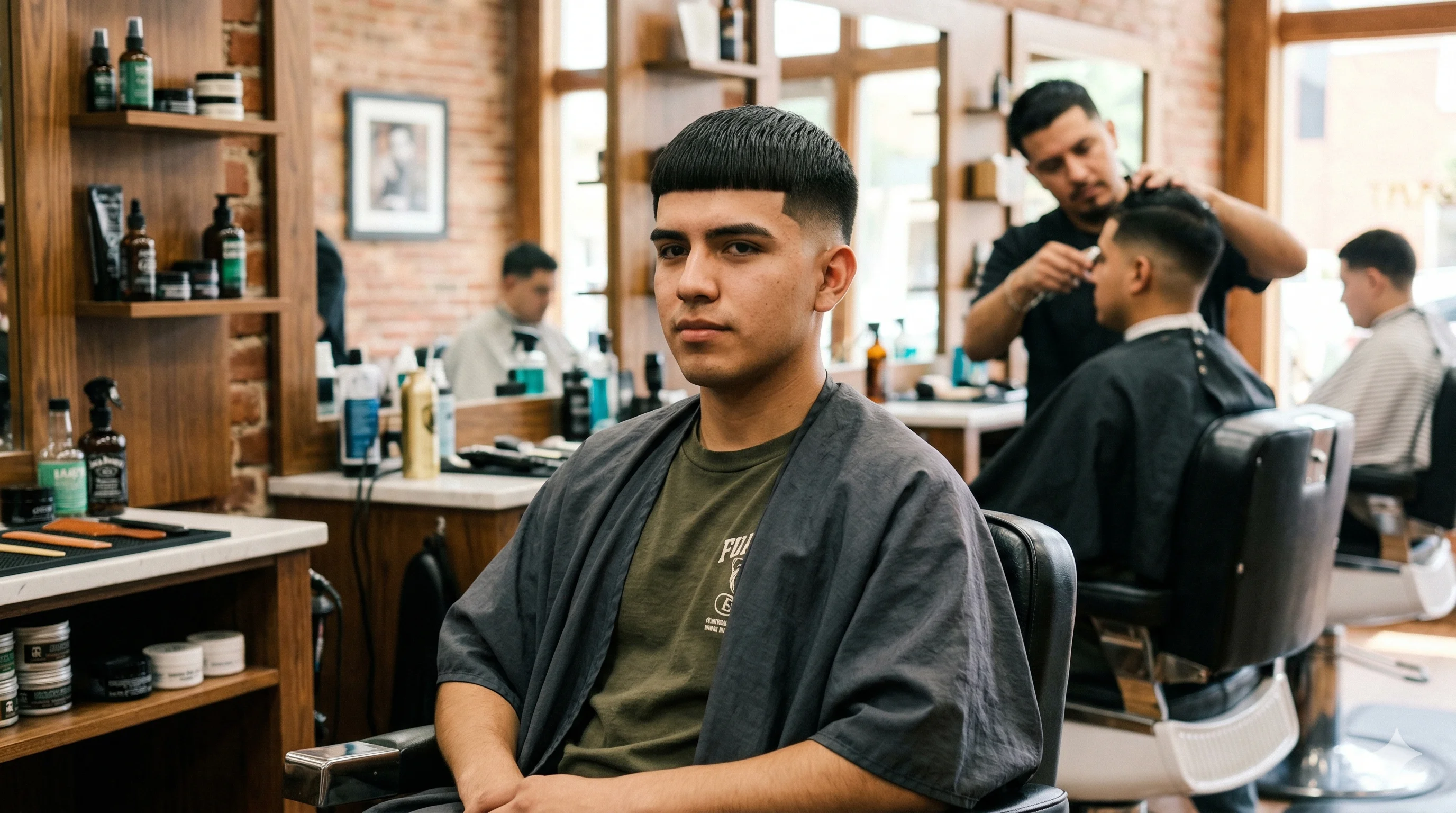
The Edgar cut is one of the most recognizable and boldly modern haircuts of the past decade—and in 2026, it shows no sign of slowing down. Defined by a blunt, horizontal fringe that cuts straight across the forehead, a sharp line-up, and tightly faded sides, the Edgar is the cut that built its reputation on attitude and precision. It's simultaneously one of the sharpest and most culturally significant styles in contemporary barbering.
Rooted in Latino and Mexican-American barbershop tradition, the Edgar cut spread globally through TikTok, Instagram, and the broader influence of Gen Z style culture. Today, you'll find it on every continent, adapted across countless hair types, fade heights, and top lengths. But the hallmarks remain consistent: the blunt fringe, the defined perimeter, and the perfectly executed fade.
This guide covers everything you need to know about the Edgar cut fade: what it is, how it differs from similar styles, every major variation, how to choose the right version for your face shape and hair type, and exactly what to say to your barber.
What Is an Edgar Cut?
The Edgar haircut is a men's cut characterized by a short, blunt fringe that falls horizontally across the forehead, a precise line-up at the temples and hairline, and a fade on the sides and back that can range from low to high depending on personal preference. The top is kept relatively short and dense, preserving enough length to create the signature square-shaped silhouette.
The name "Edgar" is widely attributed to the barber community, with some tracing it to a client named Edgar who first popularized the style at a barbershop in California. Others connect it to the broader tradition of Latino barbering aesthetics that emphasize geometric precision, sharp hairlines, and bold contrast. Regardless of exact origin, the style is deeply embedded in Mexican and Mexican-American barbering culture—and has since become a global mainstream staple.
Key Characteristics of an Edgar Cut
- Blunt horizontal fringe: The defining feature—hair across the forehead is cut in a straight, crisp line parallel to the floor
- Sharp line-up: Razor-defined hairline at the temples, forehead, and around the ears
- Faded sides: Clean fade on the sides and back, with height varying by preference
- Short, dense top: Hair on top is kept short enough to maintain the flat, structured silhouette
- High contrast: The combination of blunt top and faded sides creates dramatic visual contrast
- Strong geometric shape: The overall cut creates a distinctly angular, architectural look
Edgar Cut vs Similar Styles
The Edgar is frequently compared to other short, precision-cut styles. Understanding the distinctions helps you choose the right cut and communicate accurately with your barber.
| Feature | Edgar Cut | French Crop | Textured Crop | Caesar Cut |
|---|---|---|---|---|
| Fringe shape | Blunt, horizontal, straight | Textured or micro-textured | Soft, tousled, variable | Short, straight across |
| Fade requirement | Yes (essential) | Optional | Optional | Optional |
| Line-up | Always sharp | Often present | Sometimes | Rarely |
| Top texture | Flat, dense, structured | Textured forward | Textured, pushed forward | Smooth, forward |
| Cultural origin | Mexican/Latino barbering | European (French/British) | Modern global | Roman/European classical |
| Overall look | Bold, aggressive, precise | Clean, modern, understated | Casual, relaxed | Classic, simple |
| Best hair type | Thick, straight/coarse | Most types | Most types | Straight to wavy |
The most important distinction between an Edgar and a French crop is the fringe: the Edgar's is blunt and geometric; the French crop's is textured and softer. The Edgar is also almost universally paired with a tight fade and precise line-up, while the French crop works with or without fading.
"The Edgar is the haircut that demands respect before you say a word. That blunt fringe and razor-sharp line-up tell the world you're deliberate about everything." — Widely shared sentiment in the professional barbering community
Edgar Cut Fade Variations
The fade is not optional in a true Edgar cut—it's the technical foundation that defines the sides and makes the blunt top look intentional rather than simply short. The height of the fade dramatically changes the character of the overall look.
Edgar Cut with High Fade
The most dramatic and requested variation. The fade rises high on the sides, starting near or at the parietal ridge (the widest point of the skull), creating maximum contrast between the near-bare sides and the dense top. High contrast, high confidence.
Characteristics:
- Fade begins at approximately 75-90% up the sides
- Sides are very short to skin at the base, transitioning rapidly to the longer top
- Creates the most angular, geometric silhouette
- Sharpens the "boxed" appearance of the Edgar
Best for:
- Oval, oblong, and angular face shapes
- Men with thick, coarse hair who want maximum side reduction
- Bold fashion-forward aesthetics
- Maximum definition and contrast
Maintenance: Every 1-2 weeks to maintain the fade's sharpness
Edgar Cut with Mid Fade
The mid fade offers a balanced approach—the fade starts at the middle of the sides, roughly at the temples. This creates strong contrast without the extreme drama of a high fade, making the mid fade Edgar one of the most universally wearable variations.
Characteristics:
- Fade starts at mid-level, approximately 50% up the sides
- Moderate transition between short sides and full top
- Clean enough for professional settings, bold enough for social appeal
- Works with most face shapes
Best for:
- All face shapes, especially round and square
- Professional and casual environments equally
- Men new to the Edgar who want a less extreme first attempt
- Versatile everyday styling
Maintenance: Every 2 weeks for optimal sharpness
Edgar Cut with Low Fade
The most conservative Edgar variation. The fade starts just above the ear, staying low on the sides. The overall look is cleaner and less dramatic than higher fade versions, but the blunt fringe and line-up still deliver the signature Edgar aesthetic.
Characteristics:
- Fade begins low, just above the ear level
- More hair preserved on the sides overall
- Subtler contrast—focus remains on the blunt fringe rather than extreme fade height
- Allows a longer transition period as hair grows out
Best for:
- Corporate or conservative work environments
- Men transitioning into the Edgar for the first time
- Heart-shaped or oblong faces where high-contrast sides add unwanted width or height
- Longer hair on top (gives a fuller side profile)
Maintenance: Every 3-4 weeks
Edgar Cut with Skin Fade (Zero Fade)
A skin fade (bald fade) taken to zero—bare skin at the lowest point of the sides—combined with the Edgar's blunt top creates the sharpest, highest-contrast version of the style. This is the Edgar in its most technical form, requiring skilled barbering to execute properly.
Characteristics:
- Sides fade to literal bare skin at the base
- Maximum contrast between the sides and the full, dense top
- The blunt fringe appears even more geometric against the skin-level sides
- Sharp line-up with a razor adds precision to the overall frame
Best for:
- Men who want the definitive, no-compromise Edgar
- Thick, straight hair that holds the blunt fringe firmly
- Strong facial features that carry the high-contrast look
- Bold style statements in social or creative environments
Maintenance: Every 1-2 weeks; skin fades show regrowth faster than guard fades
Edgar Cut with Taper Fade
A more gradual transition than a full skin fade, the taper fade on an Edgar softens the severity slightly while maintaining the core geometric look. This works especially well for men with fine or thinner hair who still want the Edgar's signature silhouette without exposing bare scalp.
Best for:
- Fine or thinning hair where skin exposure is undesirable
- Men wanting the Edgar aesthetic in professional settings
- Conservative environments that accept tapered sides but not a full skin fade
Drop Edgar Fade
A variation where the fade "drops" behind the ear before continuing toward the nape, following the natural head shape rather than maintaining a horizontal line. The drop fade adds a slightly softer, more dimensional quality to the sides while the Edgar's defining blunt fringe remains unchanged at the top.
Best for:
- Men who want a slightly less severe silhouette than a straight high fade
- Round and oval face shapes
- Adding visual interest to the back and sides of the cut
Best Edgar Cut Styles by Top Length
| Top Length | Look | Fade Height | Face Shape | Maintenance |
|---|---|---|---|---|
| Very short (0.5-1 inch) | Minimalist, sharp | High or skin | Oval, oblong | Every 1-2 weeks |
| Short (1-2 inches) | Classic Edgar, bold | High or mid | Most shapes | Every 2 weeks |
| Medium (2-3 inches) | Modern, versatile | Mid or low | All shapes | Every 2-3 weeks |
| Longer top (3+ inches) | Fashion-forward, dramatic | Low to mid | Oval, heart | Every 2-3 weeks |
How to Ask Your Barber for an Edgar Cut
The Edgar cut is precise enough that clear communication prevents misalignment between what you picture and what you leave with. Use this exact language:
Step 1: Name the Cut Directly
Start with: "I want an Edgar cut" or "Can you do an Edgar fade?"
Most barbers immediately know this means a blunt, horizontal fringe with a tight fade and sharp line-up. In some regions, you may need to describe it: "Short top with a straight fringe across the forehead, faded sides, and a crisp line-up."
Step 2: Specify the Fade Height
Be explicit about where the fade starts:
- "High fade—start the fade near the top of the sides"
- "Mid fade—start it around the temples"
- "Low fade—keep it low, just above the ear"
- "Skin fade all the way—I want it at zero at the base"
Step 3: Define the Fringe Length
The fringe length changes the look dramatically:
- "Keep the fringe about half an inch long, just brushing the forehead"
- "I want it very short—barely any fringe showing"
- "Leave the top about 1.5 inches so the fringe falls naturally forward"
- "I want a longer top on the Edgar—about 2.5 to 3 inches"
Step 4: Confirm the Line-Up
The line-up is essential to the Edgar—always request it:
- "Give me a crisp line-up along the forehead and temples"
- "Square the hairline with a razor for maximum definition"
- "Sharp edge-up all around—forehead, temples, and sideburns"
Step 5: Specify the Neckline
- "Clean taper at the nape" for a natural, graduating finish
- "Square neckline" for a sharper, more defined back edge
- "Skin at the nape" for maximum contrast at the back
Step 6: Bring Reference Photos
Always bring 2-3 reference images showing the specific Edgar variation you want—ideally from the front (to show fringe and line-up), side (to show fade height), and back. Photos remove guesswork entirely and help your barber calibrate exactly to your preferences.
"When a client says 'Edgar cut, mid fade, crisp line-up, I want the top about two inches'—and shows me a picture—we're starting from a perfect foundation." — Common professional barbering perspective
Edgar Cut for Different Face Shapes
The Edgar's geometric nature means it interacts with facial structure in predictable, specific ways. Choose your variation strategically:
Oval Face
The most accommodating face shape for the Edgar. Every variation from low to high skin fade works cleanly. The oval's balanced proportions handle the Edgar's geometric angularity without any compensating adjustments.
Recommended: Any variation—focus on personal preference and lifestyle. High fade for maximum drama; mid fade for everyday versatility.
Round Face
Round faces benefit from the Edgar's sharp angles, which add definition and reduce the circular appearance. The blunt fringe and tight sides create strong horizontal and vertical lines that balance the face's curves. Avoid excessively low fades that maintain side width.
Recommended: Mid to high fade; keep the top slightly longer to add height. The strong line-up is especially important to sharpen the face's outline.
Square Face
Square faces with strong jaw angles pair naturally with the Edgar's geometric precision. The haircut's angular geometry complements the face's existing structure. A mid fade is ideal—a very high fade can overemphasize the jawline's width.
Recommended: Mid fade with a clean line-up. Avoid extremely high contrast that competes with the jaw's natural strength.
Heart-Shaped Face
Heart-shaped faces (wider forehead, narrower chin) can appear top-heavy with a high-fade Edgar. A low or mid fade maintains width lower on the sides, creating better visual balance. The blunt fringe may need to be kept slightly less severe—softer texturing at the ends rather than a pure razor-cut blunt line.
Recommended: Low to mid fade; slightly textured fringe rather than fully blunt; avoid styles that amplify forehead width.
Oblong/Rectangular Face
Longer faces should minimize height and maintain width. A low fade Edgar is ideal, preserving side volume. Avoid long top lengths that increase overall height, and be cautious with very high fades that narrow the face's appearance further.
Recommended: Low to mid fade; medium top length (1.5-2 inches); keep the fringe full rather than extremely short.
Diamond Face
Diamond faces (narrow forehead and jaw, wide cheekbones) benefit from a mid fade Edgar that emphasizes the cheekbones' natural width. The blunt fringe adds horizontal mass to the forehead area, creating better overall proportional balance.
Recommended: Mid fade; moderate fringe length; the precise line-up enhances the face's inherent angular geometry.
Edgar Cut for Different Hair Types
Straight Hair
Straight hair is the most natural match for the Edgar cut. The blunt fringe lies flat, the line-up holds its razor-sharp definition, and the fade transitions show maximum clarity. Straight hair Edgar cuts are the visual reference most people think of when they picture the style.
Tip: Use a light-to-medium hold matte clay or pomade to maintain the fringe's flat, forward position. Avoid heavy products that create sheen or separate the hair.
Wavy Hair
Wavy hair creates a slightly softer, more organic version of the Edgar's blunt fringe—the waves add movement that softens the geometry slightly. This is not a disadvantage; many clients prefer the wavy Edgar's more relaxed interpretation of the style.
Tip: A small amount of wave-enhancing cream or sea salt spray helps define the waves while keeping them forward. Your barber may need to dry-cut the fringe to ensure the blunt line holds through the wave's movement.
Thick, Coarse Hair
Thick and coarse hair holds the Edgar's structure exceptionally well. The fringe stays where it's placed, the top maintains density without effort, and the overall geometric silhouette is highly defined. This is an ideal hair type for the Edgar.
Tip: The fade on thick hair transitions more dramatically, which increases the visual contrast of the overall cut—a bonus for the Edgar's signature look. Ask for some texturizing on the top if the density is extreme, to reduce bulk while maintaining the fringe structure.
Curly or Coily Hair
Curly and coily hair transforms the Edgar into something distinctly its own. The blunt fringe takes on a softer, more rounded quality as curls resist lying perfectly flat, and the top has natural volume. The result is a creative, textured interpretation of the Edgar that's increasingly popular.
Tip: Work with a barber experienced in cutting natural textures dry—curly hair behaves very differently wet versus dry. The line-up on coily hair is especially impactful, providing sharp definition that frames the natural texture beautifully.
Fine or Thin Hair
Fine hair can pull off the Edgar, but requires adjustment. The blunt fringe may look less dense than in reference photos, and very high skin fades can draw attention to scalp visibility on the sides. A low to mid fade preserves more hair overall, and a slightly longer top increases the perception of density.
Tip: Matte fiber or volumizing paste adds lift and texture to fine hair, making the Edgar's top look denser. Avoid shine products that emphasize fineness.
Edgar Cut Maintenance
The Edgar demands regular maintenance to stay sharp—its defining features (blunt fringe, crisp line-up, tight fade) are precisely the elements that show regrowth most visibly.
Touch-Up Schedule
- Every 1-2 weeks: High skin fade Edgar; edge-up refresh maintains the most visible precision elements
- Every 2 weeks: Standard for high and mid fade Edgars
- Every 3 weeks: Mid fade Edgar with moderate top length
- Every 3-4 weeks: Low fade Edgar; grows out most gracefully
At-Home Care Between Appointments
- Fringe positioning: Apply product while hair is slightly damp and brush the fringe forward to train it in the correct direction
- Line-up upkeep: A T-blade trimmer at home can extend the hairline's sharpness between appointments—if you're comfortable with it
- Moisturize faded areas: Near-skin or skin-level sides benefit from light scalp moisturizer to prevent dryness and flaking
- Sun protection: Exposed or near-skin areas on the sides are more susceptible to UV damage—apply SPF in warm weather
Styling Products for the Edgar Cut
| Product | Best For | Hold | Finish |
|---|---|---|---|
| Matte clay | Straight and thick hair Edgars | Strong | Matte |
| Fiber paste | Fine hair, adding texture and volume | Medium-strong | Matte |
| Light pomade | Slicked-back or forward styles | Medium | Low sheen |
| Curl cream | Curly/coily Edgar variations | Medium | Natural |
| Sea salt spray | Wavy Edgar texturing | Light | Matte |
| Wax | Casual styling, definition without stiffness | Medium | Natural |
Edgar Cut Common Mistakes to Avoid
- Skipping the line-up: An Edgar without a precise line-up is just a short blunt haircut—the line-up is essential to the style's identity
- Not specifying fringe length: "Short on top" gives a barber too much latitude; specify the exact length you want for the fringe
- Wrong fade height for your face shape: A high fade on a round face can make it appear more circular, not less—think strategically
- Using the wrong products: Heavy, shiny products weigh down the blunt fringe and reduce the cut's sharpness
- Going too long between cuts: At three or four weeks, even a well-executed Edgar begins to lose its geometric precision
- Expecting it to work on very fine hair without adjustment: Very fine hair may need a softer fringe treatment and lower fade—pure blunt lines don't always translate
- Not bringing reference photos: The Edgar has many interpretations; photos prevent misalignment between your expectation and the barber's default interpretation
Frequently Asked Questions
What is the Edgar cut?
The Edgar cut is a men's haircut defined by a blunt, straight-across fringe (horizontal across the forehead), a sharp line-up at the hairline, and faded sides. It originated in Latino barbering culture and has become one of the most popular precision cuts globally.
Is the Edgar cut the same as the French crop?
No. Both cuts have short, forward-pointing tops, but the Edgar's fringe is blunt and geometrically straight—essentially a crisp horizontal line across the forehead. The French crop typically has a textured, softer, or micro-textured fringe. The Edgar also relies on a tight fade and precise line-up, whereas the French crop can be worn without any fade.
Does the Edgar cut work for all hair types?
The Edgar works across all hair types with appropriate adjustments. Straight and thick hair produces the most classic Edgar look. Wavy and curly hair creates softer, more textured interpretations. Fine hair works but may need a lower fade and slightly longer top for density. Coily and afro-textured hair creates a bold, high-texture version of the cut.
How long does an Edgar cut last?
High-fade and skin-fade Edgars begin showing visible regrowth within 1-2 weeks. Mid-fade variations look sharp for about 2 weeks. Low-fade Edgars grow out most gradually and can look clean for 3-4 weeks, though the line-up may need refreshing sooner.
How much does an Edgar cut cost?
Most barbershops charge $30-50 for an Edgar cut, reflecting the additional precision work of the line-up and blunt fringe compared to a basic fade. High-end barbershops in major cities may charge $50-80 or more. Touch-up visits for edge-up refreshes between full appointments typically cost $10-20.
Is the Edgar cut only for Latino or Mexican men?
No. The Edgar cut originated in Latino barbering culture and remains deeply associated with that tradition, but it has become a globally adopted style worn by men of all ethnicities and backgrounds. The style's popularity through social media has made it one of the most requested cuts in barbershops worldwide.
Can the Edgar cut work in a professional or corporate setting?
It depends on the workplace. A low or mid fade Edgar with a moderate top length is acceptable in many professional environments. Very high skin-fade Edgars with extremely sharp line-ups can read as too aggressive for conservative corporate settings—but individual workplace culture varies widely. When in doubt, opt for a mid fade and moderate top length.
What's the difference between an Edgar cut and a buzz cut?
A buzz cut uses uniform length across the entire head, including the top. An Edgar cut preserves a meaningful amount of length on top to create the signature blunt fringe and dense top, while fading the sides down. The Edgar's defining element—its blunt horizontal fringe—is not possible on a buzz cut.
Preview Your Edgar Cut with BaldFade AI
Not sure how an Edgar cut would look on your face? Use BaldFade's AI preview tool to visualize different Edgar cut variations before you commit to the chair. Want this exact look? Load the Edgar cut preview tool and see it on your own photo. Upload your photo, select the fade height and top length, and see exactly how the blunt fringe and tight fade would look on your actual face.
Our AI-powered tool helps you:
- Preview Edgar cut variations on your own face
- Compare high, mid, and low fade Edgar styles side by side
- Experiment with different fringe lengths to find your ideal proportions
- Generate reference images to show your barber exactly what you want
Conclusion
The Edgar cut is not a subtle haircut. It's precise, geometric, and bold—a statement cut that communicates intention from the first glance. In 2026, as precision fades and sharp line-ups continue dominating barbershop request lists, the Edgar remains at the forefront of the movement.
Whether you pair it with a high skin fade for maximum contrast, a mid fade for everyday versatility, or a low fade for professional appropriateness—the blunt fringe and sharp line-up give every version its unmistakable character. The key is choosing the right fade height for your face shape, the right fringe length for your lifestyle, and communicating clearly with a barber who understands the style's essential elements.
Use our AI preview tool to find your perfect Edgar variation before your next appointment. Then bring the reference photos, use the exact language in this guide, and walk out of the chair with the sharpest version of one of 2026's most iconic cuts.