

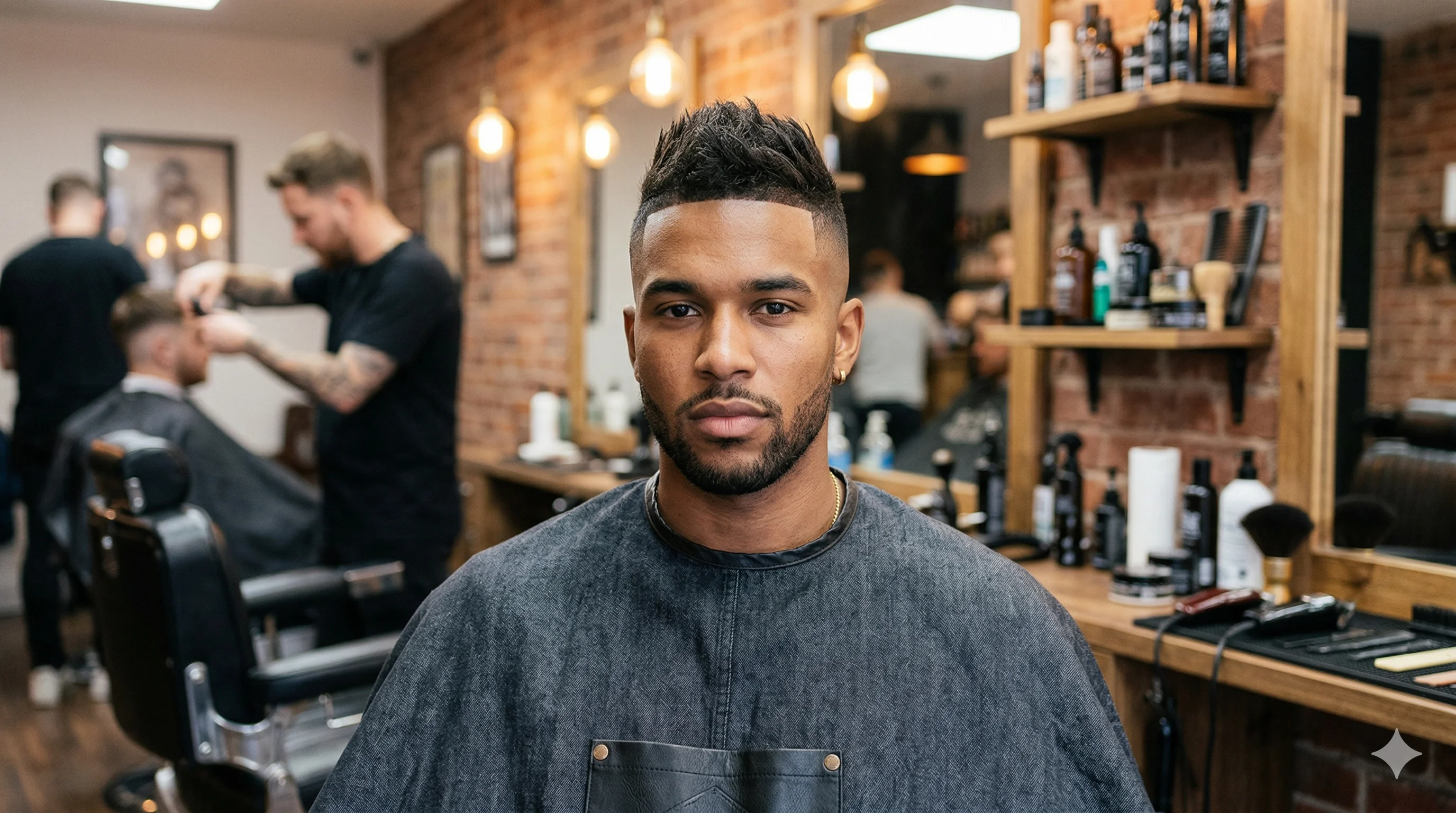
The mohawk fade is one of the most electrifying haircuts in men's grooming—a cut that refuses to fade into the background. By combining the mohawk's iconic central strip of hair with the precision and versatility of a modern fade, this style walks the line between bold individuality and barbershop craftsmanship. In 2026, the mohawk fade has evolved well beyond its punk roots into a mainstream style worn in offices, on runways, and on sports fields around the world.
Whether you want a subtle faux-hawk for the boardroom or a dramatic skin-faded mohawk for the weekend, there's a version of this cut for every personality, face shape, and hair type. This guide covers everything you need to know: what the mohawk fade is, every major variation, how to choose the right style for your features, and exactly how to communicate with your barber.
What Is a Mohawk Fade?
A mohawk fade is a men's haircut that combines two distinct elements: the mohawk—a central strip of hair running from forehead to nape, with the sides shaved or closely cropped—and a fade, where the sides transition gradually from short near the hairline to slightly longer toward the top strip, using clipper guard sizes to create a seamless blend.
The result is a haircut that has the dramatic visual impact of a mohawk but with the refined technical execution of a professional fade. Rather than an abrupt, shaved-sides-only look, the fade softens the transition and gives the mohawk a polished, contemporary character.
The mohawk traces its origins to the Mohawk Nation of Indigenous North America, where a central strip of hair was a cultural and warrior tradition. In the 20th century, the punk movement adopted and transformed it into a symbol of rebellion. Today's mohawk fade has moved far beyond any single cultural context—it's a sophisticated barbershop technique that's become one of the most requested styles globally.
Key Characteristics of a Mohawk Fade
- Central hair strip: A defined section of hair running front-to-back along the top of the head
- Faded sides: Gradual clipper blend from short at the sides to the strip above—not an abrupt shave
- Versatile height: The strip can range from a subtle ridge to a dramatic tall mohawk
- Styling options: Can be spiked, flopped forward, braided, textured, or worn naturally
- Fade variation: Low, mid, high, burst, drop, or skin fade dramatically change the look's character
Mohawk Fade vs Similar Styles
The mohawk fade is often confused with related cuts. Understanding the differences helps you choose the right style and communicate clearly with your barber.
| Feature | Mohawk Fade | Faux Hawk | Burst Fade Mohawk | Disconnected Undercut |
|---|---|---|---|---|
| Sides | Faded (gradual) | Hair on sides, combed to center | Semicircular burst fade | Hard line, no blend |
| Top strip | Clearly defined center | Suggested center, not shaved | Defined strip with burst fade | Long top, short sides |
| Edge level | Variable | No shaving required | Around the ear | Clean disconnect line |
| Boldness | High | Low to medium | Very high | Medium to high |
| Best for | Most hair types | Conservative settings | Curly/textured hair | Thick, longer hair |
| Maintenance | Every 2-3 weeks | Every 3-4 weeks | Every 2-3 weeks | Every 3-4 weeks |
The most important distinction between a mohawk fade and a faux hawk is that the faux hawk creates the illusion of a mohawk without actually shaving or fading the sides—the hair on the sides is simply styled upward and inward. A true mohawk fade removes hair from the sides through clipper fading.
"The mohawk fade is where barbering technique meets personal expression at its most deliberate. When it's executed correctly, it's one of the most satisfying cuts in the shop." — Widely shared perspective among professional barbers
Mohawk Fade Variations
The fade height and style dramatically change the character of a mohawk fade. Here are the major variations, from conservative to bold.
Low Mohawk Fade
The low mohawk fade starts the fade just above the ear level, maintaining more hair on the sides overall. The central strip is defined but the overall silhouette is more subtle. This is the most understated mohawk fade variation—appropriate for professional settings while still delivering a distinctive look.
Characteristics:
- Fade begins low, just above the ear
- More hair preserved on the sides
- The mohawk strip is suggested rather than dramatically isolated
- Grows out gracefully
Best for:
- Professional or semi-conservative environments
- Men new to the mohawk fade
- Oval and heart-shaped faces
- Hair that tends to lie flat
Maintenance: Every 3-4 weeks
Mid Mohawk Fade
The mid fade mohawk starts the fade at the temples—a balanced middle ground between subtle and bold. This is the most universally requested mohawk fade variation, offering strong visual impact while remaining practical across most lifestyle contexts.
Characteristics:
- Fade begins at mid-level, roughly at the temples
- Clear definition of the central strip without extreme contrast
- Balances boldness with wearability
- Works with virtually any top styling approach
Best for:
- Most face shapes
- Everyday versatility
- Men who want a clear mohawk without maximum drama
- Straight, wavy, and lightly curly hair
Maintenance: Every 2-3 weeks
High Mohawk Fade
The high fade mohawk starts near or above the temples, creating strong visual contrast between the closely faded sides and the prominent central strip. This is the most dramatic traditional mohawk fade and makes the strongest style statement.
Characteristics:
- Fade begins high, at or near the parietal ridge
- Sides are very short near the base, with rapid transition to the strip
- Central strip appears maximally isolated and prominent
- Delivers the most classic "mohawk" visual
Best for:
- Bold, fashion-forward style seekers
- Oval and oblong face shapes
- Thick or coarse hair that creates a dramatic strip
- Casual or creative environments
Maintenance: Every 2 weeks
Skin Fade Mohawk (Bald Fade Mohawk)
The skin fade—or bald fade—mohawk takes the sides to bare skin at the base, creating the sharpest possible contrast with the central strip. This is the most technical variation, requiring precise clipper work to blend from skin level up to the strip.
Characteristics:
- Sides fade to literal bare skin at the base
- Maximum contrast between scalp-bare sides and the full strip
- The central strip appears dramatically raised and prominent
- Requires skilled barbering to execute cleanly
Best for:
- Men who want the definitive, no-compromise mohawk look
- Thick, coarse hair that creates a substantial strip
- Bold social and creative contexts
- Strong facial features that carry high contrast well
Maintenance: Every 1-2 weeks; skin fades show regrowth quickly
Burst Fade Mohawk
The burst fade mohawk is one of 2026's most requested and visually distinctive variations. Instead of fading straight up the sides, the burst fade creates a semicircular fade that curves around the ear—radiating outward like a sunburst. When paired with a mohawk, this creates a uniquely dynamic, flowing silhouette.
Characteristics:
- Semicircular fade pattern radiating from behind the ear
- Creates a curved, organic transition rather than a straight vertical blend
- Particularly striking viewed from the side and back
- Works exceptionally well with curly, textured, and coily hair
Best for:
- Curly and textured hair types where the burst fade complements natural curl patterns
- Men wanting an especially creative, eye-catching variation
- Round and oval faces where the curved fade adds angular definition
- All fade heights (low, mid, or high burst fade)
Maintenance: Every 2-3 weeks
Drop Fade Mohawk
The drop fade drops lower behind the ear, following the natural curve of the skull toward the nape rather than maintaining a straight horizontal line. The drop creates a more organic, less geometric silhouette on the sides, which pairs well with longer or more relaxed mohawk strips.
Characteristics:
- Fade drops lower behind the ear, curving toward the nape
- More natural, less architectural than a straight high fade
- Creates an organic flow especially visible from the side
- Softens the overall look compared to a high skin fade mohawk
Best for:
- Men who want a mohawk with a slightly more relaxed edge
- Longer top strips that benefit from softer side framing
- Round and oval face shapes
- Men who find straight high fades too severe
Maintenance: Every 2-3 weeks
Faux Hawk Fade
The faux hawk fade is the office-friendly relative of the mohawk fade. No shaving required—the hair on the sides is faded and can be styled naturally when worn down, but the top is long enough to push into a central ridge for a mohawk-like appearance when desired.
Characteristics:
- Faded sides but no shaved strip definition when worn naturally
- Top is styled upward and inward to create a central ridge on demand
- Maximum versatility: wear it as a conventional fade or a faux hawk
- The most conservative mohawk variation
Best for:
- Professional or conservative settings
- Men who want mohawk style without full commitment
- Most hair types and face shapes
- Versatile day-to-night styling
Maintenance: Every 3-4 weeks
Disconnected Mohawk Fade
The disconnected mohawk fade features a hard, deliberate line between the longer top strip and the closely faded sides—rather than a gradual blend, there's a visible "disconnect" where the strip meets the sides. This creates a graphic, fashion-forward look with architectural precision.
Characteristics:
- Clear visual break between the top strip and faded sides
- No gradual blend—the separation is intentional and sharp
- Maximum contrast between top and sides
- Requires precise line-up work to maintain the disconnect
Best for:
- Bold fashion-forward aesthetics
- Thick hair that creates a dramatic strip
- Strong, angular face shapes
- Creative and fashion industry settings
Maintenance: Every 1-2 weeks to maintain clean disconnect line
Mohawk Fade for Different Face Shapes
The mohawk's central strip adds height and visual weight to the top, which interacts differently with each face shape. Strategic variation choices improve proportions.
Oval Face
The oval face is the most accommodating shape for the mohawk fade. Every variation from low to skin fade works cleanly. The oval's balanced proportions handle the mohawk's vertical emphasis without distortion.
Recommended: Any variation based on personal preference. High fade or skin fade for maximum drama; mid fade for everyday versatility.
Round Face
Round faces benefit from the mohawk's vertical emphasis, which adds height and reduces the circular appearance. The central strip draws the eye upward, elongating the face visually.
Recommended: Mid to high fade; style the top strip upright to maximize height. Avoid very low fades that maintain wide side volume. The burst fade's curved line adds angular definition.
Square Face
Square faces with strong jaw angles pair naturally with the mohawk's bold geometric quality. The haircut's vertical strip complements the jaw's horizontal strength.
Recommended: Mid fade for balance. Avoid very high skin fades that emphasize jaw width. A slight roundness or texture in the top strip softens the angularity slightly.
Heart-Shaped Face
Heart-shaped faces (wider forehead, narrower chin) should be careful with very high mohawks that exaggerate forehead width. A mid to low fade and a moderately sized strip maintain better proportions.
Recommended: Low to mid fade; moderate strip width; style the top strip with slight movement rather than perfectly upright to reduce forehead emphasis.
Oblong/Rectangular Face
Longer faces should avoid adding excessive height. Keep the top strip relatively flat or textured rather than spiked high, and opt for a mid to low fade that maintains some side width.
Recommended: Low to mid fade; style the strip flat or with texture rather than straight up; avoid skin fades that remove all side width.
Diamond Face
Diamond faces (narrow forehead and jaw, wide cheekbones) benefit from the mohawk's top emphasis, which adds balanced width to the forehead. The fade's graduated sides frame the cheekbones without adding excessive bulk.
Recommended: Mid fade; moderate strip width; burst fade works especially well to complement the face's natural angular structure.
Mohawk Fade for Different Hair Types
Straight Hair
Straight hair creates the most defined, architectural mohawk fade. The strip lies flat or spikes cleanly, and the fade shows maximum clarity. This is the classic mohawk fade reference.
Tip: Use a strong-hold matte clay or pomade to spike or position the strip. For a spiked mohawk, blow-dry while pulling the hair upright, then apply product for hold.
Wavy Hair
Wavy hair creates a slightly softer, more textured mohawk fade with organic movement in the strip. The waves add visual texture that makes the overall look more dynamic and less severe.
Tip: Enhance the waves with a sea salt spray or wave cream. Let the strip's natural wave pattern guide the styling rather than fighting it. The burst fade pairs especially well with wavy hair.
Thick, Coarse Hair
Thick and coarse hair creates a dramatic, substantial mohawk strip with natural volume and hold. The fade transitions more sharply, maximizing contrast. This is an ideal hair type for a high-impact mohawk fade.
Tip: A strong-hold fiber paste or wax is ideal—it provides control without making the strip look product-saturated. Ask your barber for some texturizing to reduce bulk if the strip feels too heavy.
Curly or Coily Hair
Curly and coily hair transforms the mohawk fade into something especially distinctive. The natural curl pattern in the strip creates beautiful texture and volume without effort. The burst fade is the ideal fade choice for curly hair, as its curved pattern complements the hair's natural shape.
Tip: Work with a barber experienced in natural textures. Use a curl-defining cream or light hold gel to define the strip's curl pattern. Avoid over-manipulation that disrupts the natural texture.
Fine or Thin Hair
Fine hair can achieve the mohawk fade look with careful adjustment. Very high skin fades can expose scalp on the sides and reduce the strip's perceived density. A mid to low fade preserves more overall volume.
Tip: Use a volumizing paste or matte fiber to build the strip's presence. Keep the strip at a moderate length for the best density perception. Avoid very long top strips that look sparse on fine hair.
How to Ask Your Barber for a Mohawk Fade
The mohawk fade is specific enough that clear communication prevents major misalignment between expectation and result. Use this framework:
Step 1: Name the Style and Fade Type
Start clearly: "I want a mohawk fade" or "Can you do a mohawk with a skin fade?" or "I'd like a burst fade mohawk."
Most barbers immediately understand these terms. In some regions, specify: "Strip of hair from front to back, faded sides—not shaved clean, gradually blended."
Step 2: Specify the Fade Height
Be explicit about the fade level:
- "Low fade—keep the fade close to the ear level"
- "Mid fade—start it around the temple level"
- "High fade—take it up near the top of the sides"
- "Skin fade all the way—I want it at zero at the base"
Step 3: Define the Strip Width and Length
The strip width and length dramatically change the look:
- "Keep the strip about 2 inches wide and 3 inches long on top"
- "I want a wider strip—about 3 to 4 inches across the top"
- "Leave the strip long enough to spike—about 4 to 5 inches"
- "Keep it short, I'll wear it textured and flat, not spiked"
Step 4: Describe How You'll Style It
This helps your barber optimize the cut:
- "I'll spike it up with pomade" — needs strong vertical direction
- "I'll wear it flopped forward, no spiking" — needs forward length
- "I'll wear it natural with texture" — needs balanced length
- "I want to be able to comb it flat for work" — needs enough length to cover
Step 5: Clarify the Neckline
- "Clean taper at the nape" for a natural finish
- "Square neckline" for a sharper, defined back
- "Skin at the nape and up" for maximum contrast at the back
Step 6: Bring Reference Photos
Always bring 2-3 reference photos—front, side, and back angles if possible. Mohawk fades vary enormously in strip width, fade height, and styling approach. Photos remove all ambiguity and give your barber a clear target.
"When a client walks in with a clear reference photo and says 'burst fade mohawk, medium strip width, I style it natural'—we're starting from a perfect place." — Common professional barbering perspective
Mohawk Fade Maintenance
The mohawk fade requires regular upkeep to maintain its defining contrast. The sides grow out faster than the strip appears to change, blurring the fade's precision quickly.
Touch-Up Schedule
- Every 1-2 weeks: Skin fade mohawk; high fade with tight sides; disconnected mohawk
- Every 2-3 weeks: Standard high or mid fade mohawk
- Every 3 weeks: Mid fade with moderate strip length
- Every 3-4 weeks: Low fade or faux hawk fade; grows out most gracefully
At-Home Care Between Appointments
- Strip positioning: Apply product while hair is damp and train the strip in your preferred direction (upright, forward, or to one side) to build hair memory
- Moisturize faded sides: Near-skin areas benefit from a light scalp moisturizer to prevent dryness
- Sun protection: Exposed scalp areas on the sides are more susceptible to UV—apply SPF in sunny weather
- Trimmer touch-ups: A home trimmer can extend the fade's edge definition at the hairline between appointments if you're comfortable doing it
Styling Products for the Mohawk Fade
| Product | Best For | Hold | Finish |
|---|---|---|---|
| Strong-hold matte clay | Spiked or upright strip, thick hair | Strong | Matte |
| Fiber paste | Adding texture and volume to the strip | Medium-strong | Matte |
| Pomade | Sleek, structured strip; slick styling | Medium | Shine |
| Curl cream | Curly and coily mohawk strips | Light-medium | Natural |
| Sea salt spray | Wavy hair, textured natural-look strip | Light | Matte |
| Strong-hold gel | Spiked or sculpted mohawk styles | Very strong | Wet/shine |
| Wax | Casual definition, low-shine styling | Medium | Natural |
Mohawk Fade Common Mistakes to Avoid
- Not specifying the strip width: "Mohawk fade" gives your barber significant latitude—specify how wide the central strip should be
- Wrong fade height for your face shape: A very high fade on an oblong face adds height; a very low fade on a round face maintains unwanted width
- Choosing the wrong product for your styling goal: Heavy gel works for spiked styles but weighs down natural texture; clay or paste is more versatile
- Going too long between cuts: The mohawk fade's contrast is its defining feature—when the sides grow out, the cut loses its impact quickly
- Not telling your barber how you'll style it: The cut should be optimized for your styling intention (spiked vs. flat vs. textured)
- Expecting extreme spike height from fine hair: Fine hair needs product support and may not achieve the height of thick hair without significant product
- Not bringing reference photos: Mohawk fades vary enormously—photos align expectations instantly
Frequently Asked Questions
What is a mohawk fade?
A mohawk fade is a men's haircut that combines a central strip of hair running from forehead to nape with faded sides—where the sides are clipper-blended from short near the hairline to slightly longer toward the strip. The fade creates a smooth, professional transition rather than an abrupt shaved look.
What's the difference between a mohawk fade and a faux hawk?
A mohawk fade actually fades the sides down, clearly defining the central strip. A faux hawk keeps hair on the sides at a comparable length but styles it inward and upward to create the illusion of a central ridge—no fading to the hairline is required. The faux hawk is more conservative and versatile; the mohawk fade is bolder and more committed.
What fade is best for a mohawk?
It depends on your goals. The mid fade mohawk is the most universally wearable. The skin fade mohawk delivers maximum contrast. The burst fade mohawk is especially suited to curly and textured hair. The low fade mohawk is best for conservative environments. Choose based on your desired boldness level, face shape, and lifestyle.
Does the mohawk fade work for curly hair?
Yes—curly and coily hair is actually ideal for certain mohawk fade variations. The burst fade mohawk works especially well with curly hair, as the curved fade complements the hair's natural texture. The strip's natural curl creates volume and definition with minimal effort.
How long does a mohawk fade last before it needs a touch-up?
Skin fade and high fade mohawks typically need touch-ups every 1-2 weeks as the faded sides show regrowth quickly. Mid fade mohawks last about 2-3 weeks. Low fade and faux hawk variations grow out most gracefully and can look clean for 3-4 weeks.
How much does a mohawk fade cost?
Most barbershops charge $30-55 for a mohawk fade, depending on the complexity of the fade type and the level of detail in the cut. Skin fades and burst fades may cost more due to the additional technique required. High-end barbershops in major cities may charge $50-90 or more.
Can I get a mohawk fade for work?
Yes—with the right variation. A low or mid fade faux hawk is the most workplace-appropriate version, as the sides can be styled flat when worn naturally. A mid fade mohawk with a moderate-length strip that can be combed over or worn flat is also office-friendly. The key is choosing a strip length and fade height that looks conventional when styled down.
How do I spike a mohawk fade?
Start with damp or dry hair. Apply a strong-hold matte clay or gel to the strip, working it through from roots to tips. Use a blow dryer on medium heat to direct the hair upright while moving your hands along the strip. Finish with additional product to lock the shape in place. The longer and thicker the strip, the more product and heat you'll need to maintain an upright position.
Preview Your Mohawk Fade with BaldFade AI
Not sure whether a mohawk fade would suit your face or which variation is right for you? Use BaldFade's AI preview tool to visualize different mohawk fade variations on your actual face before sitting in the barber's chair.
Our AI-powered tool helps you:
- Preview low, mid, high, and skin fade mohawk styles on your own photo
- Compare burst fade and drop fade mohawk variations side by side
- Experiment with different strip widths and lengths to find your ideal proportions
- Generate reference images to show your barber exactly what you want
Conclusion
The mohawk fade has earned its place as one of men's most enduring bold haircuts—and in 2026, its continued evolution through burst fades, disconnected variations, and textured natural-look strips has made it more versatile than ever. Whether you want a subtle faux hawk for the office, a mid burst fade mohawk that turns heads on weekends, or a full skin-faded mohawk for maximum statement, there's a version of this cut that's right for your face shape, hair type, and lifestyle.
The key is choosing the right fade height for your proportions, the right strip dimensions for your hair type, and communicating clearly with your barber about exactly how you'll style it. Bring the reference photos, use the language in this guide, and walk out of the chair with one of barbering's most iconic cuts—executed with modern precision.
Use our AI preview tool to find your perfect mohawk fade variation before your next appointment.