

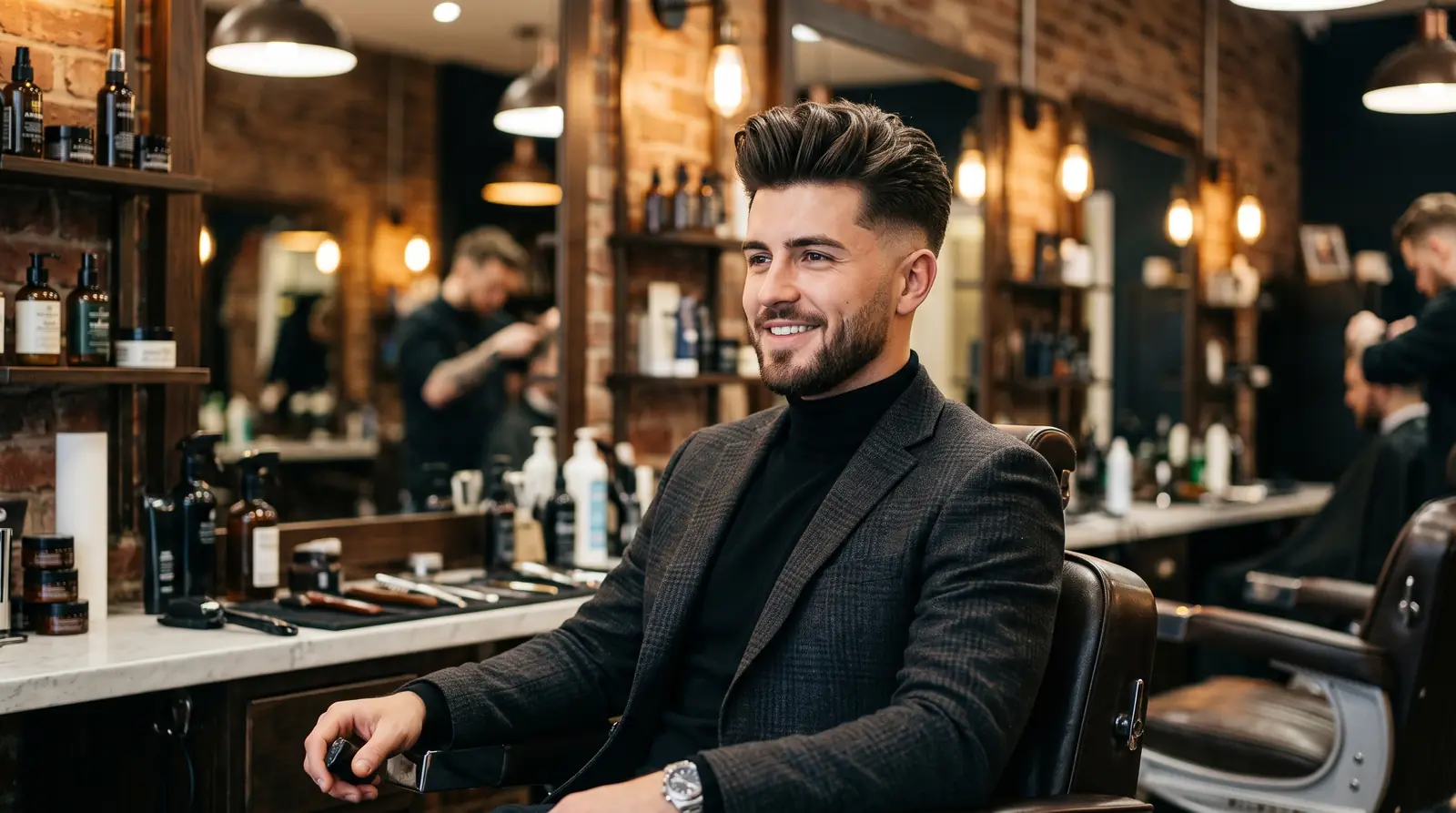
The quiff fade is one of the most versatile men's haircuts of the modern era—a style that merges the textured, forward-sweeping volume of the classic quiff with the technical precision of a clipper fade on the sides. The result is a cut that works equally well in a creative workplace, a formal event, or a casual weekend outing. In 2026, the quiff fade has evolved from a trend into a staple, requested consistently across barbershops worldwide because it flatters a wide range of face shapes and hair types while still looking distinctly intentional.
This guide covers everything: what makes a quiff fade different from similar styles, the major fade variations, how to match the cut to your face shape and hair type, and exactly what to say at your next barber appointment.
What Is a Quiff Fade?
A quiff fade combines two distinct elements: the quiff—a style where the hair on top is swept upward and slightly forward from the forehead, creating a crest of volume at the front—and a fade, where the sides and back are tapered using clippers to produce a seamless gradient from short at the base to longer near the top.
The defining feature is the forward-and-upward sweep of the top section. Unlike the pompadour, which pushes hair backward and upward to create a rounded profile behind the hairline, the quiff pushes the hair forward, so the volume peaks at or just above the hairline. The sides fade cleanly to provide contrast and keep the overall shape structured.
The quiff dates to the 1950s but became a genuinely modern haircut when barbers began pairing it with clipper fades in the 2010s. The combination solved the quiff's traditional problem—an undefined lower section—by giving the style a clean, technical foundation that elevated it from retro to contemporary.
Key Characteristics of a Quiff Fade
- Forward crest: The top section is swept upward and forward, creating a peak near the front hairline
- Faded sides: Gradual clipper blend from short at the base to longer near the top—no harsh lines
- Textured finish: Most quiff fades use a matte or low-shine product to enhance separation and movement
- Versatile height: The quiff can range from a subtle lift to dramatic, elevated height depending on length and product
- Directional contrast: Unlike the pompadour's backward sweep, the quiff faces forward, framing the face differently
Quiff Fade vs Similar Styles
The quiff fade is often confused with the pompadour fade and other top-heavy styles. Here's how they compare:
| Feature | Quiff Fade | Pompadour Fade | Faux Hawk Fade | Textured Crop Fade |
|---|---|---|---|---|
| Top direction | Upward and forward | Upward and backward | Upward and central | Forward and flat |
| Volume | Medium, front-focused | High, sweeping back | High, centered ridge | Low, close-cropped |
| Structure | Loose crest, textured | Defined rounded sweep | Mohawk-like peak | Flat, minimal lift |
| Best hair type | All types | Medium to thick | Thick, straight | All types |
| Styling time | 3–5 minutes | 5–10 minutes | 5–8 minutes | 2–3 minutes |
| Maintenance | Every 2–3 weeks | Every 2–3 weeks | Every 2–3 weeks | Every 2–4 weeks |
The clearest distinction between a quiff and a pompadour is direction: the quiff faces forward, the pompadour faces backward. A quiff projects the hair toward the viewer; a pompadour recedes away from the face. The faux hawk centers the volume into a ridge that runs front-to-back, while the quiff is a single lifted crest at the front. These are different shapes, different silhouettes, and different visual effects.
"The quiff is the most forgiving of all the volume-on-top cuts—it works with virtually every face shape, and because it's directional rather than architectural, you can adjust the height and angle to suit the person in your chair." — A common observation among experienced barbers
Types of Quiff Fade Haircuts
The height and style of the fade fundamentally changes the character of the quiff. Here are all the major variations.
Low Quiff Fade
The low quiff fade starts the taper just above the natural hairline—in the lower third of the head, near the bottom of the ears. The sides retain substantial hair length, and the fade is subtle and understated. The quiff on top is the primary visual statement; the fade simply ensures the sides look clean and defined.
Characteristics:
- Fade begins just above the ear, in the lower third of the head
- More hair retained on the sides overall
- The transition from sides to top is gradual, not dramatic
- Grows out gracefully over several weeks
Best for:
- Professional or conservative environments
- Men trying the quiff fade for the first time
- Oblong and rectangular face shapes (avoids adding extra height contrast)
- Anyone who prefers a subtle, understated style
Maintenance: Every 3–4 weeks
Mid Quiff Fade
The mid quiff fade begins the taper at temple level—roughly the midpoint of the sides. This is the most popular quiff fade variation: sharp enough to be distinctly modern, versatile enough for both professional and casual settings. The contrast between the quiff's forward crest and the faded sides is balanced rather than extreme.
Characteristics:
- Fade begins at temple level, midway up the sides
- Clear contrast between the top quiff and the faded sides
- The quiff sits visually above a distinct fade line
- Works across virtually all lifestyle contexts
Best for:
- Most face shapes, particularly oval and square
- Office environments and social settings equally
- Medium to thick hair types
- The default choice for first-time quiff fade wearers who want visible results
Maintenance: Every 2–3 weeks
High Quiff Fade
The high quiff fade starts the taper near the top of the sides—close to the crown. This creates maximum contrast between the voluminous quiff on top and the minimal hair on the sides. The effect is bold and modern: the quiff appears dramatically elevated, almost detached from the sharply faded sides beneath it.
Characteristics:
- Fade begins near the top of the sides, close to the crown
- Maximum visual contrast between quiff and sides
- The quiff appears elevated above a very short, graduated surround
- Requires more frequent maintenance to keep the fade sharp
Best for:
- Bold, fashion-forward personal styles
- Men with oval or round face shapes (the height adds length)
- Thick, dense hair with strong natural lift
- Men who visit the barber frequently
Maintenance: Every 1–2 weeks
Skin Fade Quiff
The skin fade quiff takes the fade all the way down to bare skin at the base, then builds gradually upward toward the top. Paired with the quiff's forward-swept volume, the result is the highest-contrast variation in the quiff fade family: an exceptionally clean foundation beneath the textured top.
Characteristics:
- Zero guard (bare skin) at the base near the hairline
- Seamless gradient from skin to the quiff top
- The most modern, high-contrast quiff fade variation
- Shows regrowth most quickly of all fade types
Best for:
- Men who want the sharpest, cleanest possible look
- Oval, oblong, and diamond face shapes
- Frequent barber visitors (every 1–2 weeks)
- Thick, resilient hair that holds product well
Maintenance: Every 1–2 weeks
Textured Quiff Fade
The textured quiff fade emphasizes natural movement and separation on top. Rather than a unified, combed crest, the hair is worked with product to create piece-y definition, visible strands, and a deliberate looseness. The fade keeps the sides sharp while the top reads as effortlessly styled—an intentional contrast between precision below and relaxed texture above.
Characteristics:
- Top is styled for texture and separation rather than a smooth, unified lift
- Matte or low-shine products used to enhance separation
- Works especially well with wavy or naturally textured hair
- Lower daily styling effort than the classic quiff
Best for:
- Men who prefer a casual, undone aesthetic
- Wavy and naturally textured hair types
- Creative industries and informal lifestyle contexts
- Men transitioning from a more casual style to structured cuts
Maintenance: Every 2–3 weeks
Curly Quiff Fade
The curly quiff fade works with natural curl pattern to create the quiff's characteristic forward lift without heavy styling effort. Curls naturally want to rise, and when the hair is cut and managed to channel that energy forward, a quiff shape emerges organically. The fade on the sides frames the curls and prevents the overall silhouette from looking shapeless.
Characteristics:
- Natural curl or coil pattern provides the quiff's lift and volume
- Less product needed—the curl does the structural work
- The fade is critical for defining the shape and keeping it clean
- Highly personalized look—each curl pattern produces a slightly different result
Best for:
- Type 2 (wavy) through Type 4 (coily) hair
- Men who want to work with their natural texture
- Oval, heart, and diamond face shapes
- Minimal daily styling effort
Maintenance: Every 2–3 weeks; curl care products essential
Side-Part Quiff Fade
The side-part quiff fade combines a hard side part—a defined line combed or shaved into the top section—with the quiff's forward lift and a clean fade on the sides. The result is a more structured, deliberate look that bridges the quiff's informality with the classic barbershop polish of a hard part.
Characteristics:
- Hard side part divides the top section from the faded sides
- The quiff volume is concentrated on one side
- More defined and intentional than a standard quiff fade
- Works especially well with straight or slightly wavy hair
Best for:
- Men who want a quiff fade with more classic structure
- Professional environments
- Oval, square, and heart face shapes
- Straight or slightly wavy hair that holds a part cleanly
Maintenance: Every 2–3 weeks
Choosing the Right Quiff Fade for Your Face Shape
Face shape is the primary factor when selecting a quiff fade variation. The goal in most cases is to move toward an oval silhouette.
Oval Face
The oval face is the most balanced proportionally, and it's the most versatile for the quiff fade. Virtually every variation works. If you have an oval face, base your choice on personal style preference and lifestyle context rather than structural correction.
Best variations: All quiff fade styles; particularly striking with mid fade and high fade
Square Face
Square faces have strong, defined jawlines and similar width at the temples and jaw. The quiff's forward lift adds height, which elongates the face and reduces the visual emphasis on the jaw's width.
Best variations: Mid quiff fade or high quiff fade—the added height lengthens the face proportionally; avoid very low fades that leave width at the sides without adding height
Round Face
Round faces have soft contours with cheek width roughly equal to face length. The quiff is one of the best cuts for round faces because the forward lift and added height create the appearance of a longer, narrower face.
Best variations: High quiff fade with significant top volume; mid fade with a taller quiff; avoid very low fades that emphasize the roundness
Oblong/Rectangular Face
Oblong or rectangular faces are already long and narrow. The goal is to add width without stacking more height on top.
Best variations: Low quiff fade with moderate volume; textured quiff with a shorter, wider top; avoid very high fades and very tall quiffs that make the face appear even longer
Heart Face
Heart faces are wider at the temples and forehead, narrowing toward the chin. The quiff's volume at the forehead can emphasize that width, so the goal is moderate lift rather than maximum height.
Best variations: Low or mid quiff fade with moderate volume; textured quiff with restrained height; avoid very high fades that further emphasize the broader upper face
Diamond Face
Diamond faces are widest at the cheekbones with a narrower forehead and jaw. The quiff works well here because the forward lift adds apparent width at the forehead, balancing the prominent cheekbones.
Best variations: Mid quiff fade with moderate volume; textured or side-part quiff variations; the fade keeps the cheekbone area clean
Hair Type Considerations
Your natural hair type significantly affects how a quiff fade looks and how much daily styling effort it requires.
| Hair Type | Challenge | Best Quiff Variation | Product Recommendation |
|---|---|---|---|
| Straight, fine | Lacks natural volume and lift | Mid or high quiff fade | Volumizing mousse + light clay |
| Straight, thick | Heavy, falls forward | Low to mid skin fade quiff | Medium-hold clay or paste |
| Wavy | Volume without control | Textured quiff fade | Sea salt spray + light hold cream |
| Curly | Shape management | Curly quiff fade | Curl-defining cream + light gel |
| Coily | Maximum volume, shape control | Curly quiff fade | Moisturizing cream + edge control |
Fine, straight hair requires the most effort—volumizing products and blow-drying with a brush are usually necessary to get the lift to hold. Thick, straight hair naturally falls forward (which actually helps the quiff's directional sweep) but needs a strong-hold product to prevent it from flopping. Curly and wavy hair creates quiff volume more naturally but benefits from product that defines the curl and keeps the sides looking clean against the faded gradient.
How to Style a Quiff Fade at Home
Getting a consistent quiff at home requires the right technique. Here's the step-by-step process.
What You'll Need
- Hair dryer with concentrator nozzle
- Medium-bristle brush or fine-tooth comb
- Clay, paste, or matte pomade (medium hold)
- Optional: volumizing mousse or sea salt spray for fine or wavy hair
Classic Quiff Styling Process
Step 1: Start with damp hair Apply your product to damp, towel-dried hair—not soaking wet. Work a small amount of clay or paste evenly through the top section. Use less than you think you need; too much product kills lift and creates a greasy, heavy look.
Step 2: Section the top Mentally define the quiff section—the top portion of your hair from the front hairline back. This is where all your styling effort goes. The sides are faded and don't require styling beyond the barber visit.
Step 3: Blow-dry for lift Point the hair dryer at the front hairline, directing heat upward and slightly forward. Use your brush or comb to train the hair in that direction while the dryer adds volume. Work from front to back, using the brush to lift the root—this is what creates lasting height.
Step 4: Create the crest While the hair is still warm, use your comb or fingers to push the front section upward and slightly forward. The quiff's peak should sit at or just above the hairline, not recessed back. Lean the crest slightly toward your face, not away from it.
Step 5: Lock it in A brief blast of cool air from the dryer sets the shape. Cool air closes the hair cuticle and helps the style hold throughout the day.
Step 6: Refine and define Use your fingertips to separate and define individual sections for a textured finish, or run a comb through for a cleaner, more polished look. A tiny amount of additional product worked through the surface adds definition without weight.
Product Guide by Quiff Style
- Classic quiff: Medium-hold clay—provides structure and grip without heavy shine
- Textured quiff: Matte paste or sea salt spray—enhances separation and movement
- Curly quiff: Curl-defining cream—works with natural texture rather than against it
- Polished quiff: Light pomade—adds shine and hold for a cleaner, more formal finish
- Fine hair quiff: Volumizing mousse before blow-drying + light clay to finish
Quiff Fade Maintenance Schedule
| Fade Type | Touch-Up Frequency | Full Restyle |
|---|---|---|
| Skin fade quiff | Every 1–2 weeks | Every 4–6 weeks |
| High quiff fade | Every 1–2 weeks | Every 4–6 weeks |
| Mid quiff fade | Every 2–3 weeks | Every 6–8 weeks |
| Low quiff fade | Every 3–4 weeks | Every 8–10 weeks |
| Textured quiff fade | Every 2–3 weeks | Every 6–8 weeks |
The quiff top section grows slowly and usually maintains its shape between appointments with product alone. The fade on the sides shows regrowth fastest. A "touch-up" addresses only the sides; a "full restyle" includes reshaping the top length and profile.
What to Tell Your Barber
Communicating clearly with your barber is essential. Use this language:
For the top:
- "Leave [X] inches on top—I want enough length to style a quiff"
- "I want the front swept upward and forward—a quiff shape, not swept back"
- "Keep it textured on top" (for textured variation) or "I want a clean, smooth lift" (for classic)
- "I want a hard part on the left/right" (for side-part quiff variation)
For the fade:
- "Low fade starting just above the ear" / "Mid fade starting at the temples" / "High fade starting near the crown"
- "Skin fade on the sides" (if you want bare skin at the base)
- "Blend the fade smoothly—no harsh lines"
For overall length:
- "Take [X] off the length on top but leave enough to style a quiff—at least 2.5 to 3 inches"
- "I want to maintain the current length, just clean it up"
Bring a reference photo. A photo removes ambiguity about fade height, top length, and quiff style. Save two or three images that represent exactly what you want and show them at the start of your appointment.
Frequently Asked Questions
How long does hair need to be to style a quiff fade? At minimum, 2 to 2.5 inches on top to create a recognizable quiff lift. For a more dramatic quiff with significant height, 3 to 4 inches provides more flexibility. The sides can be any length depending on the fade variation you choose.
Is the quiff fade different from a pompadour fade? Yes—the key difference is direction. A quiff sweeps hair upward and forward, so the volume peaks near the front hairline, framing the face. A pompadour sweeps hair upward and backward, creating a rounded profile behind the hairline. The silhouettes are distinctly different: the quiff projects forward; the pompadour recedes. In general, the quiff is more textured and casual; the pompadour is more structured and formal.
Does a quiff fade work with thinning hair? Yes. A mid quiff fade with moderate top length and volumizing products can create the appearance of density. Avoid very high fades that draw attention to the contrast between a sparse top section and closely shaved sides. Matte clays and volumizing mousses work better for thinning hair than heavy, shiny pomades.
How do I keep the quiff from collapsing? Use a clay or matte paste rather than a heavy pomade—these products have better grip and don't break down as quickly with humidity. Blow-dry thoroughly (heat-set styles hold better than air-dried styles), and apply product to damp hair before drying rather than after. A small amount of additional clay worked through dry hair at the end of styling locks in the shape.
Can I get a quiff fade with curly or wavy hair? Absolutely. Curly and wavy hair creates quiff volume more naturally than straight hair because the curl provides built-in lift and structure. The key is working with the natural texture—use curl-friendly products and let the natural pattern define the forward sweep. A mid or high fade on the sides keeps the overall shape controlled.
What's the difference between a quiff and a faux hawk? The faux hawk creates a central ridge of hair running front-to-back down the middle of the head, resembling a mohawk silhouette. The quiff creates a single lifted crest at the front hairline that sweeps forward. The faux hawk is more symmetrical and aggressive; the quiff is more natural and directional. They're distinct shapes with different visual effects.
How often should I get my quiff fade touched up? For skin fades and high fades, every 1–2 weeks to keep the gradient sharp. For mid fades, every 2–3 weeks. For low fades, every 3–4 weeks. The top section typically maintains its length and shape longer—most of the maintenance work is on the faded sides.
Final Thoughts
The quiff fade succeeds because it combines two things that are individually strong and work even better together: the quiff's forward energy and accessible volume, and the fade's technical precision and clean gradient. It's a cut that suits a wider range of face shapes than almost any other top-heavy style, adapts to nearly every hair type with the right variation, and scales from casual to formal depending on how it's styled.
Whether you go with a relaxed textured quiff over a low fade or a dramatic high skin fade quiff, the principles are the same: length on top, a clean gradient on the sides, and the right product to hold the forward lift in place. Bring your reference photos, communicate clearly with your barber, and you'll leave with one of the most consistently flattering haircuts available in 2026.