

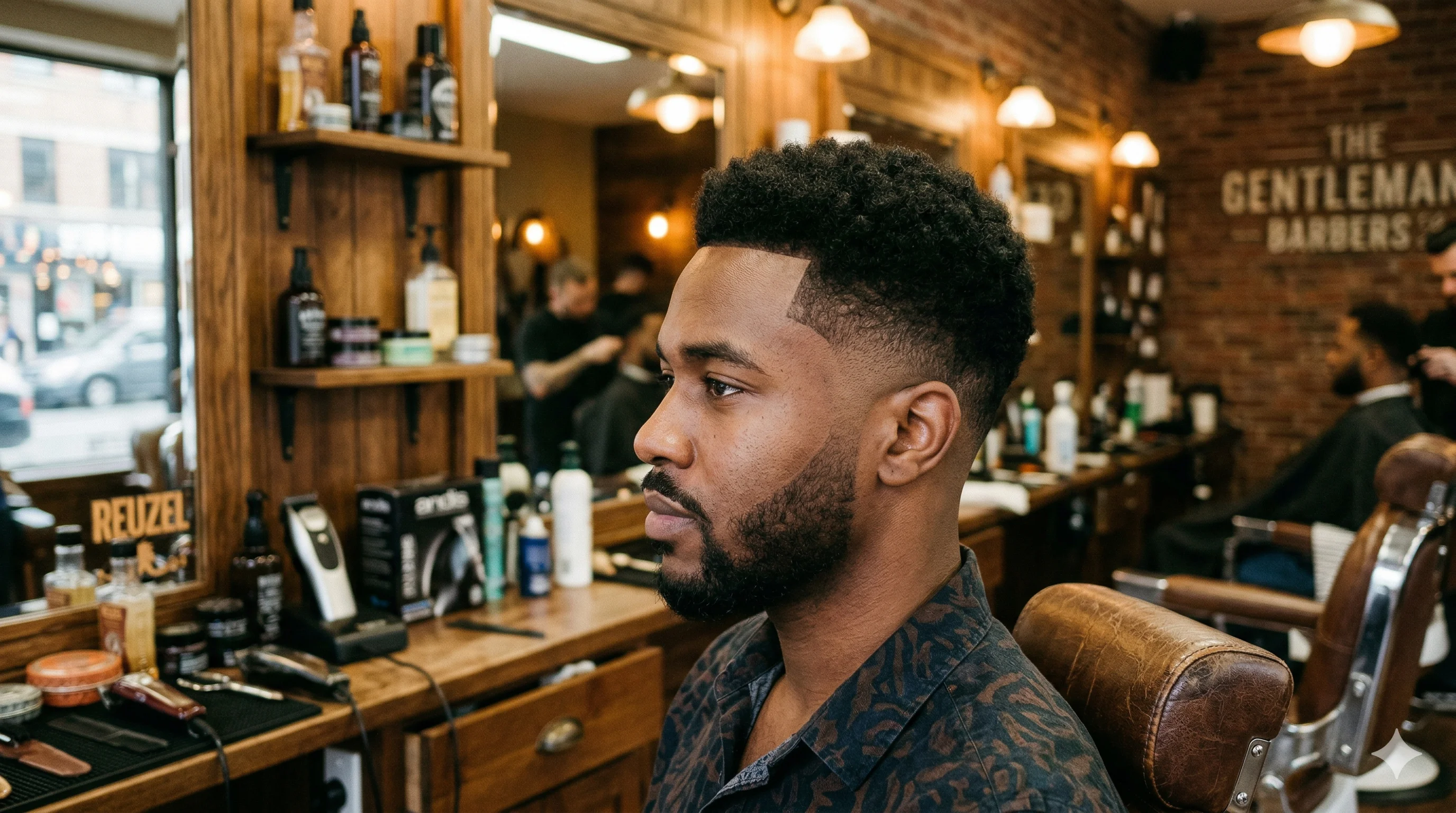
The temple fade haircut—also called the temp fade or Brooklyn fade—has been a barbershop staple for decades, and in 2026 it's more relevant than ever. Unlike full-side fades that work the entire perimeter of the head, the temple fade targets a very specific zone: the temples and sideburns. The result is a sharp, clean frame around the face that works with virtually any hairstyle on top, from waves and curls to buzz cuts and pompadours.
What makes the temple fade distinctive is its subtlety. It doesn't dramatically alter the overall silhouette the way a high fade does, but it transforms the way your face looks—defined, groomed, and intentional. If you've ever noticed that a haircut looks noticeably sharper around the ears and temples, you've seen the temp fade effect in action.
This guide covers everything you need to know about the temple fade: what it is, how it differs from other fades, which variations exist, how to choose the right one for your face shape, and the exact words to use when communicating with your barber.
What Is a Temple Fade Haircut?
A temple fade is a targeted fade that blends hair down to very short lengths—often skin level—specifically around the temple and sideburn area. The fade typically starts at the natural hairline at the temples, wraps slightly around the ear, and can extend toward the nape depending on the specific variation.
Unlike a full bald fade or skin fade that thins the entire side of the head from ear to crown, a temple fade leaves the mid and upper sides intact. The focal point is the temples and the frame created around the ears, giving the face a precisely groomed border.
The term "temp fade" is a shortened version of "temple fade," and both terms refer to the same technique. "Brooklyn fade" is a regional nickname that originated in New York barbershop culture, where the style was popularized among Black men in the 1980s before spreading globally.
Key Characteristics of a Temple Fade
- Targeted zone: Fade focuses on temples and sideburns, not the full side
- Face-framing effect: Creates clean, defined borders around the face
- Preserves mid-side hair: Does not aggressively thin the entire side panel
- Versatile pairing: Works with any length and texture on top
- Professional and casual: Clean enough for formal settings, stylish enough for any occasion
- Low-to-moderate maintenance: Lasts 2-3 weeks between barber visits
Temple Fade vs Other Fade Styles
Understanding how a temple fade compares to similar styles helps you make an informed choice and communicate accurately with your barber.
| Feature | Temple Fade | Full Skin Fade | Low Fade | High Fade |
|---|---|---|---|---|
| Where fade starts | Temple/sideburn only | Entire side perimeter | Just above the ear | Near parietal ridge |
| Skin exposure | At temples/sideburns | Full sides and back | Low line only | Full upper sides |
| Overall contrast | Moderate, targeted | High, dramatic | Subtle | Maximum |
| Top impact | Minimal | Significant | Subtle | Significant |
| Maintenance | Every 2-3 weeks | Every 1-2 weeks | Every 3-4 weeks | Every 1-2 weeks |
| Best for | Any style, all face shapes | Bold, dramatic looks | Conservative, professional | Modern, fashion-forward |
| Versatility | Extremely high | High | High | Moderate |
The temple fade occupies a unique middle ground: it's more defined and modern than a simple taper, yet less dramatic and maintenance-intensive than a full skin fade. This balance is why so many barbers and clients consider it the most universally flattering fade option available.
"The temple fade is the haircut that makes every man look like he just walked out of a barbershop, even three weeks after his appointment. It's precise where it needs to be and natural where it should be." — Master barber perspective shared widely in professional grooming communities
Types of Temple Fade Haircuts
The temple fade has evolved into several distinct variations, each suited to different preferences, hair types, and styling goals.
Classic Temple Fade (Temp Fade)
The original and most requested form. Hair at the temples fades to very short or skin level, with a clean arc that follows the natural hairline. The cut is precise but not exaggerated—a subtle upgrade to the baseline haircut that makes a significant visual difference.
Best for:
- First-time temple fade wearers
- Professional environments requiring conservative styling
- Men who want minimal change with maximum grooming impact
- Any hair type and face shape
High Bald Temple Fade
A more dramatic variation where the fade at the temples goes all the way to skin, combined with a higher fade line that extends further up the side of the head. This increases the contrast and gives a bolder, more modern look while still maintaining more hair in the mid-side than a full high fade.
Best for:
- Men wanting a sharper, high-contrast look
- Thick hair that benefits from side reduction
- Creative and urban aesthetics
- Oval and oblong face shapes
Low Temple Fade
The most conservative version—the fade starts very close to the natural hairline, barely touching the temple area. Almost invisible from a distance, it adds subtle definition without committing to dramatic change.
Best for:
- Corporate and formal environments
- Men transitioning from no-fade styles
- Those wanting the most natural-looking result
- All face shapes, especially heart-shaped faces
Temple Fade with Hard Part
A crisp, razor-drawn line separates a clearly defined side section from the top. Combined with the temple fade, this creates a highly structured, architectural look that's simultaneously classic and contemporary.
Best for:
- Professional, polished aesthetics
- Side-combed or slicked back top styles
- Men who prefer defined structure over natural movement
- Oval and square face shapes
Temple Fade with Edge-Up
The edge-up (also called a line-up or shape-up) adds a sharp, defined line along the forehead hairline and sides, complementing the temple fade's precision. This combination is one of the most requested styles in barbershops globally.
Best for:
- Maximum definition and sharpness
- Straight or tight curl patterns
- Men who prioritize an extremely clean, groomed appearance
- Oval, square, and diamond face shapes
Buzz Cut Temple Fade
A buzz cut across the entire head paired with a temple fade that sharpens the perimeter. The buzz cut's uniform length allows the temple fade to do all the styling work—and the effect is a remarkably clean, modern look.
Best for:
- Maximum low-maintenance styling
- Men transitioning to shorter hair
- Hot weather and active lifestyles
- Strong facial features that benefit from minimal distraction
Temple Fade with Waves
One of the most iconic combinations in modern barbering. A 360° wave pattern on top, paired with a precisely faded temple area, creates a style that's both technically impressive and visually striking. Popular across diverse communities, this look has deep cultural roots in African American barbering tradition.
Best for:
- Men with naturally coily or tightly textured hair training waves
- Those committed to regular moisturizing and brushing routines
- Bold, confident style statements
- Oval and round face shapes
Temple Fade with Twists or Locs
Natural hair styles like two-strand twists, starter locs, or mature locs paired with a clean temple fade create a powerful contrast between natural texture on top and precise barbering on the sides. This combination has become increasingly mainstream in 2026 as natural hair styles gain mainstream acceptance.
Best for:
- Men with natural, coily, or afro-textured hair
- Those embracing protective styling
- Cultural expression combined with precision grooming
- All face shapes
Temple Fade with Curls (Curly Top)
The curly top fade is a natural pairing with the temple fade. Free-form curls or defined ringlets on top contrast beautifully with the tight, precise temple fade line. This creates effortless volume and movement above the clean, structured sides.
Best for:
- Natural curl patterns (3A-4C)
- Men wanting to embrace texture while maintaining clean sides
- Oval, round, and heart-shaped faces
- Year-round versatility
Best Temple Fade Styles for 2026
| Style | Top Length | Maintenance | Best Setting | Contrast Level |
|---|---|---|---|---|
| Classic Temp Fade | Any | Every 2-3 weeks | Universal | Moderate |
| High Bald Temp Fade | 2+ inches | Every 1-2 weeks | Urban, casual | High |
| Low Temple Fade | Any | Every 3-4 weeks | Professional | Low |
| Temple Fade + Edge-Up | Any | Every 1-2 weeks | Any | High |
| Temple Fade + Hard Part | 2-4 inches | Every 2 weeks | Professional | Moderate-High |
| Buzz Cut Temp Fade | Uniform short | Every 2-3 weeks | Any | Moderate |
| Waves + Temp Fade | Short-medium | Every 2 weeks | Any | High |
| Curls + Temp Fade | 2-4 inches | Every 2-3 weeks | Any | Moderate |
How to Ask Your Barber for a Temple Fade
Clear, specific communication is the difference between leaving satisfied and leaving disappointed. Here's the exact language to use:
Step 1: Name the Style
Open with the foundational request: "I'd like a temple fade" or "Can you do a temp fade?" This immediately tells your barber you want targeted fading at the temples and sideburns—not a full side fade.
Step 2: Specify How Low You Want the Fade
Tell your barber how short you want the temple area:
- "Take the temples down to skin"
- "Fade the temples down to a #1 guard"
- "Give me a soft blend at the temples—not all the way to skin"
Step 3: Define the Boundary
Explain how far up or down you want the fade to extend:
- "Just the temple area and sideburns, keep the rest of the sides natural"
- "I want it to fade behind the ears as well"
- "Extend the fade a bit higher on the sides too"
- "Keep it tight just around the temples, I don't want a full fade"
Step 4: Describe the Top
Don't forget to specify what you want on top—the temple fade works with everything:
- "Leave the top natural at about 2 inches"
- "Give me a textured crop on top with the temp fade"
- "I want waves on top with a clean temple fade"
- "Keep the top longer for a pompadour"
Step 5: Request Additional Details
- Edge-up: "Add a crisp edge-up along the hairline"
- Hard part: "Can you razor a hard part on the left side?"
- Beard connection: "Blend the temple fade into my beard line"
- Neckline: "Clean taper at the nape" or "Square neckline please"
Step 6: Show Reference Photos
Bring 2-3 photos showing the specific temple fade style you want—ideally from the front, side, and back angle. Photos remove ambiguity more effectively than any verbal description.
"When a client shows me a photo and says 'temple fade, skin at the temples, keep the sides natural, edge-up at the front'—I know exactly what to do. That's the ideal consultation." — Common feedback from professional barbers
Choosing the Best Temple Fade for Your Face Shape
Different temple fade styles interact with facial structure in specific ways. Here's how to optimize your choice:
Oval Face
The most versatile face shape for temple fades. Every variation works, from low to high bald. You have the freedom to choose based purely on personal preference and lifestyle rather than compensating for specific features.
Recommended: Any variation—choose based on top style and desired contrast level
Round Face
A round face benefits from added length and reduced width. A temple fade that goes higher or includes a bolder edge-up at the temples helps define the face and create the illusion of a more angular structure. Avoid excessively low fades that keep width intact.
Recommended: High temple fade or temple fade with edge-up; taller top styles
Square Face
The strong, angular jaw of a square face pairs beautifully with the precise geometry of a temple fade. A clean, defined temple fade complements the jaw's structure without competing with it. The hard part variation adds further architectural definition.
Recommended: Classic temple fade or temple fade with hard part; avoid overly high contrast
Heart-Shaped Face
Heart-shaped faces (wider forehead, narrower chin) benefit from keeping some width at the sides below the temples. A low or classic temple fade preserves that width while still delivering clean definition. Avoid very high fades that amplify forehead width.
Recommended: Low or classic temple fade; textured crop or forward-swept top
Oblong/Rectangular Face
Longer faces should minimize height and maintain side width. A classic or low temple fade keeps more hair on the sides, avoiding further elongation. Steer away from very high, bold fades combined with tall top styles.
Recommended: Classic or low temple fade; horizontal styling on top (waves, side part)
Diamond Face
A diamond face (narrow forehead and jaw, wide cheekbones) works well with a mid temple fade that highlights the cheekbones without adding width where it isn't needed. The precise line of the temple fade enhances the face's natural angular geometry.
Recommended: Classic to mid temple fade; quiff or textured top with forward movement
Temple Fade for Different Hair Types
Straight Hair
Straight hair shows the precision of a temple fade with exceptional clarity. Every clipper guard transition is visible, making the blend technique especially important. Straight hair allows for the cleanest edge-up and hardest parts.
Tip: A temple fade with a hard part and slicked-back or side-combed top is a particularly strong combination for straight hair
Wavy Hair
Wavy hair creates natural movement on top that contrasts pleasantly with the precise temple fade. The waves' organic texture makes even a simple temple fade look styled and intentional.
Tip: Enhance waves with sea salt spray and air drying; avoid heavy products that weigh down natural movement
Curly Hair
Curly and coily hair thrives with a temple fade. The defined fade perimeter frames the natural curl pattern, making curls look intentional and cared-for rather than unkempt. This combination is timeless and extremely popular across ethnicities.
Tip: Work with a barber experienced in dry cutting curly hair; they'll know how curls will behave once dried
Thick Hair
Thick hair benefits greatly from the targeted thinning a temple fade provides. Even without thinning the full side, reducing the temple area removes bulk where it matters most for face-framing.
Tip: Ask for point cutting or texturizing shears on the top if it feels too heavy; the temple fade does the structural work
Fine/Thin Hair
Fine hair works well with a temple fade—in fact, the minimalist approach of fading only the temples rather than the full side preserves more hair coverage overall while still delivering visible refinement.
Tip: Avoid going to bare skin at the temples if hair is particularly sparse; a #1 or #0.5 guard creates definition without exposing scalp at undesirable points
Coily/Afro-Textured Hair
The temple fade has the deepest roots in barbering for afro-textured hair. It's a foundational technique that defines and frames natural patterns while celebrating their volume and texture. The edge-up addition is especially impactful for tightly coiled patterns.
Tip: Keep hair well-moisturized with leave-in conditioner; dry, brittle hair reduces the crisp quality of the fade
Temple Fade Maintenance and Care
The temple fade is one of the more maintenance-friendly fade options, but regular care keeps it sharp.
Touch-Up Schedule
- Every 3-4 weeks: Classic and low temple fades
- Every 2-3 weeks: Standard for most temple fade styles
- Every 1-2 weeks: High bald temple fade, especially if paired with an edge-up
- Mid-appointment edge-ups: Many barbers offer affordable touch-ups ($10-20) between full appointments to refresh hairline definition
Between Appointments
- Moisturize the temple area: Exposed or near-skin areas benefit from light moisturizer or scalp oil to avoid dryness
- Sun protection: Faded skin areas are more exposed to UV rays—apply SPF especially in warmer months
- Use a trimmer at home: A small electric trimmer can extend the sharpness of the hairline for 1-2 weeks if you're comfortable with at-home maintenance
- Style the top: The right product keeps the top looking intentional, which amplifies the overall effect of the clean temple fade
Styling Products
| Product Type | Best For | Hold Level | Finish |
|---|---|---|---|
| Matte Clay | Textured crops, casual looks | Strong | Matte |
| Wave Butter/Cream | Waves, defined curls | Medium | Natural |
| Pomade (water-based) | Slick styles, hard parts | Strong | Shine |
| Curl Defining Cream | Natural curls and coils | Medium | Natural |
| Sea Salt Spray | Wavy texture, effortless styles | Light | Matte |
| Light Hair Oil | Coily hair, moisturizing | None (conditioning) | Natural sheen |
Common Temple Fade Mistakes to Avoid
- Not specifying boundaries: Without clarity on how high or how far back you want the fade, barbers may over-fade or under-fade the area
- Skipping reference photos: Verbal descriptions of temple fades vary widely—photos guarantee alignment
- Ignoring the sideburn connection: A temple fade that abruptly stops at the sideburn rather than blending smoothly looks unfinished
- Neglecting moisturization: Faded skin areas dry out quickly, especially with frequent razor touch-ups
- Waiting too long between cuts: The temple fade grows out and softens within 3-4 weeks; sharp precision requires regular maintenance
- Going too short on fine hair: Bare skin at the temples on very fine hair can emphasize sparseness rather than create definition
- Forgetting the neckline: Always specify neckline preference—tapered vs squared changes the finished look significantly
Frequently Asked Questions
What's the difference between a temple fade and a regular fade?
A regular fade (or full fade) covers the entire side and back of the head from the neckline up. A temple fade specifically targets the temple and sideburn area, leaving the mid and upper sides largely unchanged. The result is a more subtle, targeted style that frames the face without dramatically altering the overall silhouette.
How long does a temple fade last?
Most temple fades maintain their sharp definition for 2-3 weeks before noticeable regrowth softens the effect. Low temple fades can look clean for up to 4 weeks. High bald temple fades with edge-ups may need freshening every 1-2 weeks.
Is a temple fade good for professional settings?
Absolutely. The temple fade is one of the most professional-appropriate fade styles available. Its subtle, targeted nature makes it acceptable in virtually any workplace, including conservative corporate environments. A classic or low temple fade is indistinguishable from a sharp, groomed haircut to most observers.
How much does a temple fade cost?
Temple fades are typically priced at $25-45 at most barbershops, often included in the price of a regular haircut since it's a technique applied during the standard service. Adding an edge-up may add $5-10 to the price. High-end barbers in major cities may charge $45-80 for the complete service.
Can a temple fade work with a beard?
Yes—the temple fade and beard combination is one of the most requested grooming setups in 2026. A skilled barber can blend the temple fade seamlessly into your beard's sideburn section, creating a unified, sculpted frame around the face. Always specifically request the beard connection during your consultation.
What does "temp fade" mean?
"Temp fade" is simply an abbreviated nickname for "temple fade." Both terms describe the same haircut technique. The shortened "temp" is widely used in barbershop culture and is equally understood by barbers everywhere.
Can women get a temple fade?
Yes—the temple fade is not gender-exclusive and has grown in popularity among women, particularly those with short styles, undercuts, or natural hair. The same principles apply: a precise, blended fade around the temple area that frames the face cleanly regardless of the top style.
What clipper guard sizes are used for a temple fade?
Barbers typically use a 0 (bare blade) or 0.5 at the lowest point of the temple fade, blending up through a 1 and 1.5 into the natural hairline. The exact guards depend on the barber's technique and how high you want the fade to go. Some barbers use a razor for the sharpest skin-level lines.
Preview Your Temple Fade with BaldFade AI
Not sure how a temple fade would look on your face? Use BaldFade's AI preview tool to visualize different temple fade styles before stepping into the barbershop. Upload your photo, select your preferred style, and see your transformation from multiple angles.
Our AI-powered tool helps you:
- Preview temple fade variations on your actual face
- Compare low, classic, and high bald temple fades side by side
- Experiment with different top styles paired with your temple fade
- Show your barber exactly the look you're after
Conclusion
The temple fade is the haircut that does more with less. By targeting one precise zone—the temples and sideburns—it transforms the way your face is framed without requiring the dramatic commitment of a full side fade. In 2026, as grooming trends continue moving toward cuts that look intentional but not overcrafted, the temple fade sits perfectly at that intersection.
Whether you're pairing it with waves and a sharp edge-up for maximum definition, natural curls for organic texture, a buzz cut for effortless minimalism, or a side-parted pompadour for classic elegance—the temple fade is the technique that makes every top style look its best. It frames your face with precision, grows out gracefully, and works equally well in the boardroom and the barbecue.
Choose your variation, communicate clearly with your barber using the language and photos in this guide, and commit to the maintenance schedule that keeps it sharp. Then use our AI preview tool to see your perfect temple fade before you commit.