

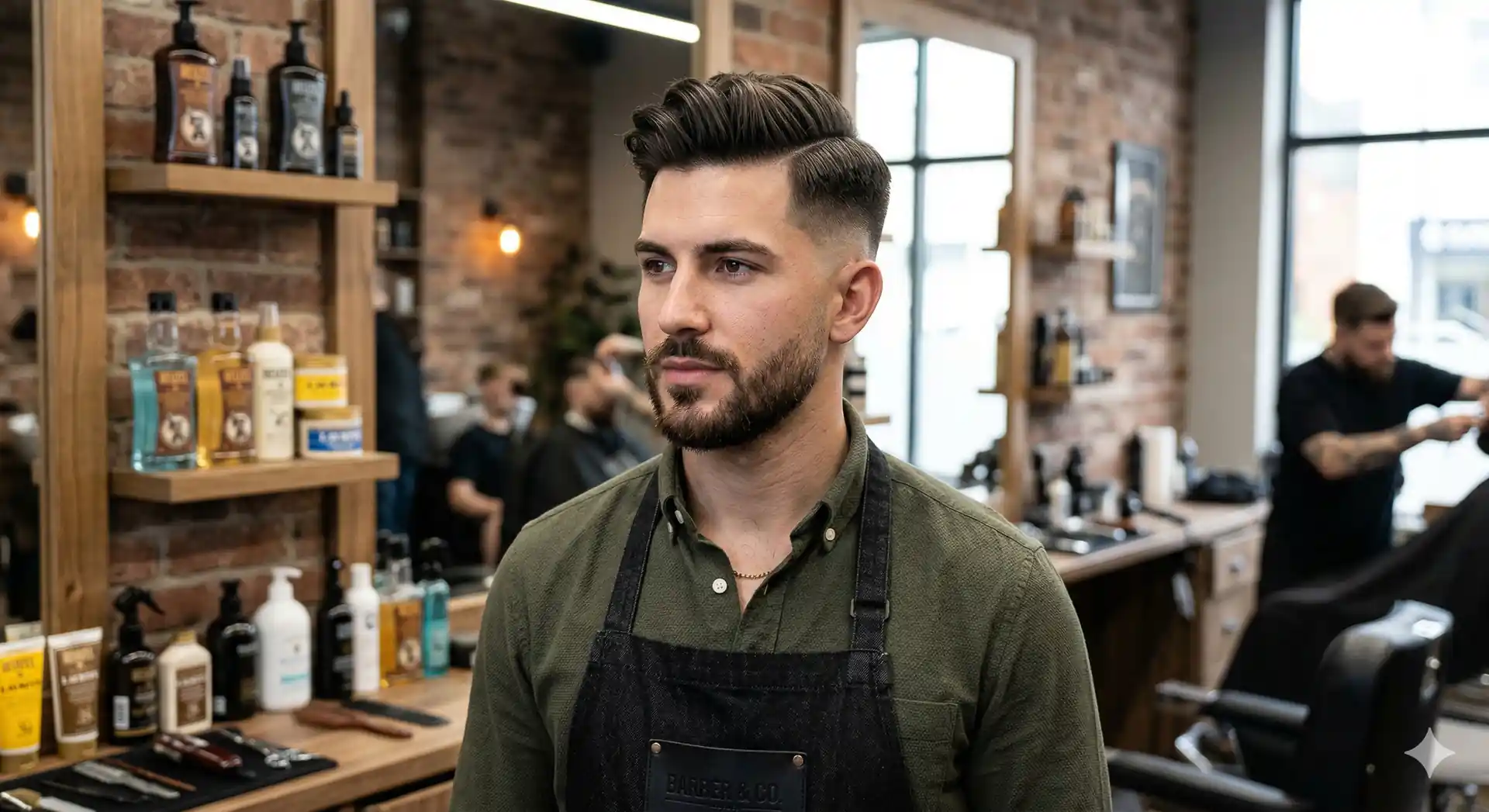
The undercut fade has earned a permanent spot in the modern men's grooming repertoire — and it's not hard to see why. It's one of those cuts that manages to be simultaneously bold and wearable, fashion-forward and office-appropriate, structured and versatile. In 2026, as men increasingly look for haircuts that work across multiple contexts without needing a complete overhaul, the undercut fade delivers on every front.
Whether you've been wearing one for years or you're considering it for the first time, this guide gives you a complete picture: what defines the cut, how the different variations work, how to match one to your face shape and hair type, and exactly how to communicate what you want to your barber.
What Is an Undercut Fade?
An undercut fade combines two distinct barbering techniques. The undercut refers to a dramatic length contrast between the hair on top and the sides and back — the sides and back are cut much shorter than the top, creating a bold separation between the two zones. The fade refers to how the sides and back are finished: instead of a blunt, uniform clipper cut, the hair blends gradually from shorter at the base to longer as it meets the top.
The result is a haircut with strong visual contrast and a clean, defined character. The fade on the sides provides the technical precision that elevates the undercut from a rough DIY look to a barbershop-quality style. The degree of separation between top and sides, the height of the fade, and how connected or disconnected the two sections are all combine to determine which version of the undercut fade you're wearing.
Key Characteristics of an Undercut Fade
- High length contrast: Significant difference between top length (typically 3–6 inches) and the faded sides
- Smooth gradient on the sides: Hair blends from short near the hairline up toward the longer top
- Defined separation line: A visible or implied boundary between the longer top and the shorter sides
- Versatile finish: The top can be styled in countless directions — swept back, to the side, textured, or left natural
- Strong silhouette: Graphic, architectural profile that reads clearly from any angle
Undercut Fade vs. Undercut: Understanding the Difference
The classic undercut and the undercut fade are related but deliver different visual results. Understanding the distinction helps you choose — and communicate — the right cut.
| Feature | Classic Undercut | Undercut Fade |
|---|---|---|
| Side finish | Uniform clipper cut or scissor | Gradient blend from short to longer |
| Transition to top | Abrupt, blunt line | Smooth or semi-smooth gradient |
| Overall look | Hard, graphic, DIY aesthetic | Polished, barber-quality finish |
| Maintenance | Every 4-6 weeks | Every 2-4 weeks |
| Formality | Casual to fashion-forward | Casual to professional |
| Grow-out grace | Harsh | More forgiving |
The undercut fade is essentially a refined undercut — the fade technique adds a level of technical finish that makes the cut look more intentional and professional. The hard line of a classic undercut can look sharp when fresh but tends to appear rough as it grows. The fade version maintains a cleaner appearance throughout the growth cycle.
Types of Undercut Fade Haircuts
The undercut fade spans a wide spectrum of looks depending on the height of the fade, the degree of disconnection, and what's done with the top. Here are the main variations trending in 2026:
Disconnected Undercut Fade
The disconnected undercut is the most graphic version of the style. Instead of a graduated blend from the sides into the top, there's a visible, deliberate separation — often a hard part or a clear line where the longer top hair meets the shorter sides. The sides may be faded among themselves (smooth gradient from the base upward), but the transition to the top is a defined cut rather than a blend.
This creates the highest-contrast, most fashion-forward look in the undercut family. It's intentionally dramatic — the goal is to make the separation between the two zones unmissable.
Best for: Oval and square face shapes, men who want a bold, editorial look, creative and fashion-forward environments.
High Fade Undercut
The fade starts high — near the parietal ridge or upper temple — creating a significant faded zone on the sides and a comparatively compact top section. The high fade undercut is one of the most requested barbershop styles because it delivers maximum visual impact while keeping the hair manageable on top.
The high starting point of the fade means the sides are almost entirely short, making the top section look like a defined island of length. This version rewards thick, dense hair on top where the length really pops against the faded sides.
Best for: Thick or textured hair, oval and round face shapes, men who want strong contrast and a modern look.
Low Fade Undercut
The fade begins just above the natural hairline — around the ear and nape — creating a subtle gradient rather than a dramatic contrast. The low fade undercut retains more hair on the sides than higher variations, resulting in a softer, more conservative look that still delivers the clean finish of a fade.
This is the most versatile and professionally appropriate version of the undercut fade. It can work in corporate environments and still looks sharp in casual settings. The slower transition from short to long makes it grow out more gracefully than a high fade.
Best for: First-time undercut fade wearers, professional environments, heart and oblong face shapes, men who prefer subtle contrast.
Mid Fade Undercut
The fade begins at approximately temple height — the midpoint between the ear and the top of the head. The mid fade undercut hits the sweet spot between the subtle low fade and the dramatic high fade, offering visible, modern contrast without going fully graphic.
This is the most universally requested fade height across all undercut styles, and for good reason — it flatters most face shapes, suits most settings, and delivers the clean, contemporary look without committing to an extreme.
Best for: Most face shapes and hair types, everyday professional and casual wear, men trying an undercut fade for the first time.
Skin Fade Undercut
The skin fade takes the gradient all the way down to bare skin at the base — the sides and nape are completely shaved near the hairline, blending upward through short lengths toward the longer top. This is the highest-contrast, most maintenance-intensive version of the undercut fade.
A skin fade undercut is unmistakable — the stark contrast between bare skin and the longer top creates a dramatic, sculptural silhouette. This version requires the most frequent barbershop visits (typically every 2 weeks) to stay sharp, but when fresh, it's one of the cleanest-looking haircuts available.
Best for: Oval face shapes, men who want maximum sharpness, those comfortable with a bold, high-maintenance style.
Taper Fade Undercut
A variation where the fade tapers more gradually — thinner and tighter near the neckline and around the ears, blending upward toward the top. Unlike the classic skin fade that reaches bare skin, the taper fade undercut maintains a thin layer of hair throughout, creating a softer, more refined transition.
The taper fade undercut skews more conservative than a skin fade version while still delivering the undercut's characteristic length contrast. It suits professional settings particularly well and grows out more cleanly between appointments.
Best for: Professional environments, men who prefer a refined finish over high contrast, square and oblong face shapes.
Undercut Fade with Curly Hair
Curly hair and the undercut fade are a genuinely excellent pairing. The clean, structured fade on the sides provides definition and control, while the natural curl pattern on top adds organic texture and movement that contrasts beautifully with the precision of the sides. This combination has become one of the most popular natural hairstyle combinations in 2026.
The key is keeping the top long enough for the curls to work — typically at least 2.5 to 4 inches. A mid or high fade creates the most flattering contrast against the volume of curls on top.
Best for: Natural curl patterns, men who want to embrace their texture while maintaining clean structure, all face shapes with some modification.
Best Undercut Fade Styles at a Glance
| Variation | Fade Height | Contrast Level | Maintenance | Best Setting |
|---|---|---|---|---|
| Disconnected Undercut | Any | Very High | Every 2-3 weeks | Fashion/Creative |
| High Fade Undercut | High | High | Every 2 weeks | Fashion/Casual |
| Mid Fade Undercut | Mid | Moderate | Every 2-3 weeks | Universal |
| Low Fade Undercut | Low | Subtle | Every 3-4 weeks | Professional |
| Skin Fade Undercut | Any | Maximum | Every 1-2 weeks | Fashion/Bold |
| Taper Fade Undercut | Low-Mid | Moderate | Every 3 weeks | Professional |
| Undercut + Curls | Mid-High | High | Every 2-3 weeks | Casual/Creative |
How to Ask Your Barber for an Undercut Fade
Clear communication is the difference between leaving the chair confident and leaving disappointed. Use this framework:
Step 1: Name the Style
Open with: "I'd like an undercut fade." This immediately establishes the two-zone length contrast combined with a gradient blend on the sides — your barber knows what direction you're headed.
Step 2: Specify the Fade Height
Tell your barber where the fade should start:
- "I want a low fade, starting just above the ear"
- "Give me a mid fade, starting around the temple"
- "I'd like a high fade, starting near the upper temple or parietal ridge"
- "Take it down to skin at the base — skin fade"
If in doubt, point directly to where you want the fade to begin rather than relying on descriptive terms alone. Different barbers interpret "high" slightly differently.
Step 3: Define the Transition — Connected or Disconnected
This is the critical choice in an undercut fade:
- "I want a hard separation — disconnected, with a visible line between the top and sides"
- "Blend it in smoothly — I want the transition to be gradual, not abrupt"
- "Can you do a hard part on the left side, then fade out from there?"
Step 4: Describe the Top
The top styling gives the undercut its full character:
- "Leave about [3 / 4 / 5] inches on top"
- "Keep it long enough to slick back"
- "I want to be able to style it with a side part"
- "Leave enough length for texture and volume"
- "Can you do some point cutting on top to remove bulk?"
Step 5: Address Finishing Details
Don't skip these:
- Neckline: "Square neckline" or "natural taper at the nape"
- Beard blend: "Can you blend the sides into my beard line?"
- Edge-up: "I'd like a sharp edge-up along the hairline"
- Hard part: "Add a hard part on the [left/right] side"
Step 6: Show Reference Photos
Bring 2–3 photos from different angles showing the fade height, disconnection level, and top styling you want. Photos remove ambiguity and give your barber a clear visual target.
"When someone shows me a photo and explains which fade height they want, the whole appointment runs smoother. I can focus on execution rather than guessing." — a consistent sentiment from experienced barbers
Choosing the Right Undercut Fade for Your Face Shape
Your face shape is the single most important factor in selecting the right undercut fade variation.
Oval Face
Oval is the most versatile face shape — virtually every undercut fade variation works. High fades, disconnected styles, skin fades, mid fades — you have the widest range of options. Choose based on your lifestyle and how much maintenance you're willing to commit to.
Recommended: Any undercut fade variation based on personal preference.
Square Face
A square face has strong, angular jaw and temple structure. The undercut fade works well, but mid to low fades are more flattering than very high fades or hard disconnections that can over-emphasize width. A slightly textured or naturally finished top softens the angularity.
Recommended: Mid or low fade undercut with a softer top styling.
Round Face
Round faces benefit from vertical emphasis. A mid to high fade undercut removes side width and lets the top length create upward visual emphasis — which counteracts the roundness. Avoid very low fades that keep the silhouette wide and horizontal.
Recommended: Mid to high fade undercut with volume or length on top.
Heart-Shaped Face
Heart-shaped faces (wider forehead, narrower jaw) should avoid very high fades and disconnected undercuts that amplify the forehead. A low to mid fade with some width preserved at the temples creates better balance. A textured crop or forward fringe on top adds weight to the lower portion of the face.
Recommended: Low to mid fade undercut, textured top styling.
Oblong / Long Face
Longer faces should minimize height. A low taper fade undercut works best — it cleans up the sides without adding vertical length. Avoid high fades and tall top styles that make the face appear even longer. Keep the top at a moderate length rather than very short or very long.
Recommended: Low fade undercut, moderate top length, avoid extreme height.
Diamond Face
Diamond faces (narrow forehead and jaw, wide cheekbones) suit a mid fade undercut well. The clean sides provide structure while the fade avoids adding excess width at the widest point. A mid-length top with natural movement is most flattering.
Recommended: Mid fade undercut with a natural or lightly textured finish on top.
Undercut Fade for Every Hair Type
Thick Hair
Thick hair is the ideal canvas for an undercut fade. The fade dramatically reduces bulk on the sides, and the strong contrast between the clean, short fade and the dense top creates maximum visual impact. Request point cutting or texture cutting on the top to reduce weight and prevent the top from becoming too bulky to style.
Styling tip: Use a matte clay or fiber to control bulk while adding texture. Blow-dry with a diffuser for natural movement.
Fine / Thin Hair
Fine hair requires a careful approach with the undercut fade. Avoid going too short on the sides — a low or mid fade that retains more hair is better than a skin fade that emphasizes thinness. Keep the top at a moderate length and use volumizing products to add body.
Styling tip: Apply a volumizing mousse to towel-dried hair and blow-dry upward. Finish with a lightweight, low-hold pomade to avoid weighing the hair down.
Curly Hair
Curly hair thrives with an undercut fade. The structured sides frame the natural curl pattern on top beautifully, and the contrast between the clean fade and the organic curl volume is one of the most visually compelling combinations available. Find a barber who understands how curls behave when dry — curly hair cut wet will be shorter than anticipated once it springs back.
Styling tip: Apply curl cream to damp hair, scrunch, and air dry or diffuse on low heat. Avoid heavy gels that create a crunchy finish.
Wavy Hair
Wavy hair suits the undercut fade very well. The natural texture and movement of waves add dimension to the longer top section, creating effortless visual interest. A mid or high fade with a loosely styled, wave-forward top is one of the most wearable and low-effort versions of the style.
Styling tip: Enhance the natural wave with a light-hold sea salt spray. Avoid over-styling — the wave pattern looks best when it's allowed to move naturally.
Straight Hair
Straight hair shows the technical precision of the undercut fade extremely clearly — the clean gradient and sharp transition stand out. The downside is that straight hair can look flat on top without some structural product. A matte clay or pomade adds texture and prevents the limp, heavy look that straight hair can develop.
Styling tip: Point cut the top section for texture, then use a matte clay to define and separate.
Coarse / Afro-Textured Hair
The undercut fade is a strong choice for coarse and afro-textured hair. The fade provides clean structure around the natural shape on top, and the length contrast creates beautiful dimension. The key is moisture — coarse hair needs regular conditioning to maintain its health, particularly in the faded areas where the scalp is exposed.
Styling tip: Use a curl cream or shea butter product on top to moisturize and define. Seal with a light oil for shine.
Styling Your Undercut Fade
The top section of the undercut fade can be styled in many directions — here are the most common approaches.
Slicked Back Undercut Fade
Sweep the top section straight back from the hairline using a pomade or gel. This version of the undercut fade is the most polished and professional. Use a fine-tooth comb to achieve a clean, defined surface, or use your fingers for a looser, more natural finish.
Products: Water-based pomade for classic shine; matte clay for a modern, less glossy version.
Side Part Undercut Fade
Create a defined part on one side and comb the hair across the top. This works particularly well with a disconnected undercut where the hard part visually extends the parting line all the way into the fade. A side part undercut fade is one of the most office-appropriate top styling choices available.
Products: Light to medium pomade or styling cream for hold and definition.
Textured / Natural Undercut Fade
Leave the top section in its natural direction with minimal deliberate styling. Apply a matte clay or fiber for a piece-y, textured finish and let the hair fall where it naturally wants to go. This version is casual, effortless, and suits everyday wear perfectly.
Products: Matte clay or fiber paste — work through dry hair with fingertips.
Forward-Swept / French Crop Top
Push the top section forward toward the face and create a textured crop effect. This works particularly well with mid to high fades where the forward-swept top creates strong contrast against the clean faded sides.
Products: Matte clay for texture and piece-y definition.
Maintenance and Care
The undercut fade requires regular barbershop visits to stay sharp. The specific frequency depends on the fade height and how important a crisp appearance is to you.
Touch-Up Schedule
- Skin fades: Every 1–2 weeks — bare skin grows out immediately and becomes visible quickly
- High fades: Every 2 weeks — the high starting point means the gradient is clearly compromised by week 3
- Mid fades: Every 2–3 weeks — the sweet spot for most men
- Low fades: Every 3–4 weeks — the most forgiving option between appointments
Between Appointments
- Edge-up services: Many barbershops offer quick edge-up appointments between full cuts — this refreshes the hairline and side lines without the full cost of a complete cut
- Scalp care: Freshly faded skin is exposed and can be sensitive. Apply a light, non-comedogenic moisturizer after cuts, especially if you're prone to dryness or irritation
- Product consistency: Establish a daily routine with 1–2 products. Using the same products consistently means the hair trains to your preferred direction over time
- Shampooing frequency: Washing 2–3 times per week is generally optimal for most hair types. Over-washing can dry out the scalp; under-washing leads to product buildup that weighs the hair down
Recommended Products
| Product Type | Best For | Hold Level | Finish |
|---|---|---|---|
| Matte Clay | Textured, casual styles | Medium-Strong | Matte |
| Water-Based Pomade | Slick back, side part | Medium-Strong | Shine |
| Styling Cream | Curly and wavy hair | Light-Medium | Natural |
| Sea Salt Spray | Wave enhancement, texture | Light | Matte |
| Fiber/Paste | Piece-y texture, movement | Medium | Low shine |
| Gel | Maximum hold, wet look | Strong | High shine |
Common Undercut Fade Mistakes to Avoid
- Not specifying connected vs. disconnected: This is the most common communication failure. Clarify explicitly whether you want a hard line separation or a smooth blend before the barber starts
- Skipping reference photos: Verbal descriptions of fade heights and top lengths are interpreted differently by different barbers. Photos remove the ambiguity
- Choosing a high or skin fade without considering maintenance: High-contrast fades require frequent visits. Be honest with yourself about your schedule and budget before committing
- Neglecting the neckline specification: Square necklines are deliberate and bold. Natural necklines grow out more cleanly. Neither is wrong — but you should specify
- Using heavy products on the faded sides: Product applied to the faded sections looks greasy and draws attention away from the clean gradient. Keep product focused on the top
- Going too short on the top: The undercut fade depends on length contrast. A top that's too short loses the entire visual concept. Keep at least 2.5–3 inches on top for the style to read properly
Frequently Asked Questions
What's the difference between an undercut and an undercut fade?
A classic undercut uses a uniform clipper setting to cut the sides and back short, creating a blunt transition to the longer top. An undercut fade uses the same length contrast but adds a gradient blend on the sides — the hair transitions smoothly from short at the base to longer near the top rather than switching abruptly. The fade finish makes the undercut look more polished and technically refined.
How long does an undercut fade last between cuts?
This depends on the fade height. A low fade undercut typically looks clean for 3–4 weeks. A mid fade requires a visit every 2–3 weeks. A high or skin fade undercut needs attention every 1–2 weeks because the high-contrast gradient becomes visibly compromised quickly as hair grows. Factor your preferred maintenance frequency into your fade height decision.
Can I get an undercut fade with curly hair?
Yes — curly hair and the undercut fade are an excellent combination. The structured fade on the sides provides clean definition, while the natural curl pattern on top adds beautiful organic texture. The key is finding a barber experienced with curly hair who understands how curls spring back when they dry. Make sure the barber cuts the top when dry (or at your natural curl state) to ensure the final length is accurate.
Is an undercut fade professional?
Yes, with the right variation. A low or mid fade undercut with a neat, styled top is appropriate for most professional environments. A disconnected undercut or skin fade undercut leans more fashion-forward and may draw more attention in conservative corporate settings — but even these are widely accepted across most industries in 2026. Your product choice also matters: a matte, textured finish reads more casual; a clean side-parted pomade finish reads more professional.
What products should I use to style an undercut fade?
It depends on the top styling you prefer. For a slicked-back or side-parted look, a water-based pomade at medium hold works for most hair types. For a textured, natural finish, a matte clay or fiber paste is the better choice. For curly and wavy hair, a curl cream or light-hold styling cream maintains the natural pattern without causing frizz or crunch. Avoid heavy gels on the sides — focus product application on the top only.
How short should the sides be for an undercut fade?
This is a matter of preference and fade height. A skin fade takes the sides down to bare skin near the hairline. Most mid and high fades use a #0.5 to #1 clipper guard at the lowest point, blending up through #1, #1.5, #2, and sometimes #3 toward the top. A low taper fade may use a #2 at the base and blend up from there. Your barber will know the exact guards to use — focus on specifying the height (low, mid, high, skin) and the degree of contrast you want.
Can I maintain an undercut fade at home?
You can perform basic maintenance between appointments — touching up the neckline with a home clipper, cleaning up the hairline edges — but the fade work itself requires professional skill. The gradient blend of a high-quality fade is one of the most technically demanding aspects of barbering. Attempting to recreate or maintain it at home typically results in visible lines and uneven blending. Budget for regular barbershop visits as part of the cost of this style.
Preview Your Undercut Fade with BaldFade AI
Not sure which undercut fade variation suits your face shape? Use BaldFade's AI preview tool to visualize different fade heights and top styles before your appointment. Upload your photo, select your desired style, and see how the undercut fade would look on you from multiple angles.
Our AI-powered tool helps you:
- Compare disconnected vs. blended undercut options side by side
- Visualize low, mid, high, and skin fade variations on your actual face
- Try different top styling directions — slick back, side part, textured crop
- Build a clear visual reference to show your barber
Conclusion
The undercut fade's staying power comes down to a simple truth: it delivers visible, intentional style with enough range to work across nearly any setting, hair type, and personal aesthetic. It's not a subtle cut — the contrast is part of the point — but within that bold framework, there's significant room to dial up or down the drama based on fade height, degree of disconnection, and how you style the top.
The fundamentals of getting it right are straightforward: choose the fade height that suits your face shape and maintenance tolerance, communicate clearly with your barber (especially about connected vs. disconnected), and invest in the right product for your preferred top style.
Whether you wear it disconnected for maximum graphic impact, mid-faded for versatile everyday use, or textured with natural curls for organic movement, the undercut fade gives you a framework that keeps working as your lifestyle demands change.
Explore related styles in our complete guides to the high fade, skin fade, and taper fade.