

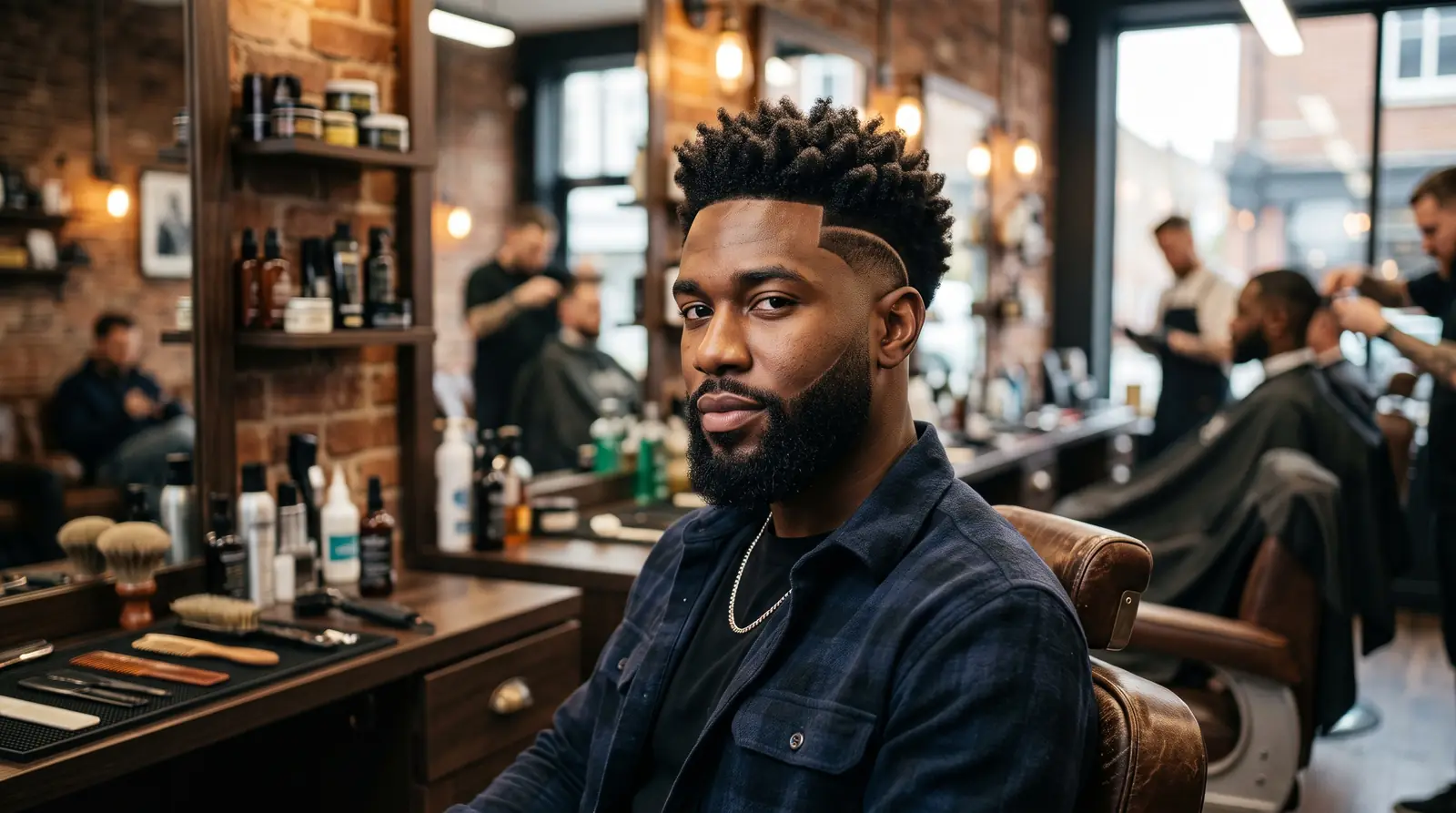
The burst fade is one of the most visually striking fade variations in modern barbering. While most fades work vertically—blending hair from the neckline up—the burst fade radiates outward in a semicircular arc around the ear, creating a distinctive halo effect that draws the eye and adds serious definition to any hairstyle it accompanies.
In 2026, the burst fade has cemented its place as the go-to choice for anyone wanting a fade that does more than just clean up the sides. It's bold, structural, and unmistakably intentional. Whether you're pairing it with a mohawk, a mullet, a textured crop, or even a natural afro, the burst fade brings geometric precision to the equation. This guide covers everything: what it is, how it differs from other fades, which variations suit different styles and face shapes, and how to walk into any barber and communicate exactly what you want.
What Is a Burst Fade?
A burst fade is a type of fade haircut where the hair is tapered in a semicircular shape that radiates outward from behind the ear. Rather than blending hair uniformly down to the neckline like a standard fade, the burst fade creates an arc—the hair is shortest at the center point behind the ear and gradually gets longer as it fans outward above and below, like a sunburst or halo.
The defining visual characteristic is that the fade "bursts" outward around the ear, leaving the neckline with more length compared to a typical taper or fade. The hair above the fade (on top of the head) and directly on the neck can remain longer, which is what makes the burst fade such a versatile partner for styles like the mohawk, mullet, or pompadour.
Key Characteristics of a Burst Fade
- Semicircular arc shape: The fade radiates outward from behind the ear, not straight down
- Ear-centered focal point: The shortest point anchors behind or around the ear
- Preserved neckline length: Unlike drop fades, the back of the neck often retains more length
- Dramatic visual contrast: Creates a bold outline that defines the top style
- High versatility: Pairs with mohawks, mullets, afros, textured crops, and more
- Available in multiple heights: Low, mid, and high burst variations exist
Burst Fade vs Similar Fades
The burst fade is often grouped with other fade types, but its structure is genuinely distinct. Here's how it compares to the fades you're most likely to encounter:
| Feature | Burst Fade | Drop Fade | Taper Fade | Skin Fade | Temple Fade |
|---|---|---|---|---|---|
| Shape | Semicircular arc around ear | Drops behind ear following curve | Straight blend from sides | Full shave to skin | Fades at temple/hairline only |
| Neckline | More length preserved | Low, curved | Natural taper | Can go to zero | Natural, untouched |
| Visual Impact | Bold, sculptural halo | Sleek curved drop | Clean, conservative | Maximum contrast | Subtle, refined |
| Best Paired With | Mohawk, mullet, afro, curls | Textured crop, side part | Crew cut, pompadour, classic styles | Any short style | Slick back, side part, waves |
| Barber Difficulty | Moderate-High | Moderate | Low-Moderate | Moderate | Low |
| Maintenance Frequency | Every 2 to 3 weeks | Every 2 to 3 weeks | Every 3 to 4 weeks | Every 1 to 2 weeks | Every 3 to 4 weeks |
The burst fade's superpower is its ability to frame a style from the sides and back while preserving length at the neck—a quality no other fade quite matches.
Types of Burst Fade Variations
Not all burst fades are the same. The placement, depth, and the style on top all influence which variation works best for you.
Low Burst Fade
The arc sits low on the head, just above and around the ear. This is the most subtle version—still visually distinctive, but more conservative than higher placements. It works well when you want definition without making too aggressive a statement. Ideal for professional settings where you want a clean, polished look that's still modern.
Mid Burst Fade
The arc starts at ear level and extends upward past the temple to roughly the midpoint of the head. This is the most common burst fade variation—high enough to be bold, low enough to stay clean. Most barbers will default to a mid burst fade when you simply ask for "a burst fade."
High Burst Fade
The arc rises up to the upper temples and crown area. Combined with styles like a mohawk or a high top, this creates maximum contrast and a very dramatic silhouette. The high burst fade isn't for the faint-hearted—it's a statement cut.
Burst Fade Mohawk
The burst fade's most iconic pairing. The semicircular arc on each side perfectly outlines the mohawk strip running down the center, creating a sculptural, runway-ready look. The mohawk strip can be any length—from a couple inches of natural texture to a full foot-long styled Mohawk. The burst fade is what gives it that precise, intentional edge.
Burst Fade Mullet
The mullet-burst-fade combination has exploded in popularity because the burst fade solves the mullet's biggest visual challenge: the awkward transition from short sides to long back. The arc creates a defined boundary between the tight sides and the flowing back, making the mullet look intentional and modern rather than dated.
Burst Fade with Afro or Natural Hair
For textured and natural hair types, the burst fade is exceptionally effective. The arc creates a sculpted frame around the afro or twist-out that enhances the hair's natural volume and shape. A burst fade at the sides and back with a rounded afro on top produces one of the most visually harmonious haircuts available for 4A to 4C hair textures.
Burst Fade with Curly Hair
Curly-haired clients benefit enormously from the burst fade's structure. The arc provides definition and boundary for curls that might otherwise look formless at the sides. The contrast between the short, precise fade and the natural movement of curls on top creates a dynamic, textured look.
Taper Burst Fade
A hybrid variation that incorporates elements of the taper at the neckline while maintaining the burst fade's semicircular shape around the ears. This is a cleaner, less aggressive version suitable for clients who want the burst fade's distinctive shape without the skin-close fade at the sides.
Burst Fade by Face Shape
Like all fades, the burst fade's visual effect changes depending on your face shape. Choosing the right variation can make the cut look purposeful rather than accidental.
Round Face
For round faces, height is your ally. A high burst fade paired with height on top (a high mohawk, a quiff, or a high-volume natural style) adds vertical length to counterbalance horizontal width. Avoid very low burst fades that emphasize the sides—they'll make a round face look rounder.
Oval Face
Oval faces work with virtually every burst fade variation. This is the most versatile face shape for experimentation. A mid burst fade is a reliable default, but feel free to try high or low variations depending on the style on top.
Square Face
Square faces have strong jawlines and angular features that pair naturally with the burst fade's bold geometry. A mid burst fade matches the existing structure. A high burst fade with a soft, textured top adds contrast between the angular jaw and loose, flowing hair above—a very compelling combination.
Diamond Face
Diamond faces are widest at the cheekbones with a narrower forehead and jawline. A low to mid burst fade keeps the profile balanced without adding extra width at the temples. Avoid high burst fades that emphasize the wide cheekbones.
Oblong/Rectangular Face
For longer faces, a low burst fade with width on top (like a textured crop or afro) works best. This adds visual width and balances the length. High burst fades and very close crops can elongate an already long face further.
Heart Face
Heart-shaped faces (wider at forehead, narrower at jaw) benefit from a low to mid burst fade that creates balance. Volume at the sides should be minimal to avoid emphasizing the wide top of the face.
How to Ask Your Barber for a Burst Fade
Walking into the barber chair without clear instructions is the most reliable way to leave disappointed. Here's how to communicate exactly what you want:
The essential information to provide:
- Fade type: "I want a burst fade" — this tells them the arc shape around the ear
- Height: "Low, mid, or high burst fade" — specify where you want the arc to sit
- Skin depth: "Down to skin" or "down to a [number] guard" at the shortest point
- Style on top: Describe exactly what you want on top — mohawk, textured, natural, mullet, etc.
- Reference photo: Always bring a photo. Barber language varies by region — a photo removes ambiguity entirely
What to say:
"I'd like a mid burst fade, down to skin behind the ear, fading out to about a 2 on the sides. Keep the top [describe your top style] and leave the neck [longer/natural/also faded]."
Questions your barber may ask:
- "How tight do you want it at the shortest point?" — Answer with zero (skin), 0.5, or 1 guard
- "Do you want the back tapered or natural?" — The burst fade typically leaves the neckline natural, but you can request a clean line or taper if preferred
- "What length are you keeping on top?" — Be specific; use inches or centimeters
Common mistakes to avoid:
- Saying "short on the sides" without specifying burst fade — you'll get a regular fade
- Not mentioning the neckline preference — barbers will default to their own style
- Forgetting to mention the top style — the burst fade frames the top, so both must be coordinated
Burst Fade Maintenance and Styling
How Often to Get a Burst Fade Touched Up
A burst fade loses its shape faster than a standard taper because the arc is so geometrically precise—any growth immediately breaks the clean outline. For a skin-level burst fade, expect to visit your barber every 1 to 2 weeks to maintain sharpness. For a burst fade that fades to a 1 or 2 guard, every 2 to 3 weeks is more realistic.
The style on top determines the upper limit: if the top grows faster than the fade, the whole cut starts to look unbalanced.
At-Home Maintenance Between Cuts
- Keep the arc visible: Most people can't DIY the burst arc at home without the skill to execute the semicircular shape. Focus on keeping the top style fresh rather than attempting to re-fade at home.
- Moisturize textured hair: For natural and curly burst fade styles, scalp and hair hydration is essential. Use a light oil or leave-in conditioner on the longer sections.
- Edge up at home: The hairline and temple areas can be maintained at home with a trimmer for basic tidiness between barber visits.
Styling Products by Hair Type
| Hair Type | Recommended Products | Application |
|---|---|---|
| Straight/Fine | Matte clay or pomade | Work through slightly damp hair, style into place |
| Wavy | Sea salt spray + light hold cream | Scrunch into damp hair, let air dry |
| Curly | Curl cream or curl-defining gel | Apply section by section to wet hair |
| Coily/Natural | Shea butter moisturizer + light oil | LOC method (Liquid, Oil, Cream) on damp hair |
Burst Fade FAQs
Does the burst fade work on all hair types?
Yes. The burst fade is a technique applied to the sides and back of the head, so it works regardless of hair texture on top. The style on top will change based on hair type, but the fade itself is achievable on straight, wavy, curly, and coily hair.
How is a burst fade different from a regular fade?
A regular (standard) fade blends hair straight down the sides and back in a vertical gradient. A burst fade creates a semicircular arc around the ear, radiating outward. This means the burst fade typically preserves more length at the neckline and creates a distinctly different silhouette.
Can I get a burst fade if I have thinning hair?
Yes, with some considerations. A burst fade can actually work well for thinning hair because it creates the illusion of defined structure where natural density may be lacking. Avoid very high burst fades that expose large areas of scalp. A low to mid burst fade with a textured crop on top is a common choice.
Is the burst fade high maintenance?
Compared to standard fades, yes—slightly. The arc shape is very precise, and growth disrupts the clean outline quickly. Plan for more frequent barber visits (every 1 to 3 weeks depending on depth). The upside is that the style looks extremely deliberate and polished when fresh.
What styles go best with a burst fade?
The burst fade pairs best with styles that have visible length on top: mohawks, mullets, afros, textured crops, pompadours, and curly styles. It doesn't pair as naturally with very uniform short cuts (like buzz cuts) because the top and sides would be the same length, eliminating the contrast.
How long does a burst fade take?
An experienced barber can execute a burst fade in 20 to 40 minutes depending on the complexity of the top style. More intricate combinations (like a burst fade mohawk with complex detailing) can take up to an hour.
What's the difference between a burst fade and a drop fade?
A drop fade dips lower behind the ear and follows the natural curve of the head downward—it's a downward drop. A burst fade radiates outward from behind the ear in a semicircular arc—it fans up and out, creating a halo or sunburst shape. Drop fades are generally cleaner and more conservative; burst fades are more sculptural and bold.
Ready to Book Your Burst Fade?
The burst fade is one of the most confident haircut choices you can make in 2026. Its geometric precision, dramatic framing effect, and compatibility with virtually any style on top make it one of the most photographed and most requested fades in barbershops worldwide.
The key to a great burst fade is communication. Know your height, know your fade depth, know your top style, and bring a reference photo. Walk in with that information and you'll walk out with exactly what you came for.
Explore more fade guides on BaldFade to find the perfect companion style for your burst fade—whether that's a mohawk fade, a mullet fade, a skin fade, or a taper fade.