

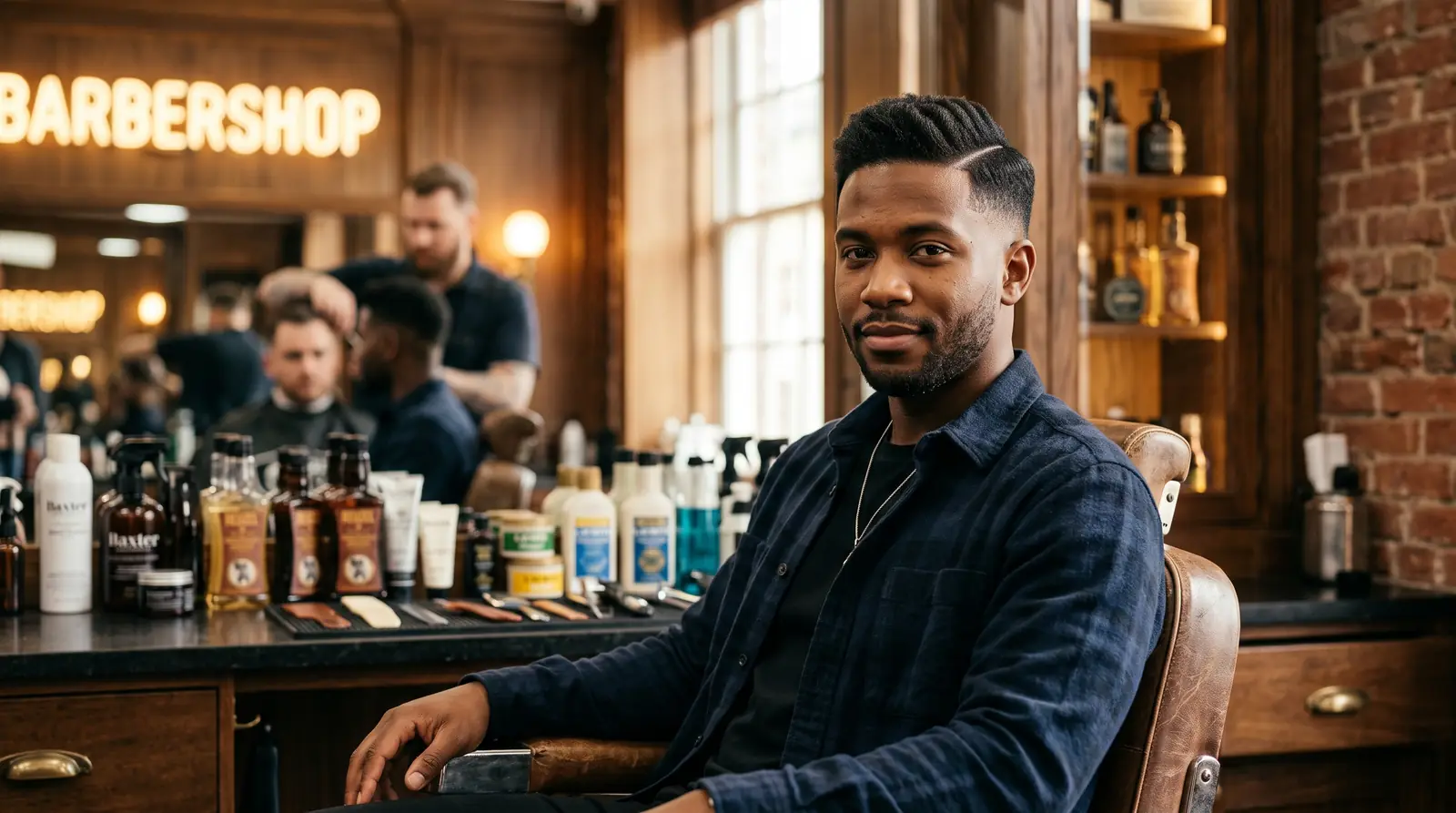
The ivy league fade is one of the most consistently requested haircuts in barbershops right now — and for good reason. It occupies a rare middle ground between the precision of a short professional cut and the versatility of a style that can be dressed up or down depending on how you finish it. In 2026, it's undergoing a quiet resurgence: updated with cleaner fades, looser texture on top, and a more modern silhouette that feels right at home in both a boardroom and a weekend setting.
This guide covers everything: what defines an ivy league fade, how it differs from similar styles, all the fade variations available, how to match the right version to your face shape and hair type, and exactly what to say to get it right at your next appointment.
What Is an Ivy League Fade?
An ivy league fade combines the classic ivy league haircut — a short, clean cut with a side part and slightly longer length on top — with a clipper fade on the sides and back that blends from short near the hairline upward toward the longer top. The result is a tailored, structured cut with a smooth gradient that makes the overall style look sharp and intentional.
The ivy league cut itself, sometimes called a Princeton cut or Harvard clip, originated in American prep-school and collegiate culture. It's essentially a grown-out crew cut — the top is left longer (typically 1.5 to 3 inches), allowing for a side part and some styling, while the sides and back are kept short. The fade modernizes this by replacing the blunt or scissor-tapered sides with a precise clipper gradient that creates a seamless blend from the hairline up.
What separates an ivy league fade from a plain crew cut or a standard ivy league is that clipper blend on the sides. Where a traditional ivy league has sides cut short but not necessarily faded, the fade version introduces a gradual transition — shorter at the base, blending longer as it reaches the top — that gives the cut a much more polished, contemporary edge.
Key Characteristics of an Ivy League Fade
- Longer top: Typically 1.5–3 inches — enough for a defined side part and light styling
- Faded sides: Smooth clipper gradient blending from the base upward toward the top length
- Side part: The classic ivy league features a clean, defined part that completes the look
- Short fringe: Hair at the front is cut to fall just above or onto the forehead — no overhang
- Clean, structured finish: The cut communicates precision and professionalism without being severe
Ivy League Fade vs Similar Styles
The ivy league fade is frequently compared to several related haircuts. Understanding the differences helps you choose the right style and communicate clearly with your barber.
| Feature | Ivy League Fade | Crew Cut Fade | Side Part Fade | Comb Over Fade |
|---|---|---|---|---|
| Top length | 1.5–3 inches | 0.5–1.5 inches | 2–4 inches | 2–5 inches |
| Fringe | Short, at forehead | Very short or cropped | Swept to one side | Swept to one side |
| Side part | Optional but classic | Rarely styled | Defined, essential | Defined, essential |
| Styling required | Light to moderate | Minimal | Moderate | Moderate |
| Formality | Business casual to formal | Casual to athletic | Versatile | Versatile |
| Maintenance | Every 2–3 weeks | Every 2–4 weeks | Every 2–3 weeks | Every 2–3 weeks |
The key distinction between an ivy league fade and a crew cut fade is top length. A crew cut keeps the top very short — often just a quarter inch or so — while the ivy league grows it out enough to allow styling. If you can part and comb the top, it's an ivy league. If it's uniformly buzzed, it's a crew cut.
Compared to a comb over fade, the ivy league fade wears shorter on top and features less dramatic horizontal movement. A comb over pushes hair significantly to one side, sometimes with considerable length and volume. An ivy league sits neatly, with subtle styling rather than bold horizontal sweep.
"The ivy league fade is the cut I recommend most to professional men who want something clean and modern but don't want to spend time in the mirror every morning. You can style it in two minutes and it looks sharp all day." — common feedback from experienced barbers
Types of Ivy League Fade Haircuts
The height and type of fade dramatically changes the character of the ivy league. Here are all the major variations, from understated to high-contrast.
Low Ivy League Fade
The fade begins just above the ear and at the nape, keeping the transition subtle and close to the natural hairline. This is the most conservative and versatile option — appropriate for virtually any professional environment, and the easiest to maintain between appointments. The low fade complements the ivy league's clean aesthetic without making the sides too dramatic.
Best for: Professional environments, conservative dress codes, first-time fades.
Mid Ivy League Fade
The fade starts around temple height, creating more visible contrast between the faded sides and the styled top. This is the most commonly requested version — it's modern enough to feel current but restrained enough to remain highly versatile. The mid fade accentuates the side part and gives the whole silhouette a cleaner edge.
Best for: Most men, most occasions. The all-purpose ivy league fade.
High Ivy League Fade
The fade starts high — above the temples, sometimes just below the top section — creating strong contrast and a sharper, bolder silhouette. At this height, the boundary between the faded sides and the styled top is very visible, lending a more contemporary, fashion-forward character. This version reads as intentional and stylish rather than simply professional.
Best for: Oval and oblong face shapes, men who want a more modern, expressive look.
Skin (Bald) Ivy League Fade
The fade goes all the way down to the skin at the base, creating maximum contrast. The sides and back are essentially bare near the hairline, blending smoothly up toward the longer top. This is the most dramatic version — it makes the side part and top styling pop visually and gives the cut an extremely clean, sharp finish.
Best for: Oval face shapes, men who prefer minimal maintenance on the sides, barbershop-fresh looks.
Taper Ivy League Fade
Rather than a full clipper fade, the sides are tapered — gradually decreased in length using both scissors and clippers, staying closer to the natural line of the hair. The result is softer than a hard fade, with a more understated gradient that suits traditional or conservative dress codes particularly well.
Best for: Classic aesthetics, office environments, men who prefer a subtler transition.
Textured Ivy League Fade
The top is styled with texture rather than a neat, slicked part — loose, piece-y, or slightly messy on top, contrasted against a clean fade on the sides. This version leans into the 2026 trend toward natural-looking, low-shine finishes. It retains the ivy league's structure while softening the overall feel.
Best for: Casual settings, thick or wavy hair, men who want modern styling without high effort.
Ivy League Fade for Every Face Shape
The right ivy league fade variation depends heavily on your face shape. Here's how to match the cut to your features.
Oval Face Shape
Oval faces are the most accommodating — virtually any ivy league fade works. High and mid fades with clean side parts create excellent results. The balanced proportions of an oval face mean you can push toward more contrast without worrying about the cut looking unbalanced.
Square Face Shape
For square faces, a mid or low fade with some texture on top works best. The slight softness from texture or a loose part counterbalances the strong jaw. Avoid very high fades that over-emphasize the width of the temples and jaw.
Round Face Shape
A mid or high fade with a clearly defined side part and some height on top helps elongate the face. The vertical emphasis of a neat part and the contrast from a visible fade draw the eye upward, making round faces appear more oval. Avoid very low fades that keep things horizontal and emphasize roundness.
Oblong / Long Face Shape
A low to mid fade with less height on top and softer styling reduces the appearance of vertical length. A loose, relaxed texture on top rather than a swept-back part is more flattering. Avoid skin fades and very high fades that add length to the silhouette.
Diamond Face Shape
The ivy league fade flatters diamond faces particularly well. A low to mid fade that doesn't remove too much width from the temples, paired with moderate top length, keeps the silhouette balanced. The fringe of the ivy league also helps fill in the narrower forehead typical of diamond faces.
Ivy League Fade for Every Hair Type
Straight Hair
Straight hair shows the side part and styling most crisply — the ivy league fade looks its cleanest on straight hair. Light pomade or matte clay works perfectly. Low to mid fades enhance the precision of straight hair without competing with it.
Wavy Hair
Wavy hair adds natural texture that works beautifully with the ivy league fade. The waves give the top movement and character without requiring much product. Opt for a mid fade to let the wave pattern of the top play against clean sides. Matte paste or light styling cream works well.
Thick Hair
Thick hair holds the ivy league's structure extremely well. Request that the barber thin the top slightly so it doesn't sit too heavy. A skin or high fade on the sides creates excellent contrast against the volume of thick hair on top.
Fine Hair
Fine hair requires a slightly different approach. A mid to low fade prevents the sides from looking too sparse. Keep the top at the higher end of the ivy league length range (2.5–3 inches) to maximize volume, and use a light volumizing product rather than heavy pomade.
Curly Hair
Curly hair can work with an ivy league fade but requires specific communication with your barber. The curls add significant visual volume, so a mid or high fade is usually necessary to keep proportions balanced. The top may be styled loose for a natural look or lightly defined with a curl cream.
How to Ask Your Barber for an Ivy League Fade
Clear communication with your barber is the difference between getting exactly what you want and walking out disappointed. Here's a precise brief you can use:
The complete request:
"I'd like an ivy league fade — keep the top about [1.5 / 2 / 2.5] inches, with a clean side part on the [left/right]. For the sides, I'd like a [low / mid / high / skin] fade. Keep the fringe short — just at the forehead, not below it. For the neckline, [squared / rounded / natural taper]."
What to clarify before they start:
- Top length: Use inches, not vague terms. "About two finger-widths" is useful if you're unsure of exact measurements.
- Fade height: Point to where you want the fade to start — at ear height, mid-temple, or above the temple.
- Fringe length: Show your current fringe and confirm you want it shortened, not left as-is.
- Part side: Specify left or right. Most barbers will default to your natural part, but confirm it.
- Neckline shape: Squared looks sharp and deliberate. Rounded is softer. Natural taper grows out most cleanly between appointments.
Photos help: Bring one or two reference photos that show the fade height and top length you want. Showing is always more reliable than describing.
Styling an Ivy League Fade
One of the ivy league fade's best qualities is how little styling it actually requires. Here's how to finish it correctly.
Everyday Styling (5 minutes or less)
- Wash and towel-dry hair until damp but not dripping
- Work a small amount (dime-sized) of matte clay or light pomade through the top
- Comb to one side to establish the part — use a fine-tooth comb for a clean line
- Use your fingers to refine the texture, if desired
- Allow to air-dry or use a hairdryer on low heat for 60 seconds
Products that work well: Matte clay for texture, medium-hold pomade for a cleaner finish, light styling cream for wavy or curly hair.
Formal/Professional Styling
For high-definition results — job interviews, events, weddings:
- Use a medium-hold pomade or low-shine pomade for a clean, structured look
- Blow-dry while combing to set the part crisply
- Finish with a fine-tooth comb for maximum definition
Going Product-Free
The ivy league fade works remarkably well without any product. If your hair holds a part naturally, simply comb it after drying and you're done. The fade does the visual work — the top just needs to be neat.
Maintenance Schedule
Consistent maintenance is what keeps an ivy league fade looking intentional rather than grown-out.
- Every 2 weeks: If you got a high or skin fade, you'll need a freshen-up at this interval. Fades grow out quickly and the contrast diminishes noticeably after 2 weeks.
- Every 3 weeks: For mid and low fades, 3 weeks is the sweet spot — the fade is starting to soften but the shape is still there.
- Every 4 weeks: Low fades and tapers can stretch to 4 weeks, particularly if you're comfortable with a slightly grown-out look.
Between Appointments
- Neckline: This is the first area that looks unkempt as hair grows. Many barbers will clean up the neckline between appointments at minimal or no cost — ask if your barber offers this.
- Product: A light product keeps the top laying correctly as it grows. Avoid heavy products that make the top look greasy or over-styled.
- Washing: Wash 3–4 times per week for most hair types. Over-washing removes natural oils and can make fine hair look flat.
Frequently Asked Questions
Is the ivy league fade a professional haircut? Yes — the ivy league fade is one of the most office-appropriate modern haircuts. The structured top, clean part, and tailored fade read as polished and deliberate. It works in conservative professional environments as well as creative ones.
What's the difference between an ivy league and a crew cut? Length on top. A crew cut is cut uniformly short with clippers across the entire top — usually a number 2–4 guard. An ivy league keeps the top long enough (1.5–3 inches) to part and style. Both can have fades on the sides, but only the ivy league has enough top length for actual styling.
How long does an ivy league fade take to cut? Typically 20–35 minutes with an experienced barber. The fade itself requires the most care — expect 10–15 minutes for precise fade work, plus time for the top.
Can I get an ivy league fade with thick hair? Yes, and thick hair often produces excellent results — it holds the part cleanly and the top has natural body. Request that the barber thin the crown slightly to prevent the top from sitting too heavy.
How do I grow out an ivy league fade? As the top grows, the ivy league naturally transitions toward a longer side part style. You can let the fade grow out into a low taper, which maintains a neat appearance while requiring less frequent barber visits. At around 3–4 inches of top length, you're in classic side part territory and can choose whether to keep the fade tight or let it grow more naturally.
What product should I use for an ivy league fade? Start with a matte clay for everyday texture, or a medium-hold pomade for a cleaner, more defined finish. Avoid heavy petroleum pomades unless you specifically want a high-gloss, slicked-back look. For wavy or curly hair, a light styling cream or curl-defining product works better than clay.
Ready to Get an Ivy League Fade?
The ivy league fade is a genuinely versatile haircut that works across face shapes, hair types, and dress codes. Whether you go with a conservative low fade and clean part or a high skin fade with textured styling, the underlying structure of the cut does most of the work for you.
Find a barber experienced with fades, bring a reference photo, use the briefing language above — and you'll walk out with one of the sharpest, most wearable haircuts available in 2026.
Explore more fade styles in our complete guides to the crew cut fade, comb over fade, and high fade.